
Sjögren’s disease is an autoimmune condition best known for dry eyes and a dry mouth, but it can also affect the nerves out in the body. Sjögren’s neuropathy is fairly common: a 2023 meta-analysis put it at about 15 percent of people with Sjögren’s. The most frequent form is a length-dependent axonal neuropathy, and nerve symptoms often come before the Sjögren’s diagnosis.1, 2
I have neuropathy myself, and I write these pages to make the research easier to read. This page covers the different kinds of neuropathy seen in Sjögren’s, how Sjögren’s is looked for, and what the evidence really says about treatments that calm the immune system. That last part is less certain than many people expect.
What is Sjögren’s disease?
NIDCR, the US institute for dental and craniofacial research, describes Sjögren’s as an autoimmune disorder that reduces tears and saliva. It can also affect other parts of the body, such as the kidneys, lungs and blood vessels, and cause joint pain, fatigue, and numbness or tingling in the hands and feet. Women are nine times more likely to have it than men.1
You will see both “Sjögren’s syndrome” and “Sjögren’s disease”. The Sjögren’s Foundation says the international Sjögren’s community changed the name to “disease” to show that it is serious and systemic, and the consensus was formally published in June 2025. Much of the older research I cite still says “syndrome”.5
How common is Sjögren’s neuropathy?
The numbers vary a lot, and that is mostly about how neuropathy is defined and who is studied. A 2007 review gave reported figures from 10 to 60 percent. StatPearls, a medical reference, says peripheral nerve complications occur in up to 16 percent.6, 7
A 2023 meta-analysis of 49 papers estimated 15 percent overall. A 2026 review in Communications Medicine explains that figures depend on the cohort, how people were referred and the criteria used for nerve involvement. Some studies report small fibre neuropathy in as many as 30 percent, though the authors warn that the way cases were found may have pushed that figure up.2, 8
What kinds of neuropathy can Sjögren’s cause?
Sjögren’s can affect the nerves in several different ways, and the Sjögren’s Foundation guideline notes that more than one form can exist at the same time. The 2026 review and the 2023 meta-analysis describe these main forms:9, 8
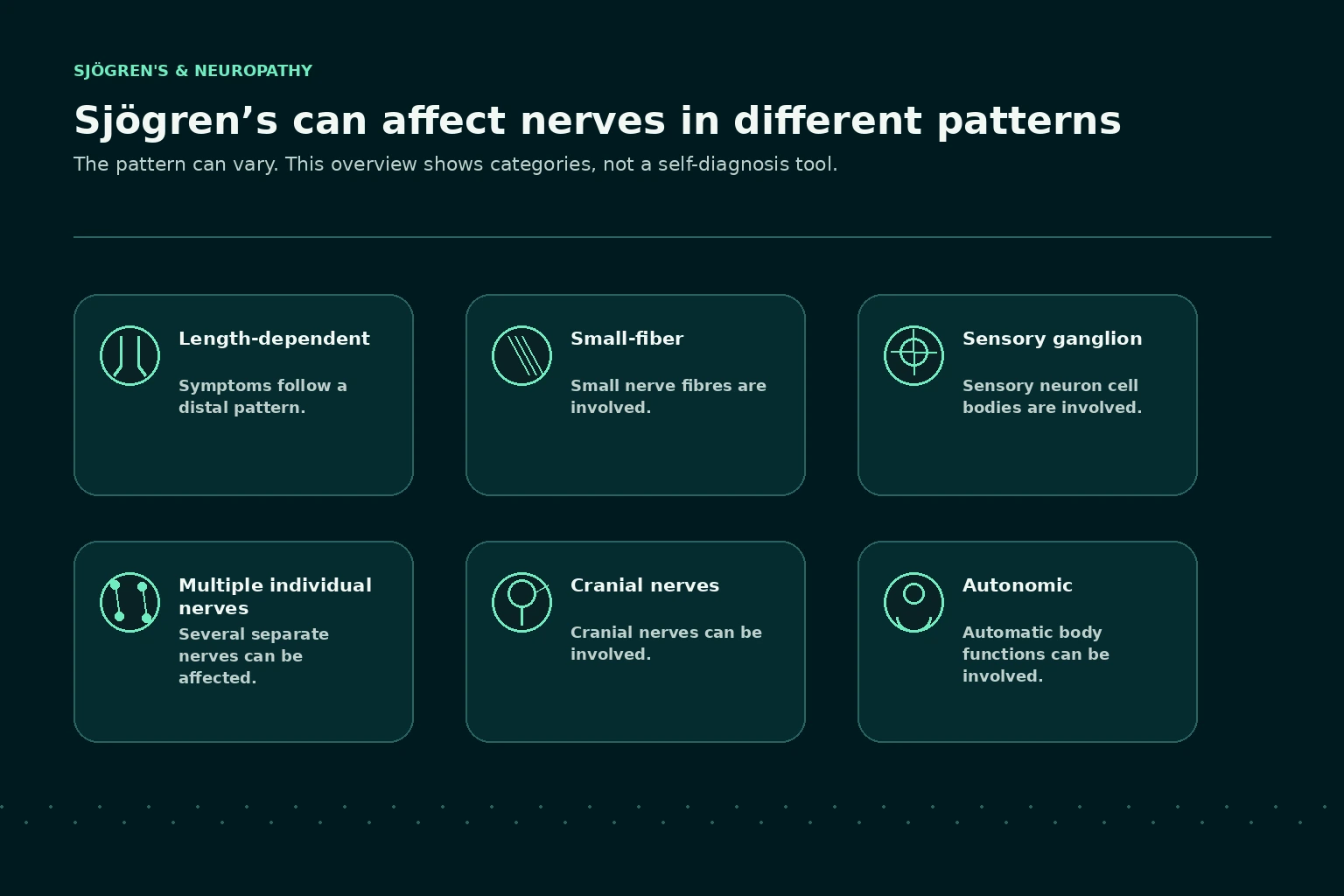
- Length-dependent axonal polyneuropathy. Tingling and numbness that start in the feet, in a “stocking” pattern. In the meta-analysis it made up about 80 percent of Sjögren’s-related neuropathy.2
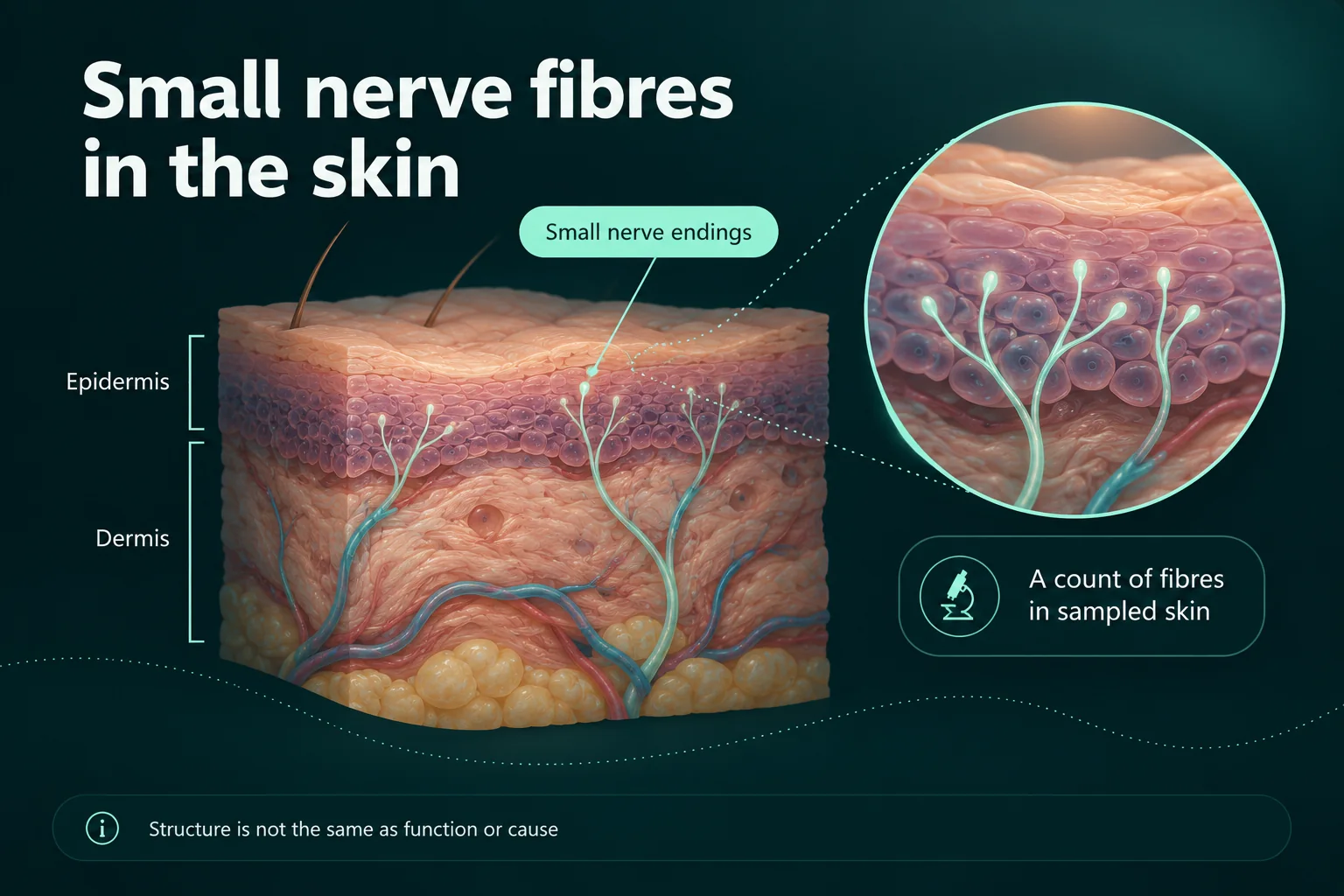
- Small fibre neuropathy. Burning pain and skin that hurts from light touch, while strength and reflexes stay normal.8
- Sensory ganglionopathy (neuronopathy). Damage to the sensory nerve cells themselves. It typically causes severe sensory ataxia: clumsy movements and poor balance because the sense of position is lost.8
- Vasculitic neuropathy and mononeuritis multiplex. Inflammation in the blood vessels that supply the nerves. The clues are a painful, uneven and rapidly progressing neuropathy, sometimes affecting several single nerves.8, 3
- Cranial neuropathies. The trigeminal nerve, which carries feeling from the face, is the one most often reported. The facial nerve and the nerves that move the eyes are affected less often.8
- Autonomic neuropathy. Damage to the nerves that run things like heart rate, blood pressure and sweating. The guideline lists it next to mononeuropathies and polyneuropathies.9
- Demyelinating neuropathy (CIDP). Uncommon, under 1 percent of reported cases according to the 2026 review, and it can come before the Sjögren’s diagnosis.8
A 2005 study in the journal Brain of 92 people with Sjögren’s-associated neuropathy found sensory ataxic neuropathy in 39 percent, painful sensory neuropathy without ataxia in 20 percent, trigeminal neuropathy in 16 percent and multiple mononeuropathy in 12 percent. The mix differs from the meta-analysis, which is one reason the figures are hard to compare.10
As I read it, the pattern of nerve damage matters more than the general label, because it steers both the tests and the treatment.
Can neuropathy come before the Sjögren’s diagnosis?
Yes, and often. In the 2005 Brain study, 93 percent were diagnosed with Sjögren’s after their nerve symptoms had appeared. The Sjögren’s Foundation guideline summary says nerve symptoms can come before the diagnosis in up to 90 percent of cases.10, 4
The 2023 meta-analysis found that nerve symptoms came first, or led to the diagnosis, twice as often as the other way round.2
Dryness can be mild or not yet noticed. The Sjögren’s Foundation says many people had neurological symptoms long before dry eyes or a dry mouth. The 2026 review adds that many people with ganglionopathy test negative for anti-Ro antibodies, and the diagnosis was instead made with a salivary gland biopsy.11, 8
How is Sjögren’s looked for when you have neuropathy?
StatPearls describes the usual building blocks, which are put together with your history and an examination.7
- Antibody blood tests. Anti-Ro (SSA) antibodies are the most sensitive and specific test for Sjögren’s, but they do not confirm it on their own. They can also appear in other autoimmune diseases, and they are missing in up to a third of people with Sjögren’s.7
- Schirmer test. A small paper strip measures tear production; 5 mm of wetting or less in five minutes counts as abnormal.7
- Salivary flow. Saliva is collected over a set time; 0.1 mL per minute or less is abnormal.7
- Lip biopsy (minor salivary gland biopsy). A small sample from the inside of the lip is checked for clusters of immune cells, reported as a focus score.7
The StatPearls chapter on small fibre neuropathy lists tests for both SSA and SSB antibodies among the first tests when the cause is being looked for.12
The 2016 criteria are for classification
You may hear about the 2016 ACR/EULAR criteria, from the American and European rheumatology organisations. They give 3 points each for anti-Ro/SSA antibodies and a lip biopsy with a focus score of at least 1, and 1 point each for an abnormal eye staining score, Schirmer test or unstimulated salivary flow. A total of 4 or more meets the criteria. Anti-La/SSB is not part of them.13
The authors write that the criteria are well suited for enrolling people in clinical trials. StatPearls says they should not be used on their own to make a diagnosis, but can give a structured framework for evaluating people. As I understand it, the diagnosis itself rests on the whole picture, with the criteria as a guide.13, 7
Which nerve tests are used?
The Sjögren’s Foundation guideline summary lists nerve conduction studies and EMG done by an experienced examiner when nerve symptoms persist, a punch skin biopsy when small fibre neuropathy is suspected, and, when there are symptoms such as light-headedness or fainting on standing, formal autonomic testing such as a tilt table test, a sweat test called QSART and heart rate variability. My articles on how neuropathy is diagnosed, on skin biopsy and on autonomic testing explain these.4
In vasculitic neuropathy, the 2026 review says a nerve biopsy may show inflammation in the walls of the blood vessels.8
What does the evidence say about treating Sjögren’s neuropathy?
This is where I want to be most careful. The new guideline from the Sjögren’s Foundation, in the July 2026 issue of Arthritis Care & Research, found only nine studies to build on: six case series and three cohort studies, none with a comparison group. Its authors write that, because high-level evidence is scarce, the guideline “predominantly derives from expert opinion”.9
The 2020 EULAR recommendations, from the European rheumatology organisation, say systemic treatment may be considered for active systemic disease and should be tailored to how severely each organ is affected. Their general sequence of glucocorticoids, immunosuppressive drugs and biologics rests on the lowest level of evidence: expert opinion.14
Vasculitic neuropathy and mononeuritis multiplex
According to the 2026 review, the 2020 EULAR recommendations put glucocorticoids first for vasculitic neuropathy, with immunosuppressive tablets or rituximab as second options and cyclophosphamide after that. The Sjögren’s Foundation guideline instead makes a strong recommendation for immediate high-dose glucocorticoids together with rituximab from the start, and a conditional one for glucocorticoids with cyclophosphamide if that does not work.8, 4
The review points out that these treatment plans have not been tested in randomised trials; they rest on retrospective data and expert consensus. As I read it, “strong” here reflects the seriousness of the condition and the experts’ confidence, not trial proof.8
Sensory ganglionopathy
The review reports that EULAR names immunoglobulin (IVIG) first, pulses of the glucocorticoid methylprednisolone second, and cyclophosphamide for hard-to-treat cases. The Sjögren’s Foundation guideline recommends aggressive and immediate treatment with glucocorticoids and immune-modulating drugs when symptoms are significant.8, 4
The evidence behind this is observational: small case series and retrospective studies. In one retrospective study of 13 people, 3 of the 6 given IVIG improved or stayed stable.8
Small fibre neuropathy and IVIG
Here the evidence is mixed at best. A systematic review published in September 2026 in the Journal of the Peripheral Nervous System, searching up to August 2025, found seven studies with 165 people treated with IVIG. The two randomised trials, in idiopathic or broadly defined small fibre neuropathy, showed no significant benefit over placebo for pain, autonomic symptoms, quality of life or nerve fibre density.15
The five observational studies reported improvement, particularly in autoimmune-associated forms, but they were small, lacked control groups and had a high risk of bias. The certainty of evidence was low to very low. The authors conclude that the evidence does not support routine IVIG in small fibre neuropathy, and that apparent benefits in selected immune-mediated groups remain inconclusive.15
Two trials I read show the pattern. In a Dutch trial of 60 people with idiopathic small fiber neuropathy, pain fell by at least one point in 40 percent on IVIG and 30 percent on placebo, a difference that was not significant. A small pilot trial that enrolled 20 people with two particular autoantibodies (TS-HDS and FGFR-3) did not detect a benefit either.16, 17
Neither trial was in people with Sjögren’s, and the 2026 review notes the negative trial might reflect a different underlying cause. For Sjögren’s-related small fibre neuropathy there are case series, such as a 2020 report of lasting improvement with immunoglobulins in people whose small fibre neuropathy had not responded to usual treatment, but I found no randomised trial.8, 18
The Sjögren’s Foundation guideline makes a conditional recommendation: consider IVIG for at least three months, but only for Sjögren’s-related, immune-mediated small fibre neuropathy that has not responded to symptom treatment and is recent, severe or progressive. That is a narrow group, and a conditional recommendation means the balance of benefit and harm is less certain.4
The other forms
The same guideline makes conditional recommendations to consider IVIG in immune-mediated large fibre polyneuropathy that is not caused by vasculitis, and in immune-mediated autonomic problems that are severe, progressive and have not responded to lifestyle measures and medicines, with rituximab if IVIG does not help. It also makes conditional recommendations for a short course of glucocorticoids in trigeminal neuropathy that seems to have an acute inflammatory cause, and in an acute facial nerve palsy. For autonomic symptoms it strongly recommends education and non-drug measures. For CIDP it strongly recommends the standard CIDP treatments, which my CIDP article covers.4
Treating the pain
Nerve pain is treated much as in other neuropathies. The Sjögren’s Foundation guideline strongly recommends gabapentin, pregabalin or an SNRI antidepressant as first options, and EULAR mentions gabapentin, pregabalin and amitriptyline. My article on polyneuropathy treatment explains these medicines. I give no doses here; any change belongs with your own doctor.4, 14
| Neuropathy type | Typical features | How it is usually assessed | What the evidence says about immunotherapy |
|---|---|---|---|
| Length-dependent axonal polyneuropathy | Tingling and numbness starting in the feet | Nerve conduction studies and EMG | Guideline: consider IVIG if immune-mediated and not vasculitic (conditional, mainly expert opinion). No trial evidence found. |
| Small fibre neuropathy | Burning pain, skin that hurts from light touch; normal strength and reflexes | Punch skin biopsy for nerve fibre density | Two randomised trials outside Sjögren’s found no clear benefit. Observational studies: low to very low certainty. Guideline: consider IVIG only in a narrow group (conditional). |
| Sensory ganglionopathy (neuronopathy) | Severe sensory ataxia: poor balance and position sense | Nerve conduction studies and EMG; anti-Ro may be negative, so a lip biopsy can matter | Observational only (case reports, small series). EULAR: IVIG first. Newer guideline: glucocorticoids plus immune-modulating drugs (strong, expert-based). |
| Vasculitic neuropathy, mononeuritis multiplex | Painful, uneven, rapidly progressing; several single nerves | Nerve tests; a nerve biopsy may show vessel-wall inflammation | No randomised trials; retrospective data and consensus. EULAR, as reported in a 2026 review: glucocorticoids first, other drugs later. Newer guideline: glucocorticoids with rituximab from the start (strong). |
| Cranial neuropathy, most often trigeminal | Altered feeling in the face; facial and eye nerves less often | Not detailed in the sources I read | Guideline: short course of glucocorticoids for trigeminal neuropathy with a suspected acute inflammatory cause, or an acute facial nerve palsy (conditional). No trial evidence found. |
| Autonomic neuropathy | Affects heart rate, blood pressure, sweating | Tilt table, QSART sweat test, heart rate variability; sometimes a skin biopsy of sweat gland nerves | Education and non-drug measures first (strong). IVIG, then rituximab, only in severe immune-mediated cases that have not responded to other measures (conditional). No trial evidence found. |
| Demyelinating neuropathy (CIDP) | Uncommon, under 1 percent of reported cases | As for CIDP in general | Standard CIDP treatments (strong). EULAR, as reported in a 2026 review: IVIG first, rituximab second. |
Not all small fibre neuropathy is autoimmune
StatPearls lists many causes of small fibre neuropathy: diabetes and impaired glucose tolerance, vitamin B12 deficiency, thyroid problems, alcohol and some medicines, infections, inherited conditions, and immune conditions including Sjögren’s. As many as half of cases are considered idiopathic, meaning no cause is found.12
So a positive antibody test, or the known link between Sjögren’s and neuropathy, does not by itself show that the immune system is causing your nerve damage. EULAR ties systemic treatment to active systemic disease, and the Sjögren’s Foundation guideline limits IVIG in small fibre neuropathy to immune-mediated cases that are recent, severe or progressive. As I read the evidence, an association alone is not a reason to start immunotherapy.14, 4
We who live with neuropathy often hope for a treatment that switches the cause off. For most forms linked to Sjögren’s, that hope is not yet backed by good trials, and it is fair to ask how strong the evidence is for any treatment offered.
What remains uncertain
- Who, if anyone, with Sjögren’s-related small fibre neuropathy benefits from IVIG. I found no randomised trial in Sjögren’s, and the trials in other groups were negative.15
- The best first treatment for vasculitic neuropathy and ganglionopathy. EULAR and the newer guideline differ, and neither rests on randomised trials.8, 4
- How common each form really is. The figures depend on definitions and on who is studied.8
- The long-term outlook. The meta-analysis says evidence on long-term prognosis is limited, and that immunosuppressive treatment in non-vasculitic neuropathy needs more research.2
Questions to take to your appointment
- Which type of neuropathy do I have, and what pattern does it follow?
- Have I been tested for Sjögren’s, and would a lip biopsy add anything if my antibodies are negative?
- Is there evidence that my neuropathy is immune-mediated and active, or is it only an association?
- How strong is the evidence for the treatment you suggest in my type of neuropathy, and how will we judge whether it helps?
- Should both a neurologist and a rheumatologist be involved in my care?
- Which changes mean I should contact you straight away?
I’m not a doctor. I’ve written this from published research and guidance, and to help you prepare questions for your own care.
Sources
- National Institute of Dental and Craniofacial Research (NIDCR). Sjögren’s Disease (health information page). Last reviewed February 2026. https://www.nidcr.nih.gov/health-info/sjogrens-disease
- Liampas A, Parperis K, Erotocritou MF, Nteveros A, Papadopoulou M, Moschovos C, Akil M, Coaccioli S, Hadjigeorgiou GM, Hadjivassiliou M, Zis P. Primary Sjögren syndrome-related peripheral neuropathy: A systematic review and meta-analysis. European Journal of Neurology 2023;30(1):255–265. doi:10.1111/ene.15555. https://onlinelibrary.wiley.com/doi/full/10.1111/ene.15555
- Mirian A, Aljohani Z, Grushka D, Florendo-Cumbermack A. Diagnosis and management of patients with polyneuropathy. CMAJ 2023;195(6):E227–E233. doi:10.1503/cmaj.220936. https://www.cmaj.ca/content/195/6/E227
- Sjögren’s Foundation. Clinical Practice Guideline for Evaluation and Management of Peripheral Nervous System Manifestations in Sjögren’s Disease (guideline summary document). December 2025. https://info.sjogrens.org/hubfs/Sj%C3%B6grens_Foundation_PNS_CPG_2026.pdf
- Sjögren’s Foundation. Sjögren’s Syndrome to Sjögren’s Disease: Why the Name Changed. Undated web page. https://sjogrens.org/understanding-sjogrens/sjogrens-syndrome-to-sjogrens-disease-why-the-name-changed
- Mellgren SI, Göransson LG, Omdal R. Primary Sjögren’s Syndrome Associated Neuropathy. Canadian Journal of Neurological Sciences 2007;34(3):280–287. doi:10.1017/S0317167100006697. https://www.cambridge.org/core/journals/canadian-journal-of-neurological-sciences/article/primary-sjogrens-syndrome-associated-neuropathy/2205FF4D218AD89F7633F5668FC3C015
- Carsons SE, Blum MA. Sjogren Disease. StatPearls [Internet]. StatPearls Publishing; last update 6 July 2025. NBK431049. https://www.ncbi.nlm.nih.gov/books/NBK431049/
- Pucino V, Nayar S, Fehmi J, et al. Clinical features and pathogenesis of Sjögren’s disease related peripheral neuropathy and their relevance to clinical trials. Communications Medicine 2026;6:350. Published 19 June 2026. doi:10.1038/s43856-026-01688-2. https://www.nature.com/articles/s43856-026-01688-2
- Deboo A, Fox R, Hammitt KM, Frantsve-Hawley J, Baker MC, et al. Clinical Practice Guideline for Evaluation and Management of Peripheral Nervous System Manifestations in Sjögren’s Disease. Arthritis Care & Research 2026;78(7):860–874. doi:10.1002/acr.70004. https://acrjournals.onlinelibrary.wiley.com/doi/10.1002/acr.70004
- Mori K, Iijima M, Koike H, et al. The wide spectrum of clinical manifestations in Sjögren’s syndrome-associated neuropathy. Brain 2005;128(11):2518–2534. doi:10.1093/brain/awh605. https://academic.oup.com/brain/article/128/11/2518/316904
- Sjögren’s Foundation. Nervous System and Sjögren’s Disease. Undated web page. https://sjogrens.org/understanding-sjogrens/how-sjogrens-disease-affects-the-body/nervous-system-and-sjogrens-disease
- Cascio MA, Mukhdomi T. Small Fiber Neuropathy. StatPearls [Internet]. StatPearls Publishing; last update 12 December 2022. NBK582147. https://www.ncbi.nlm.nih.gov/books/NBK582147/
- Shiboski CH, Shiboski SC, Seror R, Criswell LA, Labetoulle M, et al. 2016 American College of Rheumatology/European League Against Rheumatism classification criteria for primary Sjögren’s syndrome: a consensus and data-driven methodology involving three international patient cohorts. Annals of the Rheumatic Diseases 2017;76(1):9–16. doi:10.1136/annrheumdis-2016-210571. https://ard.bmj.com/content/76/1/9
- Ramos-Casals M, Brito-Zerón P, Bombardieri S, Bootsma H, De Vita S, et al. EULAR recommendations for the management of Sjögren’s syndrome with topical and systemic therapies. Annals of the Rheumatic Diseases 2020;79(1):3–18. doi:10.1136/annrheumdis-2019-216114. https://ard.bmj.com/content/79/1/3
- Ng QX, Neo KML, Zhang B, Yeo ZC, Anitha PN, Chan ACY. Use of Intravenous Immunoglobulin Therapy for Small Fiber Neuropathy: A Systematic Review of Current Clinical Evidence. Journal of the Peripheral Nervous System 2026;31(3):e70138. Published September 2026. doi:10.1111/jns.70138. https://onlinelibrary.wiley.com/doi/10.1111/jns.70138
- Geerts M, de Greef BTA, Sopacua M, van Kuijk SMJ, Hoeijmakers JGJ, Faber CG, Merkies ISJ. Intravenous Immunoglobulin Therapy in Patients With Painful Idiopathic Small Fiber Neuropathy. Neurology 2021;96(20):e2534–e2545. doi:10.1212/WNL.0000000000011919. https://www.neurology.org/doi/10.1212/WNL.0000000000011919
- Gibbons CH, Rajan S, Senechal K, Hendry E, McCallister BT, Levine T. A double-blind placebo-controlled pilot study of immunoglobulin for small fiber neuropathy associated with TS-HDS and FGFR-3 autoantibodies. Muscle & Nerve 2023;67(5):363–370. doi:10.1002/mus.27745. https://onlinelibrary.wiley.com/doi/10.1002/mus.27745
- Pindi Sala T, Villedieu M, Damian L, et al. Long-term efficacy of immunoglobulins in small fiber neuropathy related to Sjögren’s syndrome. Journal of Neurology 2020;267:3499–3507. doi:10.1007/s00415-020-10033-z. https://link.springer.com/article/10.1007/s00415-020-10033-z
Sources checked on 26 September 2026.
Related reading

Restless legs or neuropathy? Similar symptoms, different assessments
Written by someone living with neuropathy: how restless legs syndrome differs from neuropathy, why the two are so often confused, how often they occur together, how each is assessed, and questions to take to your doctor.

Cold feet: nerve symptoms, circulation and when to seek help
Written by someone living with neuropathy: why feet can feel cold without being cold, when cold feet point to circulation instead, the warning signs that need urgent help, and a description aid for your appointment.

Numb hands and weak grip: neuropathy or another nerve problem?
Written by someone living with neuropathy: why numb hands and a weak grip can be a trapped nerve, a neck problem or polyneuropathy, the warning signs, and a description aid to take to your doctor.