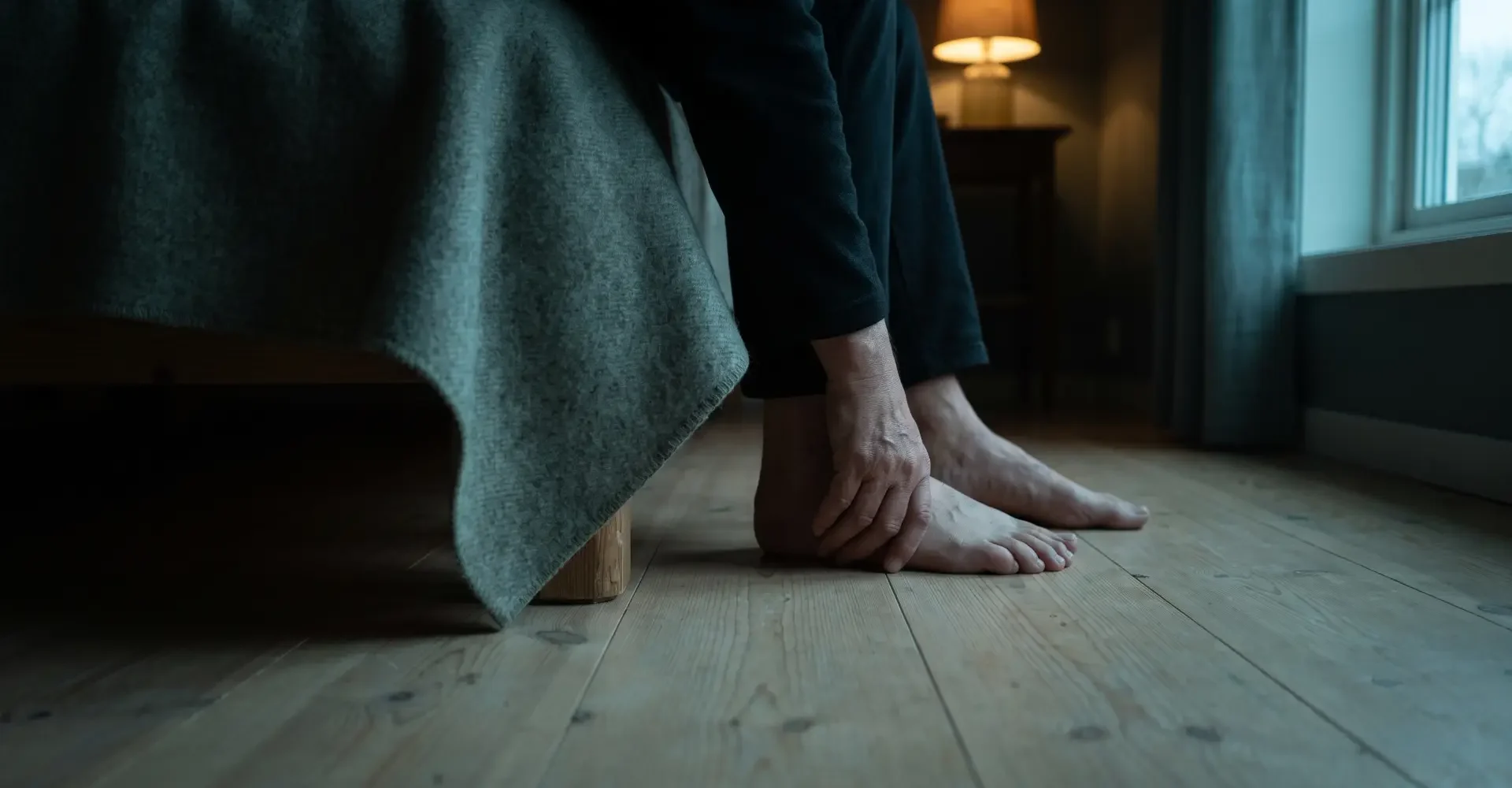
Numbness in both feet can be unsettling, especially when it creeps in slowly and you can’t quite say when it started. I have neuropathy myself, so I know how easy it is to lie awake wondering what it means. The honest answer is that numbness and tingling in both feet have many possible causes. When the feeling starts in the toes, is the same on both sides and spreads slowly over months, a polyneuropathy is one common explanation. When it comes on over hours or days, is clearly worse on one side, or weakness is more prominent than the numbness, it needs prompt medical attention.1, 2
This page won’t tell you what you have. What it can do is help you understand why the pattern and the speed matter, and help you describe your symptoms clearly when you see a doctor.
What do numbness and tingling in your feet actually describe?
Doctors often call tingling, prickling or burning sensations paraesthesia. It is a description of what you feel, not a diagnosis. The US National Institute of Neurological Disorders and Stroke (NINDS) describes it as a burning, itching, tingling or prickling feeling, usually in the hands, arms, legs or feet.16 Numbness is slightly different: a reduced or missing sense of touch, as if your feet were wrapped in something.
These sensations can come from the peripheral nerves, the long nerves that run out to your feet. They can also come from nerve roots in the back, or from the spinal cord or brain. The NHS lists causes as varied as diabetes, sciatica, a trapped nerve in the back or neck, multiple sclerosis, chemotherapy and alcohol.17 That is exactly why the pattern matters so much.
Why the pattern of numbness in both feet matters
The most common kind of polyneuropathy is length-dependent. The longest nerves are affected first, and the nerves to your feet are the longest in your body. That is why symptoms typically start in the toes and feet and appear on both sides at roughly the same time. A 2023 review in the Canadian Medical Association Journal (CMAJ) describes it this way: the sensory loss begins in the feet, and when it reaches the upper calf, the fingertips often start to be affected. This is sometimes called a “stocking and glove” pattern.1, 3

The sources describe several features that do not fit this typical picture and deserve a closer look sooner. The CMAJ review names sudden or fairly quick onset (days to weeks), a pattern that does not start furthest out, weakness as marked as or more marked than the numbness, and signs of illness elsewhere in the body, such as weight loss, skin changes or fever. A review in American Family Physician (AFP) lists similar warning features: sudden onset, clear differences between the two sides, mainly weakness or mainly autonomic symptoms (such as dizziness on standing or bladder or bowel problems), and a quickly worsening course.1, 2
| What you notice | More typical of a slow, length-dependent polyneuropathy | Worth prompt or urgent attention |
|---|---|---|
| Where it started | In the toes or soles of both feet | In one foot or one leg only, in the hands first, or in the thighs or upper arms |
| Both sides? | Roughly the same on both sides | Clearly different between the two sides, or one side of the body including the face |
| How fast | Gradually, over months to years | Over hours, days or a few weeks |
| Strength | Mainly changed feeling; any weakness comes later and is mild at first | Weakness early on or more than the numbness, trouble climbing stairs or lifting your arms |
| Other symptoms | Sometimes burning pain, pins and needles, or unsteadiness when walking | New bladder or bowel problems, numbness around the genitals, trouble breathing or swallowing, slurred speech |
What can cause numbness and tingling in both feet?
This is where I want to be careful. A list of causes is not a way to work out which one you have, and several causes can overlap. With that said, these are the ones the sources mention most often.
Causes of polyneuropathy
- Diabetes is the most common cause of polyneuropathy in the sources I read, and NINDS calls it the leading cause of peripheral neuropathy in the United States.1, 3
- Alcohol, especially long-term heavy drinking.1, 3
- Low vitamin B12. Metformin, a common diabetes medicine, can lower B12 levels, and B12 testing is suggested for people treated with metformin or with stomach-acid medicines called proton pump inhibitors.11
- Other medical conditions, such as an underactive thyroid, kidney disease and a blood protein abnormality called monoclonal gammopathy.2, 4
- Medicines and toxins, including some chemotherapy drugs.1, 3
- Inherited neuropathies, where a family history can be an important clue.2, 4
Even after a careful assessment, no cause is found for a fair share of people. Estimates vary between sources: the CMAJ review puts it at about 30 percent, while the AFP review gives a range of 25 to 46 percent.1, 2 Not finding a cause does not mean the symptoms are imagined.
Things that can feel similar but aren’t polyneuropathy
- Narrowing of the spinal canal in the lower back (lumbar spinal stenosis). It can cause numbness and tingling in both legs, typically worse when walking or standing and eased by sitting or bending forward.12
- A pinched nerve root in the back, as with sciatica. It usually affects the buttock and the back of one leg rather than both feet evenly.8
- A trapped nerve at the ankle (tarsal tunnel syndrome), which can cause numbness, tingling or burning in the sole, often worse with long periods of standing or walking.13
- Problems in the spinal cord in the neck (cervical myelopathy), which the CMAJ review names as a condition that can mimic polyneuropathy.1
- Poor circulation in the legs (peripheral arterial disease). Its hallmark is an aching pain in the legs when walking that eases after a few minutes’ rest, but numbness can also occur.14
How are numb feet usually investigated?
The starting point is a conversation and an examination. Your doctor will usually ask about how and when it started, how it has changed, other illnesses, medicines, alcohol, work and exposures, and whether anyone in your family has had something similar. The examination often includes feeling, vibration sense, strength, balance and the ankle reflexes.1, 2, 3
Blood tests are usually next. An evidence review from the American Academy of Neurology and partner societies found that blood glucose, vitamin B12 (with related markers) and a test for abnormal blood proteins gave the highest yield in the common symmetrical type of polyneuropathy. The AFP review also lists a full blood count, kidney and liver tests and thyroid function among the first tests.2, 10
Nerve conduction studies and EMG are not needed for everyone. The AFP review suggests them when symptoms are worrying (sudden onset, one-sided, mainly weakness or autonomic symptoms, or quickly worsening), or when symptoms persist or the diagnosis is unclear.2
What to note down before your appointment
Doctors rely heavily on your own description, so I think a few written notes are one of the most useful things you can bring. You could take this list with you and fill it in:
- Where: which toes or parts of the foot, and how far up it goes now. Is it the same on both sides?
- When and how fast: roughly when you first noticed it, and whether it changed over weeks, months or years.
- What it feels like: numb, tingling, burning, like walking on cotton wool, cold, or painful to light touch.
- Strength and balance: tripping, catching your toes, trouble on stairs, unsteadiness in the dark.
- Other changes: hands, bladder or bowel, dizziness on standing, back pain, weight loss.
- Your background: diabetes or other conditions, all medicines and supplements, alcohol, past chemotherapy, and similar symptoms in the family.
- What makes it better or worse: for example walking, standing, sitting down or rest.
These points match what the sources say clinicians ask about.2, 3 Photos of any sores or skin changes on your feet can help too.
Looking after numb feet while you wait
When feeling is reduced, you may not notice a stone in your shoe, a blister or a small cut. Advice written for people with diabetes is to check your feet every day for cuts, sores, red spots, blisters and swelling, and to contact your care team if a wound does not start to heal after a few days. I think that habit makes sense for anyone with numb feet. Wearing socks with closed shoes and taking care with very hot or very cold surfaces are also suggested, to avoid burns and frostbite you may not feel.4, 15

I’m not a doctor. I’ve written this from published research and guidance, and to help you prepare questions for your own care.
Sources
- Mirian A, Aljohani Z, Grushka D, Florendo-Cumbermack A. Diagnosis and management of patients with polyneuropathy. CMAJ 2023;195(6):E227–E233, 13 February 2023 (with correction CMAJ 2023;195(11):E415). https://www.cmaj.ca/content/195/6/E227
- Castelli G, Desai KM, Cantone RE. Peripheral Neuropathy: Evaluation and Differential Diagnosis. American Family Physician 2020;102(12):732–739, 15 December 2020. https://www.aafp.org/pubs/afp/issues/2020/1215/p732.html
- National Institute of Neurological Disorders and Stroke (NINDS). Peripheral Neuropathy. Last reviewed 13 March 2026. https://www.ninds.nih.gov/health-information/disorders/peripheral-neuropathy
- Hammi C, Yeung B. Neuropathy. StatPearls Publishing (NCBI Bookshelf), updated 15 October 2022. https://www.ncbi.nlm.nih.gov/books/NBK542220/
- National Institute of Neurological Disorders and Stroke (NINDS). Guillain-Barré Syndrome. Last reviewed 13 March 2026. https://www.ninds.nih.gov/health-information/disorders/guillain-barre-syndrome
- NHS. Guillain-Barré syndrome. Page last reviewed 12 August 2024. https://www.nhs.uk/conditions/guillain-barre-syndrome/
- NHS. Stroke: Symptoms. Page last reviewed 12 September 2024. https://www.nhs.uk/conditions/stroke/symptoms/
- NHS. Sciatica. Page last reviewed 3 December 2024. https://www.nhs.uk/conditions/sciatica/
- Rider LS, Marra EM. Cauda Equina and Conus Medullaris Syndromes. StatPearls Publishing (NCBI Bookshelf), updated 7 August 2023. https://www.ncbi.nlm.nih.gov/books/NBK537200/
- England JD, Gronseth GS, Franklin G, et al. Practice Parameter: Evaluation of distal symmetric polyneuropathy: role of laboratory and genetic testing (an evidence-based review). Neurology 2009;72(2):185–192, 13 January 2009 (AAN/AANEM/AAPM&R; abstract). https://researchconnect.suny.edu/en/publications/practice-parameter-evaluation-of-distal-symmetric-polyneuropathy-/
- Ankar A, Kumar A. Vitamin B12 Deficiency. StatPearls Publishing (NCBI Bookshelf), updated 10 September 2024. https://www.ncbi.nlm.nih.gov/books/NBK441923/
- Munakomi S, Foris LA, Varacallo M. Spinal Stenosis and Neurogenic Claudication. StatPearls Publishing (NCBI Bookshelf), updated 13 August 2023. https://www.ncbi.nlm.nih.gov/books/NBK430872/
- Adler L, Bergman R, Kaiser K. Tarsal Tunnel Syndrome. StatPearls Publishing (NCBI Bookshelf), updated 24 May 2026. https://www.ncbi.nlm.nih.gov/books/NBK513273/
- NHS. Peripheral arterial disease (PAD). Page last reviewed 10 April 2026. https://www.nhs.uk/conditions/peripheral-arterial-disease-pad/
- National Institute of Diabetes and Digestive and Kidney Diseases (NIDDK). Diabetes & Foot Problems. Reviewed January 2017. https://www.niddk.nih.gov/health-information/diabetes/overview/preventing-problems/foot-problems
- National Institute of Neurological Disorders and Stroke (NINDS). Glossary of Neurological Terms (entry: paresthesia). Last reviewed 26 March 2025. https://www.ninds.nih.gov/health-information/disorders/glossary-neurological-terms
- NHS. Pins and needles. Page last reviewed 4 January 2024. https://www.nhs.uk/symptoms/pins-and-needles/
Sources checked on 24 September 2026.
Related reading

Restless legs or neuropathy? Similar symptoms, different assessments
Written by someone living with neuropathy: how restless legs syndrome differs from neuropathy, why the two are so often confused, how often they occur together, how each is assessed, and questions to take to your doctor.

Cold feet: nerve symptoms, circulation and when to seek help
Written by someone living with neuropathy: why feet can feel cold without being cold, when cold feet point to circulation instead, the warning signs that need urgent help, and a description aid for your appointment.

Numb hands and weak grip: neuropathy or another nerve problem?
Written by someone living with neuropathy: why numb hands and a weak grip can be a trapped nerve, a neck problem or polyneuropathy, the warning signs, and a description aid to take to your doctor.