
Restless legs vs neuropathy comes down to one question: is the main problem an urge to move your legs, or a sensation in them? Restless legs syndrome (RLS) is an urge to move that starts or gets worse at rest, is worse in the evening or at night, and eases when you move. Neuropathy is nerve damage that causes numbness, tingling or pain, usually starting in the feet. The two can look alike, and they can also occur together.1, 2
I have neuropathy myself, and I write these pages to make the research easier to read. This one is about telling two often-confused conditions apart, why they so often overlap, and how each is assessed. It is not a way to diagnose yourself, and it does not cover treatment choices, which belong with your doctor.
Restless legs vs neuropathy: what is the core difference?
NINDS, the US neurology institute, describes RLS as an irresistible urge to move the legs, often with uncomfortable feelings that people call aching, throbbing, pulling, itching, crawling or creeping. The symptoms come on with rest and inactivity, ease when you move, and are worse in the evening and at night, often with a symptom-free spell in the early morning.1
Polyneuropathy is different at its root. The CMAJ review describes the usual type as starting in the feet, with pins and needles, reduced feeling or pain, in a “glove and stocking” pattern. When the small nerve fibres are affected, the main symptom is often pain. NINDS adds that nerve pain is sometimes worse at night and can disturb sleep.5, 6
So both can bother you most at night, in the legs, while you lie still. As I read the sources, the clearest difference is the urge to move and the relief that movement brings, not the time of day.

Why are the two so easy to mix up?
The international diagnostic criteria from the International Restless Legs Syndrome Study Group (IRLSSG), updated in 2014, have four core features: an urge to move the legs, worse at rest, relieved by movement, and worse in the evening or night. The same paper says other conditions can meet or come very close to meeting those four features, and calls them “mimics”. Among the features that point to a mimic, it lists numbness (neuropathy), alongside knotted muscles (leg cramps), sore muscles, swelling, joint problems (arthritis) and discomfort that eases with a simple change of position.2
A 2009 family study interviewed relatives of people with RLS and of people without it by telephone, with an RLS expert making the diagnosis. Of the 788 relatives judged not to have RLS, 126 (16%) still met all four features. The authors named leg cramps, positional discomfort and local leg problems among the conditions that can do this. The 2014 criteria added a fifth requirement to make the diagnosis more specific: the symptoms must not be fully explained by another medical or behavioural condition.2, 7
Leg cramps are named as a mimic in both papers. I cover them in my article on neuropathy and muscle cramps rather than here.2, 7
Can you have both at once?
Yes. The IRLSSG paper says plainly that someone can have RLS and peripheral neuropathy at the same time, and that this needs attention to the features of each. NINDS says RLS may happen alongside neuropathy, and Mayo Clinic, under risk factors, names peripheral neuropathy among the conditions RLS sometimes occurs with.1, 2, 8
A 2021 systematic review in the European Journal of Neurology pooled studies of the two conditions. RLS was reported in between 5% and 54% of people with peripheral neuropathy, on average about 22%, more often than in comparison groups. It was reported especially in neuropathy linked to diabetes, kidney failure, inherited neuropathies such as Charcot-Marie-Tooth disease, and chronic inflammatory neuropathy. The authors suggest the wide spread between studies could be due to differences in the diagnostic criteria used for both conditions, so it is not a figure to apply to any one person.9
How is each one assessed?
There is no single test for RLS. NINDS says the diagnosis rests on your description of the symptoms, your medical and family history, the medicines you take and an examination, with blood tests used to look for other causes. The IRLSSG paper says the same: no biological test can make the diagnosis, which rests on a clinician’s assessment of what you describe.1, 2
Iron is part of the picture. The NHS says RLS is thought to be linked to iron and dopamine levels, and the treatment guideline from the American Academy of Sleep Medicine (AASM), published in January 2025, says iron studies, including ferritin, should be tested regularly in everyone with clinically significant RLS. What the results mean for treatment is a decision for your doctor, so please do not start iron on your own.10, 11
Neuropathy is assessed differently. The CMAJ review describes an examination for reduced ankle reflexes, reduced feeling and weakness in the feet, and nerve conduction studies to show the type of damage. Those tests only measure the larger nerve fibres, so they can be normal in small fibre neuropathy, where a skin biopsy is the gold standard. My articles on how polyneuropathy is diagnosed and on small fibre neuropathy go further.5
Comparing the symptoms, with limits
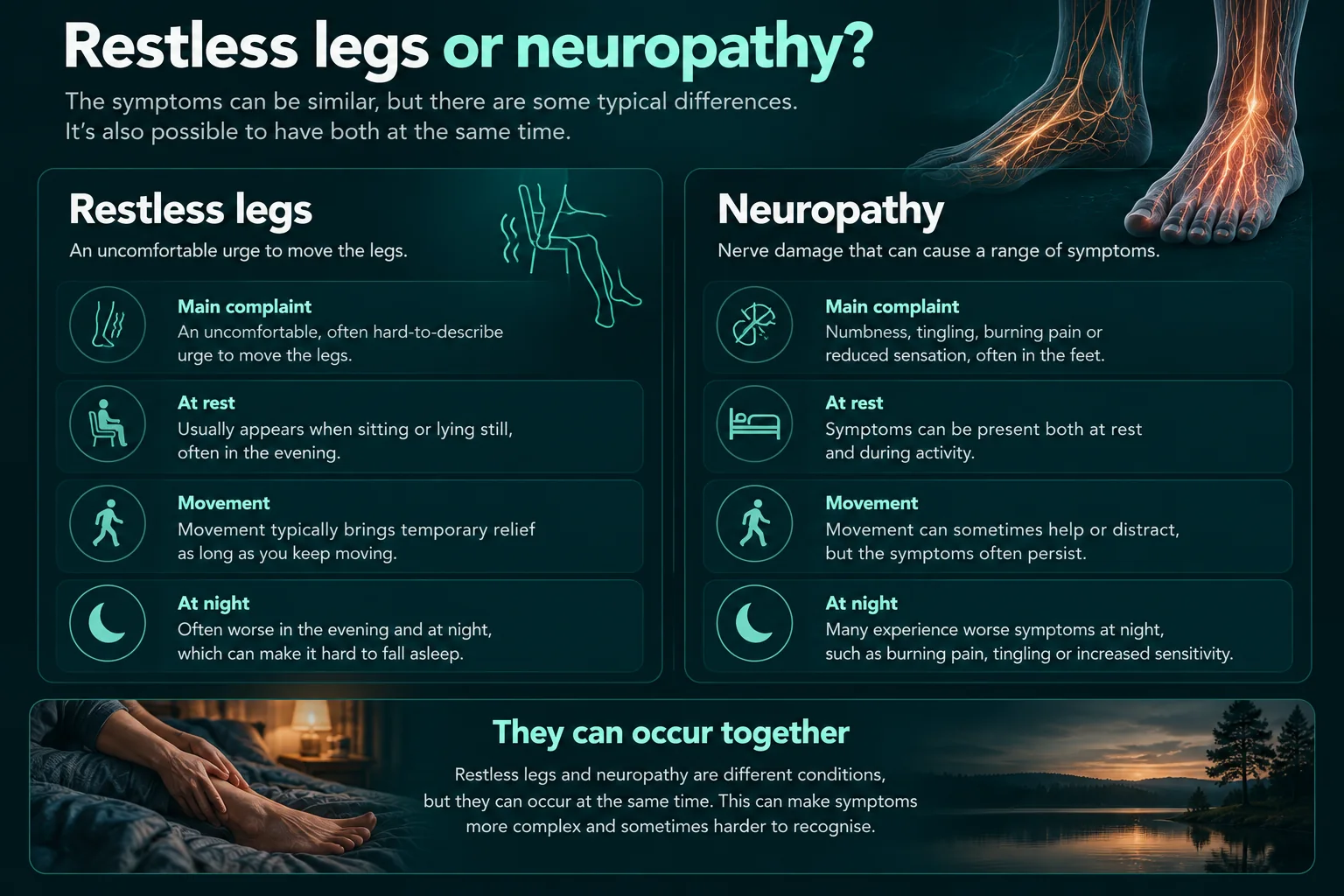
This table is my own summary from the sources. It is not a self-test. The features overlap, the two conditions can coexist, and only an assessment can sort them out.
| Feature | Typical of restless legs | Typical of neuropathy | Limitation |
|---|---|---|---|
| Main complaint | An urge to move the legs, often with unpleasant feelings deep in them | Numbness, pins and needles, burning or other pain | Both can include uncomfortable leg sensations |
| Effect of movement | Eases, at least while you keep moving | Not a defining feature | Cramps and positional discomfort can also ease with movement |
| Rest and time of day | Starts or worsens at rest; worse in the evening or night | Pain is sometimes worse at night | Night-time symptoms alone do not separate them |
| Where it is felt | Mainly the legs, sometimes the arms | Usually starts in the feet, in a stocking pattern | Both mostly affect the legs |
| Numbness or surface burning | Not typical | Common | Someone with neuropathy can also have RLS |
| How it is assessed | Clinical diagnosis using the IRLSSG criteria; blood tests, including iron studies | Examination, nerve conduction studies, sometimes a skin biopsy | Normal nerve tests do not rule out small fibre neuropathy |
What about treatment?
I am not going into medicines here, and I give no doses. One thing is worth knowing at an information level, though. The AASM guideline suggests against the standard use of the dopamine agonists pramipexole, ropinirole and rotigotine for RLS. These are conditional recommendations, made mainly because of the risk of augmentation: a gradual worsening of RLS symptoms that develops over months to years of taking such medicines. NINDS also notes that long-term use of dopamine medicines may worsen symptoms. If you already take one of these, talk to your doctor before changing anything.1, 11
Sleep matters with both conditions. I cover sleeping with neuropathy pain in a separate article.
Questions to take to your doctor
- Do my symptoms fit restless legs, neuropathy, or could it be both?
- Could something else, such as cramps or the way I lie, explain what I feel?
- Should my iron status, including ferritin, be checked, and what would the results mean for me?
- Do I need nerve conduction studies, and if they are normal, is a small fibre problem still possible?
- Could any of my current medicines be making my legs worse?
- Which changes mean I should come back quickly?
What is still uncertain
The link between the two conditions has been reported many times, but it is not well understood. The 2021 review found wide differences between studies and called for larger studies that combine clinical assessment, nerve tests and skin biopsy. It also mentions nerve test findings suggesting small fibre loss in people diagnosed with RLS of no known cause, and says it remains to be seen whether that is a separate form of RLS. The IRLSSG adds that mimics have been confused with RLS particularly in written surveys, so studies that rely on questionnaires need care.2, 9
As I read it, the honest summary is this: an urge to move is the clue that points towards RLS, but neuropathy can look similar, the two can travel together, and an assessment is the only way to know.
I’m not a doctor. I’ve written this from published research and guidance, and to help you prepare questions for your own care.
Sources
- National Institute of Neurological Disorders and Stroke (NINDS). Restless Legs Syndrome. Last reviewed 13 March 2026. https://www.ninds.nih.gov/health-information/disorders/restless-legs-syndrome
- Allen RP, Picchietti DL, Garcia-Borreguero D, Ondo WG, Walters AS, Winkelman JW, Zucconi M, Ferri R, Trenkwalder C, Lee HB; International Restless Legs Syndrome Study Group. Restless legs syndrome/Willis-Ekbom disease diagnostic criteria: updated International Restless Legs Syndrome Study Group (IRLSSG) consensus criteria – history, rationale, description, and significance. Sleep Medicine 2014;15(8):860–873. doi:10.1016/j.sleep.2014.03.025. https://www.sciencedirect.com/science/article/abs/pii/S1389945714001907
- NHS. Sciatica. Page last reviewed 3 December 2024. https://www.nhs.uk/conditions/sciatica/
- NHS. Guillain-Barré syndrome. Page last reviewed 12 August 2024. https://www.nhs.uk/conditions/guillain-barre-syndrome/
- Mirian A, Aljohani Z, Grushka D, Florendo-Cumbermack A. Diagnosis and management of patients with polyneuropathy. CMAJ 2023;195(6):E227–E233. Published 13 February 2023. doi:10.1503/cmaj.220936. https://www.cmaj.ca/content/195/6/E227
- National Institute of Neurological Disorders and Stroke (NINDS). Peripheral Neuropathy. Last reviewed 13 March 2026. https://www.ninds.nih.gov/health-information/disorders/peripheral-neuropathy
- Hening WA, Allen RP, Washburn M, Lesage SR, Earley CJ. The four diagnostic criteria for Restless Legs Syndrome are unable to exclude confounding conditions (“mimics”). Sleep Medicine 2009;10(9):976–981. doi:10.1016/j.sleep.2008.09.015. https://www.sciencedirect.com/science/article/abs/pii/S1389945708003614
- Mayo Clinic. Restless legs syndrome – Symptoms and causes. Page dated 30 June 2026. https://www.mayoclinic.org/diseases-conditions/restless-legs-syndrome/symptoms-causes/syc-20377168
- Jiménez-Jiménez FJ, Alonso-Navarro H, García-Martín E, Agúndez JAG. Association between restless legs syndrome and peripheral neuropathy: A systematic review and meta-analysis. European Journal of Neurology 2021;28(7):2423–2442. doi:10.1111/ene.14840. https://onlinelibrary.wiley.com/doi/10.1111/ene.14840
- NHS. Restless legs syndrome. Page last reviewed 22 September 2025. https://www.nhs.uk/conditions/restless-legs-syndrome/
- Winkelman JW, Berkowski JA, DelRosso LM, Koo BB, Scharf MT, Sharon D, Zak RS, Kazmi U, Falck-Ytter Y, Shelgikar AV, Trotti LM, Walters AS. Treatment of restless legs syndrome and periodic limb movement disorder: an American Academy of Sleep Medicine clinical practice guideline. Journal of Clinical Sleep Medicine 2025;21(1):137–152. Published 1 January 2025. doi:10.5664/jcsm.11390. https://jcsm.aasm.org/doi/10.5664/jcsm.11390
Sources checked on 27 September 2026.
Related reading

Cold feet: nerve symptoms, circulation and when to seek help
Written by someone living with neuropathy: why feet can feel cold without being cold, when cold feet point to circulation instead, the warning signs that need urgent help, and a description aid for your appointment.

Numb hands and weak grip: neuropathy or another nerve problem?
Written by someone living with neuropathy: why numb hands and a weak grip can be a trapped nerve, a neck problem or polyneuropathy, the warning signs, and a description aid to take to your doctor.
Autonomic neuropathy: dizziness, digestion, bladder and other symptoms
Written by someone living with neuropathy: the symptoms autonomic neuropathy can cause in blood pressure, digestion, bladder, sex life, sweating and eyes, the other common causes to rule out for each, and questions to take to your doctor.