
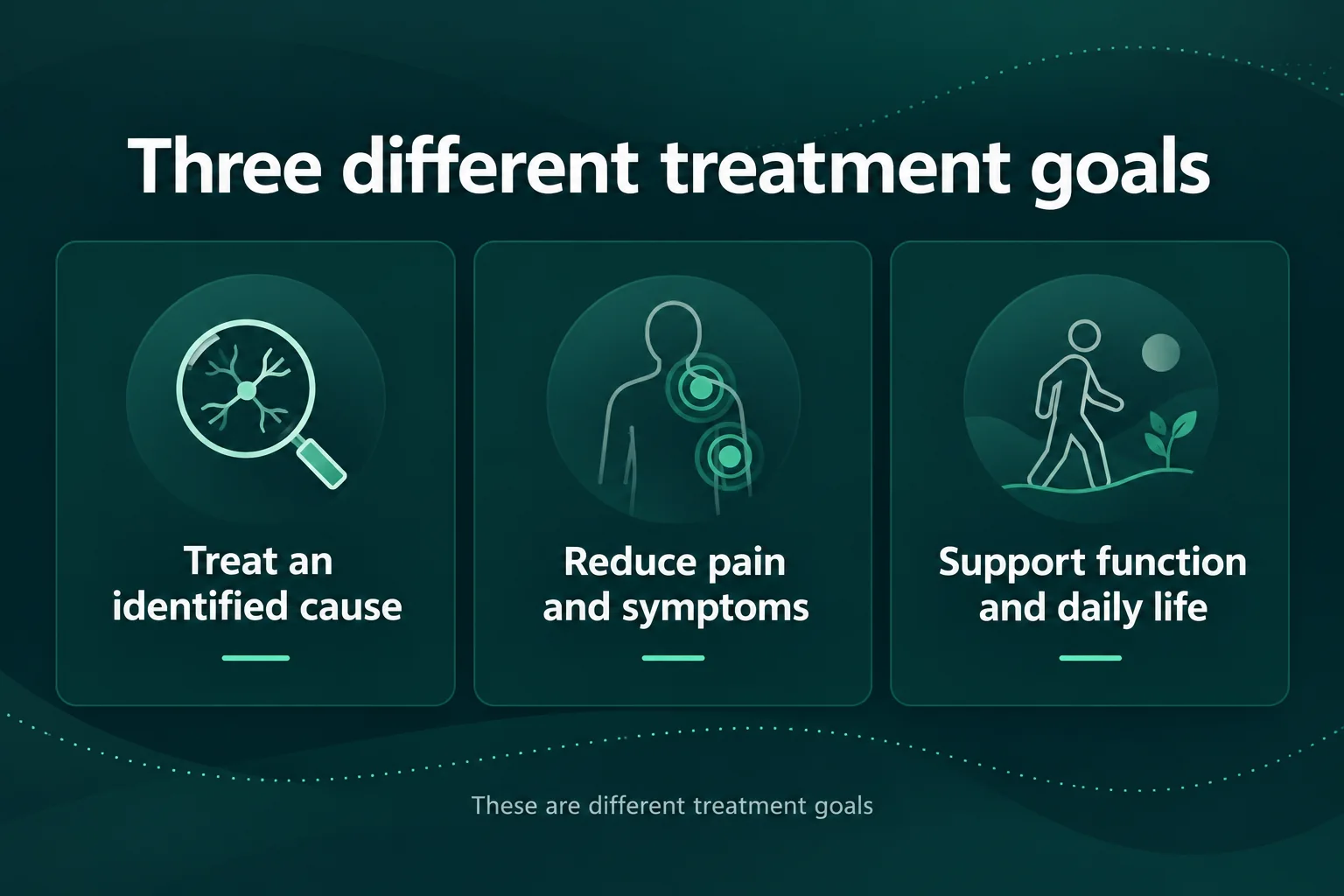
Peripheral neuropathy treatment is not one single thing. It usually has three separate goals: treating the cause if one is found, easing nerve pain if you have it, and protecting your balance, feet and everyday life. Which of these matters most depends on the type of neuropathy. Not all neuropathies can be reversed, but there is usually at least one of the three goals that can be worked on.1, 2, 3
I have neuropathy myself, and I’ve noticed how easy it is to hear “treatment” and think of one pill that fixes the nerves. It rarely works like that. Here is how I understand the three goals, what the research actually shows for each, and where the evidence runs out.
Don’t wait with these.
- Call your local emergency number if weakness or numbness is spreading quickly over hours or days, or if you have any difficulty breathing or swallowing. Rapidly spreading weakness can signal Guillain-Barré syndrome, which can affect the breathing muscles.26
- Get urgent help if you take gabapentin or pregabalin and become confused, extremely sleepy or unusually dizzy, have slow, shallow or difficult breathing, or your lips or skin look bluish. The risk is higher if you also take opioids or other sedating medicines, have a lung disease, or are older.16
- Contact your doctor or an urgent care service promptly if symptoms get much worse over days or weeks, if one side is clearly worse than the other, if you develop a sudden foot drop, or if weakness in your hips, thighs or shoulders becomes a main problem.1
- See your doctor soon about a cut, blister or sore on your foot that isn’t healing, especially if you have diabetes.4
Why is peripheral neuropathy treatment not one single treatment?
Polyneuropathy is a pattern of nerve damage with many possible causes: diabetes, vitamin B12 deficiency, alcohol, certain medicines, immune diseases, inherited conditions and more. Treating a cause, calming pain and keeping you steady on your feet are different jobs, and a medicine that helps one does nothing for the others. Nerve pain medicines ease the pain, for example, but they treat the symptom rather than the nerve damage itself.2, 3
A review in the Canadian Medical Association Journal (CMAJ) estimates that in the common, symmetrical type of polyneuropathy, history and examination identify the cause in nearly 60 % of people, and screening blood tests add about another 10 %. In the rest, no cause is found, and the focus shifts to symptoms and function.1
The US National Institute of Neurological Disorders and Stroke (NINDS) puts the hopeful side plainly: sometimes, when the cause is corrected, the neuropathy can resolve as the nerves recover and regrow. A clinical review in StatPearls adds the realistic side: not all peripheral neuropathies are reversible.2, 3
| Goal | Who it applies to | What the evidence shows | Limitations |
|---|---|---|---|
| Treat the cause: blood sugar | Diabetes | Good glucose control prevents or delays neuropathy in type 1 diabetes | Weaker evidence in type 2 diabetes; a modest slowing at best, not a reversal |
| Treat the cause: replace a deficiency | Proven vitamin B12 deficiency | B12 injections or tablets treat the deficiency | Treating a cause doesn’t guarantee the nerves recover; not all neuropathies are reversible |
| Treat the cause: remove a toxin | Alcohol, some medicines and chemotherapy, excess vitamin B6 | Stopping the exposure can lead to improvement | Some damage often remains; prescribed medicines are changed only with your doctor |
| Immune treatment | CIDP, Guillain-Barré syndrome, vasculitis | Immunoglobulin, steroids or plasma exchange help in specific diagnoses | Specialist treatment; no role in ordinary diabetic or idiopathic neuropathy |
| Ease nerve pain | Painful neuropathy; studied mostly in diabetic neuropathy and nerve pain after shingles | Some antidepressants and gabapentin/pregabalin give meaningful relief to a minority | Modest effects, side effects are common, and it doesn’t treat the nerve damage |
| Balance and strength | Mainly studied in diabetic and chemotherapy-related neuropathy | Balance and sensorimotor training improve balance | Little research in other types |
| Protect the feet | Anyone with reduced feeling in the feet | Regular foot checks and suitable footwear are standard care, especially in diabetes | Evidence and guidance mostly come from diabetes |
Treatment matrix: goals, patient groups, evidence and limitations (sources 1–4, 6–8, 10, 13 and 17). It shows what exists, not what you should use. There is no general “best treatment”.
Treating the cause, when one is found
Diabetes: better evidence in type 1 than type 2
This is where the type of diabetes matters. The American Diabetes Association (ADA), in its 2026 Standards of Care, recommends optimising glucose management to prevent or delay neuropathy in type 1 diabetes (grade A evidence) and to slow its progression in type 2 diabetes (grade C, weaker evidence). For type 2, the ADA notes that studies show at most a modest slowing, without reversal of the nerve loss.4
A Cochrane review points the same way. Tighter glucose control significantly reduced the risk of developing neuropathy in people with type 1 diabetes, but the reduction in type 2 diabetes was small and not statistically significant. Tighter control also clearly increased the risk of severe low blood sugar episodes, so the targets are something to set with your diabetes team.5
Vitamin B12 deficiency
A proven B12 deficiency is treated with B12 injections or tablets, according to the NHS. For people with diabetes and neuropathy, the ADA advises considering B12 deficiency as another possible cause, especially in those who have taken metformin for a long time. To me, that’s a good reason not to leave it untested.4, 7
Alcohol, medicines and toxins
For alcohol-related neuropathy, StatPearls describes treatment as stopping alcohol, replacing nutrients such as thiamine, B12 and folic acid, and physical and occupational therapy. Improvement can follow months to years of abstinence, but some neuropathy often remains.6
Neuropathy caused by a medicine may improve if that medicine is stopped, the NHS says. Please don’t stop a prescribed medicine on your own: talk to the doctor who prescribed it first, because the medicine may be treating something important.7
Chemotherapy is a clear example. The American Society of Clinical Oncology (ASCO) guideline says that when neuropathy becomes intolerable or affects function, the cancer team should assess and discuss with you whether to delay, reduce or stop the chemotherapy, or switch to a medicine that doesn’t cause neuropathy. That is a decision for your oncologist, weighed against the cancer treatment itself.8
Too much vitamin B6 can also cause neuropathy. The US Office of Dietary Supplements describes severe sensory neuropathy from long-term high-dose B6, and says symptoms usually stop if the supplement is stopped as soon as they appear.9
Why the subtype matters for immune and specialist treatments
Some neuropathies are caused by the immune system attacking the nerves. They are treated very differently, and usually by a neurologist.
For chronic inflammatory demyelinating polyneuropathy (CIDP), the European Academy of Neurology and Peripheral Nerve Society (EAN/PNS) guideline strongly recommends immunoglobulin (IVIg) or corticosteroids as first treatment, and plasma exchange if those don’t work. A Cochrane overview found that IVIg and plasma exchange both improved disability in the short term compared with placebo or sham treatment.10, 11
Guillain-Barré syndrome is an emergency treated in hospital, typically with IVIg or plasma exchange. Vasculitic neuropathy, where inflamed blood vessels damage the nerves, is treated with immunosuppressive medicines. The CMAJ review flags rapidly progressive, painful neuropathy and symptoms that develop over days to weeks as reasons for urgent specialist referral.1, 2, 26
These treatments don’t help the common diabetic or idiopathic neuropathy, and they carry real risks, so they are only used when the diagnosis fits. If your neuropathy started quickly or doesn’t behave like the slow, symmetrical type, it’s worth asking whether an immune cause has been considered.
Treating nerve pain: benefits, limitations and follow-up
Not everyone with neuropathy has pain, and many people with numbness need no pain medicine at all. When pain is there, the aim is to reduce it, not remove it completely, as the CMAJ review puts it.1
What guidelines recommend first
The UK guideline from NICE offers a choice of amitriptyline, duloxetine, gabapentin or pregabalin as initial treatment for neuropathic pain. If the first doesn’t work or isn’t tolerated, NICE suggests trying one of the others, and switching again if needed. It advises considering tramadol only if acute rescue treatment is needed, and capsaicin cream for localised pain in people who want to avoid tablets.12
An international review by the neuropathic pain group of the IASP (NeuPSIG), published in 2025, gives a strong first-line recommendation to three drug groups: tricyclic antidepressants such as amitriptyline, SNRIs such as duloxetine, and gabapentin or pregabalin. Capsaicin and lidocaine treatments applied to the skin are weak second-line options, and botulinum toxin, magnetic brain stimulation (rTMS) and opioids are weak third-line options. The authors describe treatment outcomes as modest.13
For painful diabetic neuropathy, the ADA lists the same main groups plus sodium channel blockers, and says opioids, including tramadol and tapentadol, should not be used except in rare circumstances.4
How much do these medicines help?
Honestly, less than many people hope. In Cochrane reviews, which mostly studied painful diabetic neuropathy and nerve pain after shingles, about 38 % of people with painful diabetic neuropathy on gabapentin got at least half their pain relieved, compared with 23 % on placebo (32 % against 17 % in nerve pain after shingles). For duloxetine in painful diabetic neuropathy, about five people needed treatment for one extra person to get that level of relief. Pregabalin showed a similar, modest pattern.14, 15, 28
In other words, a real minority gets good relief, and many people don’t. The NeuPSIG figures tell the same story: depending on the drug group, between about five (tricyclic antidepressants) and nine (gabapentin or pregabalin) people need to be treated with a first-line drug for one more person to get meaningful relief than with placebo.13
Side effects and follow-up
The NHS lists tiredness, dizziness and feeling “drunk” as the most common side effects of neuropathic pain medicines, and advises not to drive if you feel drowsy or have blurred vision. In 2019 the US Food and Drug Administration (FDA) warned about serious breathing problems with gabapentin and pregabalin, mainly in combination with opioids or other sedating medicines, in lung disease and in older people.7, 16
NICE recommends an early review after starting or changing a medicine, and regular reviews of pain, sleep, daily activities, physical and psychological wellbeing, and side effects. It also suggests referral to a specialist pain service if pain is severe or badly limits daily life or sleep.12 I find it helps to agree beforehand what “working” would mean for you, such as sleeping better or walking further, so the review isn’t just a vague “a bit better, maybe”.

I won’t give doses or suggest combinations or changes. Those belong with your doctor and pharmacist, who know your other medicines and health.
Treatments without tablets
The evidence here is thin, and I’d rather say so plainly:
- A Cochrane review of TENS (small electrical pulses through the skin) found evidence too weak to say whether it works better than sham TENS for nerve pain. Side effects were mostly minor skin irritation.18
- Psychological therapies have too few trials in neuropathic pain to draw conclusions, according to Cochrane, although NICE still recommends discussing coping strategies.12, 20
- For acupuncture, Cochrane found insufficient evidence to support or refute its use in neuropathic pain.21
- For severe painful diabetic neuropathy that hasn’t responded to medicines, spinal cord stimulation is a specialist option. In an open-label trial of 216 people, 79 % with high-frequency stimulation plus usual care had at least 50 % pain relief at three months (85 % at six months), compared with 5 % on usual care alone. It involves surgery, with a small risk of infection: about 2 % needed the device removed because of infection.19
Improving function, balance and everyday life
For many of us, this is where treatment makes the biggest difference day to day, even when the nerves themselves don’t change.
Exercise and balance training
A 2022 meta-analysis of randomised trials found that exercise improved balance in diabetic neuropathy and improved balance, quality of life and symptoms in chemotherapy-related neuropathy. A combination of endurance and sensorimotor training (balance exercises that train the body’s sense of position) seemed most useful in diabetic neuropathy. Of 41 trials, only five covered other causes, so for other types this is a reasonable extrapolation rather than proof.17
The ADA also says exercise can improve symptoms, balance and function in diabetic neuropathy, but rates the strength of that evidence as low.4
Physiotherapy, braces and walking aids
NINDS writes that hand or foot braces can reduce disability and pain, and that orthopaedic shoes can improve walking and help prevent foot injuries. Mayo Clinic and the NHS mention physiotherapy to improve strength and movement, and walking aids where needed, and Mayo Clinic also lists hand or foot braces, a cane, a walker or a wheelchair.2, 7, 27
Looking after your feet
Reduced feeling makes it easy to miss a blister, a stone in the shoe or a small cut. For people with diabetes and lost protective sensation, the ADA recommends a foot inspection at every visit, daily self-checks, and specialist foot care and therapeutic footwear for those at high risk. The guidance is written for diabetes, but checking your feet makes sense to me whatever the cause of the numbness.4
NINDS lists stopping smoking, avoiding alcohol and toxins, exercise, healthy eating and keeping a healthy weight as ways to support healthier nerves. They are unglamorous, and none of them is a cure, but they are the parts we can do ourselves.2
How to assess supplements and new treatment claims
Neuropathy attracts a lot of promises. A few things I’ve learned to check from the research:
- Alpha-lipoic acid: a 2024 Cochrane review in diabetic neuropathy concluded that, after six months, it probably has little or no effect on symptoms and may have little or no effect on nerve impairment. The studies covered diabetes only.23
- B vitamins without a deficiency: a Cochrane review found insufficient evidence to say whether they help or harm, in studies of alcohol-related and diabetic neuropathy. Replacing a proven deficiency is a different matter, and too much B6 can itself damage the nerves.9, 24
- Cannabis-based medicines: a Cochrane review updated in January 2026 found no high-quality evidence that they reduce neuropathic pain more than placebo, and products containing THC increased dizziness and drowsiness. NICE says cannabis sativa extract shouldn’t be started for nerve pain outside specialist settings unless a specialist advises it.12, 22
- Acetyl-L-carnitine: ASCO strongly advises against it for preventing chemotherapy-related neuropathy.8
The FDA lists warning signs of health fraud that fit neuropathy “cures” well: one product that does it all, personal testimonials instead of trials, quick fixes, “all natural”, “miracle cure”, guaranteed results and secret ingredients.25 My own rule of thumb: ask which type of neuropathy it was tested in, how many people, compared with what, and for how long. Tell your doctor or pharmacist about anything you take, since supplements can interact with medicines.
What can you realistically expect?
If a treatable cause is found and dealt with early, some neuropathies improve. When the damage has affected the nerve fibres themselves, recovery tends to be slower and less complete. For pain, most treatments reduce it rather than end it, and it can take a few tries to find something that helps with side effects you can live with.1, 3, 12
There is some good news in the NINDS material too: over time, as the nerves heal, many people can take less of their medicines or stop them altogether, and NINDS adds that this is something to talk over with a doctor first. And when tests don’t show a cause, Mayo Clinic notes that watchful waiting may be recommended, to see whether the neuropathy stays the same or gets better.2, 27
Questions to take to your next appointment
- Has a cause been found, and is it being treated as well as it can be?
- Does my type of neuropathy need a specialist or immune treatment, or is that not relevant for me?
- If I have pain, what would count as the medicine working, and when will we review it?
- Which side effects should make me contact you, and are any of my other medicines a concern together with this one?
- Could physiotherapy, balance training, a brace or better footwear help me?
- How often should my feet be checked, and by whom?
I’m not a doctor. I’ve written this from published research and guidance, and to help you prepare questions for your own care.
Sources
- Mirian A, Aljohani Z, Grushka D, Florendo-Cumbermack A. Diagnosis and management of patients with polyneuropathy. CMAJ 2023;195(6):E227–E233, 13 February 2023. https://www.cmaj.ca/content/195/6/E227
- National Institute of Neurological Disorders and Stroke (NINDS). Peripheral Neuropathy. Last reviewed 13 March 2026. https://www.ninds.nih.gov/health-information/disorders/peripheral-neuropathy
- Hammi C, Yeung B. Neuropathy. StatPearls, NCBI Bookshelf. Last updated 15 October 2022. https://www.ncbi.nlm.nih.gov/books/NBK542220/
- American Diabetes Association Professional Practice Committee. 12. Retinopathy, Neuropathy, and Foot Care: Standards of Care in Diabetes—2026. Diabetes Care 2026;49(Suppl 1):S261–S276. https://doi.org/10.2337/dc26-S012
- Callaghan BC, Little AA, Feldman EL, Hughes RAC. Enhanced glucose control for preventing and treating diabetic neuropathy. Cochrane Database of Systematic Reviews 2012, Issue 6, CD007543.pub2, 13 June 2012. https://www.cochrane.org/CD007543/NEUROMUSC_enhanced-glucose-control-for-preventing-and-treating-diabetic-neuropathy
- Sadowski A, Houck RC. Alcoholic Neuropathy. StatPearls, NCBI Bookshelf. Last updated 30 December 2022. https://www.ncbi.nlm.nih.gov/books/NBK499856/
- NHS. Peripheral neuropathy – Treatment. Last reviewed 10 October 2022. https://www.nhs.uk/conditions/peripheral-neuropathy/treatment/
- Loprinzi CL, Lacchetti C, Bleeker J, et al. Prevention and management of chemotherapy-induced peripheral neuropathy in survivors of adult cancers: ASCO guideline update. Journal of Clinical Oncology 2020;38(28):3325–3348. https://scholarworks.indianapolis.iu.edu/server/api/core/bitstreams/39ad7ce4-38f5-4d07-ba1e-e1314dfc8da4/content
- NIH Office of Dietary Supplements. Vitamin B6 – Fact Sheet for Health Professionals. Updated 16 June 2023. https://ods.od.nih.gov/factsheets/VitaminB6-HealthProfessional/
- Van den Bergh PYK, van Doorn PA, Hadden RDM, et al. European Academy of Neurology/Peripheral Nerve Society guideline on diagnosis and treatment of chronic inflammatory demyelinating polyradiculoneuropathy: Report of a joint Task Force—Second revision. European Journal of Neurology 2021;28(11):3556–3583 (abstract). https://pure.eur.nl/en/publications/european-academy-of-neurologyperipheral-nerve-society-guideline-o-2
- Oaklander AL, Lunn MPT, Hughes RAC, van Schaik IN, Frost C, Chalk CH. Treatments for chronic inflammatory demyelinating polyradiculoneuropathy (CIDP): an overview of systematic reviews. Cochrane Database of Systematic Reviews 2017, CD010369. https://www.cochrane.org/CD010369/NEUROMUSC_treatment-chronic-inflammatory-demyelinating-polyradiculoneuropathy-cidp-overview-systematic-reviews
- NICE. Neuropathic pain in adults: pharmacological management in non-specialist settings (CG173). Published 20 November 2013, last updated 22 September 2020. https://www.nice.org.uk/guidance/cg173/chapter/Recommendations
- Soliman N, Moisset X, Ferraro MC, et al.; NeuPSIG Review Update Study Group. Pharmacotherapy and non-invasive neuromodulation for neuropathic pain: a systematic review and meta-analysis. Lancet Neurology 2025;24(5):413–428 (abstract). https://vbn.aau.dk/en/publications/pharmacotherapy-and-non-invasive-neuromodulation-for-neuropathic-
- Wiffen PJ, Derry S, Bell RF, et al. Gabapentin for chronic neuropathic pain in adults. Cochrane Database of Systematic Reviews 2017, CD007938. https://www.cochrane.org/evidence/CD007938_gabapentin-chronic-neuropathic-pain-adults
- Lunn MPT, Hughes RAC, Wiffen PJ. Duloxetine for treating painful neuropathy, chronic pain or fibromyalgia. Cochrane Database of Systematic Reviews 2014, CD007115. https://www.cochrane.org/CD007115/NEUROMUSC_duloxetine-treating-painful-neuropathy-chronic-pain-or-fibromyalgia
- US Food and Drug Administration. FDA warns about serious breathing problems with seizure and nerve pain medicines gabapentin (Neurontin, Gralise, Horizant) and pregabalin (Lyrica, Lyrica CR). Drug Safety Communication, 19 December 2019. https://www.fda.gov/safety/medical-product-safety-information/neurontin-gralise-horizant-gabapentin-and-lyrica-lyrica-cr-pregabalin-drug-safety-communication
- Streckmann F, Balke M, Cavaletti G, et al. Exercise and neuropathy: systematic review with meta-analysis. Sports Medicine 2022;52:1043–1065. https://link.springer.com/article/10.1007/s40279-021-01596-6
- Gibson W, Wand BM, O’Connell NE. Transcutaneous electrical nerve stimulation (TENS) for neuropathic pain in adults. Cochrane Database of Systematic Reviews 2017, CD011976. https://www.cochrane.org/evidence/CD011976_transcutaneous-electrical-nerve-stimulation-tens-neuropathic-pain
- Petersen EA, Stauss TG, Scowcroft JA, et al. Effect of high-frequency (10-kHz) spinal cord stimulation in patients with painful diabetic neuropathy: a randomized clinical trial. JAMA Neurology 2021;78(6):687–698. https://jamanetwork.com/journals/jamaneurology/fullarticle/2777806
- Eccleston C, Hearn L, Williams AC de C. Psychological therapies for the management of chronic neuropathic pain in adults. Cochrane Database of Systematic Reviews 2015, CD011259. https://www.cochrane.org/CD011259/SYMPT_psychological-treatments-chronic-pain-involving-damage-or-disease-nerves-responsible-pain
- Ju ZY, Wang K, Cui HS, et al. Acupuncture for neuropathic pain in adults. Cochrane Database of Systematic Reviews 2017, CD012057. https://www.cochrane.org/evidence/CD012057_acupuncture-neuropathic-pain-adults
- EurekAlert! / Cochrane. Cannabis-based medicines for chronic neuropathic pain in adults (news release on the Cochrane review update by Ateş G, Welsch P, Klose P, et al., CD012182.pub3, published 19 January 2026), 18 January 2026. https://www.eurekalert.org/news-releases/1112290
- Baicus C, Purcarea A, von Elm E, Delcea C, Furtunescu FL. Alpha-lipoic acid for diabetic peripheral neuropathy. Cochrane Database of Systematic Reviews 2024, CD012967.pub2, 11 January 2024. https://www.cochrane.org/evidence/CD012967_alpha-lipoic-acid-natural-antioxidant-better-no-treatment-or-dummy-treatment-nerve-damage-people
- Ang CD, Alviar MJM, Dans AL, et al. Vitamin B for treating peripheral neuropathy. Cochrane Database of Systematic Reviews 2008, CD004573. https://www.cochrane.org/CD004573/NEUROMUSC_vitamin-b-for-treating-peripheral-neuropathy
- US Food and Drug Administration. 6 Tip-offs to Rip-offs: Don’t Fall for Health Fraud Scams. Consumer Update, 4 March 2021. https://www.fda.gov/consumers/consumer-updates/6-tip-offs-rip-offs-dont-fall-health-fraud-scams
- National Institute of Neurological Disorders and Stroke (NINDS). Guillain-Barré Syndrome. Last reviewed 13 March 2026. https://www.ninds.nih.gov/health-information/disorders/guillain-barre-syndrome
- Mayo Clinic. Peripheral neuropathy – Diagnosis and treatment. 19 May 2026. https://www.mayoclinic.org/diseases-conditions/peripheral-neuropathy/diagnosis-treatment/drc-20352067
- Derry S, Bell RF, Straube S, et al. Pregabalin for neuropathic pain in adults. Cochrane Database of Systematic Reviews 2019, CD007076. https://www.cochrane.org/evidence/CD007076_pregabalin-chronic-neuropathic-pain-adults
Sources checked on 25 September 2026.
Related reading

Restless legs or neuropathy? Similar symptoms, different assessments
Written by someone living with neuropathy: how restless legs syndrome differs from neuropathy, why the two are so often confused, how often they occur together, how each is assessed, and questions to take to your doctor.

Cold feet: nerve symptoms, circulation and when to seek help
Written by someone living with neuropathy: why feet can feel cold without being cold, when cold feet point to circulation instead, the warning signs that need urgent help, and a description aid for your appointment.

Numb hands and weak grip: neuropathy or another nerve problem?
Written by someone living with neuropathy: why numb hands and a weak grip can be a trapped nerve, a neck problem or polyneuropathy, the warning signs, and a description aid to take to your doctor.