
Yes, you can have neuropathy without diabetes, and a normal blood sugar result is not the end of the search for a cause. Diabetes is the most common single cause, but reviews describe many others, including heavy alcohol use, vitamin B12 deficiency, kidney disease and medicines such as chemotherapy. Around three in ten people end up with no cause found, and that is a diagnosis you reach after a proper work-up, not before it.1
I have neuropathy myself, and I know how confusing it can be to hear “it isn’t diabetes” and then not hear what comes next. This page is my attempt to map the other possibilities in plain language, and to show which questions are worth asking. It is not a way to work out your own cause from a list. That needs someone who can take your history and examine you.
Why neuropathy without diabetes still needs a cause
Polyneuropathy is common. The CMAJ review puts it at about 1–3% of the general population and roughly 7% of people over 65. It lists diabetes, alcohol use disorder, kidney problems and medicines, including chemotherapy, as common causes of the typical form that starts in both feet, with diabetes the most common.1
A review of the epidemiology of chronic polyneuropathy found that diabetes accounts for 18–49% of cases, depending on the study. That still leaves a large group of people whose neuropathy comes from something else.3
The reason this matters, as I see it, is that some of the other causes can be treated, removed or at least kept from getting worse. A vitamin that is low can be replaced. A medicine can be reviewed. A protein in the blood can be followed up. You only get those chances if someone looks.
“My blood sugar is normal” is not the whole answer
A single normal fasting glucose does not rule out every problem with blood sugar. The American Academy of Neurology’s practice parameter from 2009 says that if routine glucose testing shows no definite diabetes, testing for impaired glucose tolerance may be considered in distal symmetric sensory polyneuropathy. It is older guidance with a low level of evidence, but later reviews say something similar.4
A 2015 review in JAMA includes a glucose tolerance test in the limited set of routine blood tests it says the evidence supports. The CMAJ review recommends a two-hour glucose tolerance test if HbA1c is 6.0–6.4%, the range just below diabetes.1, 5
Researchers have also looked at prediabetes and body weight. A systematic review found higher rates of neuropathy in prediabetes than expected, mostly of the small nerve fibres, but the estimates varied enormously between studies, from 2% to 77%. A large study from China found neuropathy in about 3% of people with normal blood sugar, 6% with prediabetes and 15% with diabetes, and linked higher weight to neuropathy too. Studies like these show links, not proof of cause, and the review of chronic polyneuropathy calls the results not entirely consistent.3, 6, 7
A cause map: what else can lie behind it
The table is my own summary of the groups of causes the sources describe. It is a map for conversations with your doctor, not a checklist to work through at home. Some causes overlap, and a population study from the Netherlands found combinations of risk factors in about one in five people with chronic axonal polyneuropathy.8

| Group | Examples from the sources | Why it is worth finding | How it is usually looked for |
|---|---|---|---|
| Blood sugar short of diabetes | Impaired glucose tolerance, prediabetes, links with obesity and metabolic syndrome | The link is uncertain, but blood sugar and weight are things you can work on with your care team | Fasting glucose, HbA1c, sometimes a two-hour glucose tolerance test |
| Too little of a vitamin | Vitamin B12; also B1, B6, copper and vitamin E are listed | B12 deficiency can be treated; early diagnosis helps avoid lasting damage | B12, sometimes with methylmalonic acid |
| Alcohol and toxins | Long-term heavy drinking, toxins, heavy metals | Exposure can be reduced or stopped | An honest history, blood count, liver tests |
| Medicines and supplements | Some chemotherapy drugs, high-dose vitamin B6 | A doctor can weigh the medicine against the nerve symptoms | Going through every medicine and supplement you take |
| Other body systems | Kidney or liver disease, underactive thyroid | The underlying condition can be treated in its own right | Kidney and liver tests; thyroid tests if the doctor thinks they are relevant |
| Blood proteins and the immune system | Monoclonal gammopathy (MGUS), CIDP, vasculitis, Sjögren’s, lupus, some infections | Some need follow-up or specific treatment from a specialist | Serum protein electrophoresis with immunofixation, examination, nerve tests |
| Inherited | Charcot-Marie-Tooth disease, hereditary amyloidosis | Explains the pattern and can matter for relatives | Family history, foot shape, nerve tests, sometimes genetic testing |
| No cause found | Idiopathic or cryptogenic polyneuropathy | A “no cause” answer after a full work-up still guides symptom care and follow-up | What is left when the other groups have been checked |
Causes that can often be dealt with
Vitamin B12. The US Office of Dietary Supplements (ODS) says B12 deficiency can cause numbness and tingling in the hands and feet, sometimes without anaemia, and that early diagnosis matters to avoid irreversible damage. It names metformin and acid-reducing medicines as things that can lower B12, and says that, depending on the definition used, between 3% and 43% of older adults living at home have a deficiency. Recreational nitrous oxide is another route: a 2024 case series from Thailand explains that it inactivates B12, and that a functional deficiency can occur even when the B12 level looks normal.12, 13
Alcohol. CMAJ lists alcohol use disorder among the common causes. The epidemiology review reports neuropathy in 13–66% of people with long-term alcohol dependence in different studies.1, 3
Medicines and supplements. The American Cancer Society lists platinum drugs, taxanes, plant alkaloids such as vincristine, thalidomide and bortezomib among the cancer drugs more likely to cause neuropathy, and says the risk grows with dose and each cycle. On the supplement side, the ODS says long-term very high doses of vitamin B6 can cause a severe sensory neuropathy, and that symptoms usually stop if the supplement is stopped as soon as they appear.14, 15 I would never change a prescribed medicine on my own because of this. It is a conversation to have with the prescriber.
Kidneys, liver and thyroid. NINDS says kidney and liver disorders can lead to high levels of toxins in the blood that damage nerves. Mayo Clinic lists an underactive thyroid among the metabolic causes.9, 10
Causes a specialist may look for
A protein in the blood. Mayo Clinic describes monoclonal gammopathy of undetermined significance (MGUS) as a condition with an abnormal protein in the blood that is most often found in blood tests done for other reasons. It becomes more common with age: about 3% of people over 50 and 9% of people over 85. The AAN names serum protein immunofixation among the three tests with the highest yield in neuropathy.4, 16
The immune system. Mayo Clinic lists Sjögren’s, lupus, rheumatoid arthritis, CIDP and vasculitis among autoimmune causes. CMAJ says a pattern with weakness both near the trunk and further out in the limbs may point to an inflammatory condition such as CIDP.1, 10
Infections. NINDS, Mayo Clinic and StatPearls all list infections, for example HIV, Lyme disease and shingles, and Mayo Clinic and StatPearls also name hepatitis C. None of them gives figures for how often infections are the cause.9, 10, 11
Inherited neuropathy. NINDS calls Charcot-Marie-Tooth disease the most common inherited neuropathy, often starting in the teens or early adulthood, with high arches and curled toes. CMAJ notes that calf muscle wasting, hammer toes and high-arched feet suggest a long-standing neuropathy, often an inherited one. The AAN says genetic testing may be considered when someone without a known cause has a pattern that looks inherited.1, 4, 17
When no cause is found
CMAJ describes it like this: a cause is found in nearly 60% of people after the history and examination, blood tests find one in about 10% more, and around 30% remain idiopathic. The epidemiology review gives 20–30% across studies. CMAJ uses the name chronic idiopathic axonal neuropathy for people who can still walk and have a slowly progressing neuropathy, usually starting after 60.1, 3
A systematic review describes this form as starting gradually, progressing slowly or not at all over at least six months, with no cause found despite appropriate investigation. As I read it, “idiopathic” is an answer that only makes sense after the other groups on the map have been looked at. There is a separate page on this site about idiopathic polyneuropathy.18
What the next steps usually look like
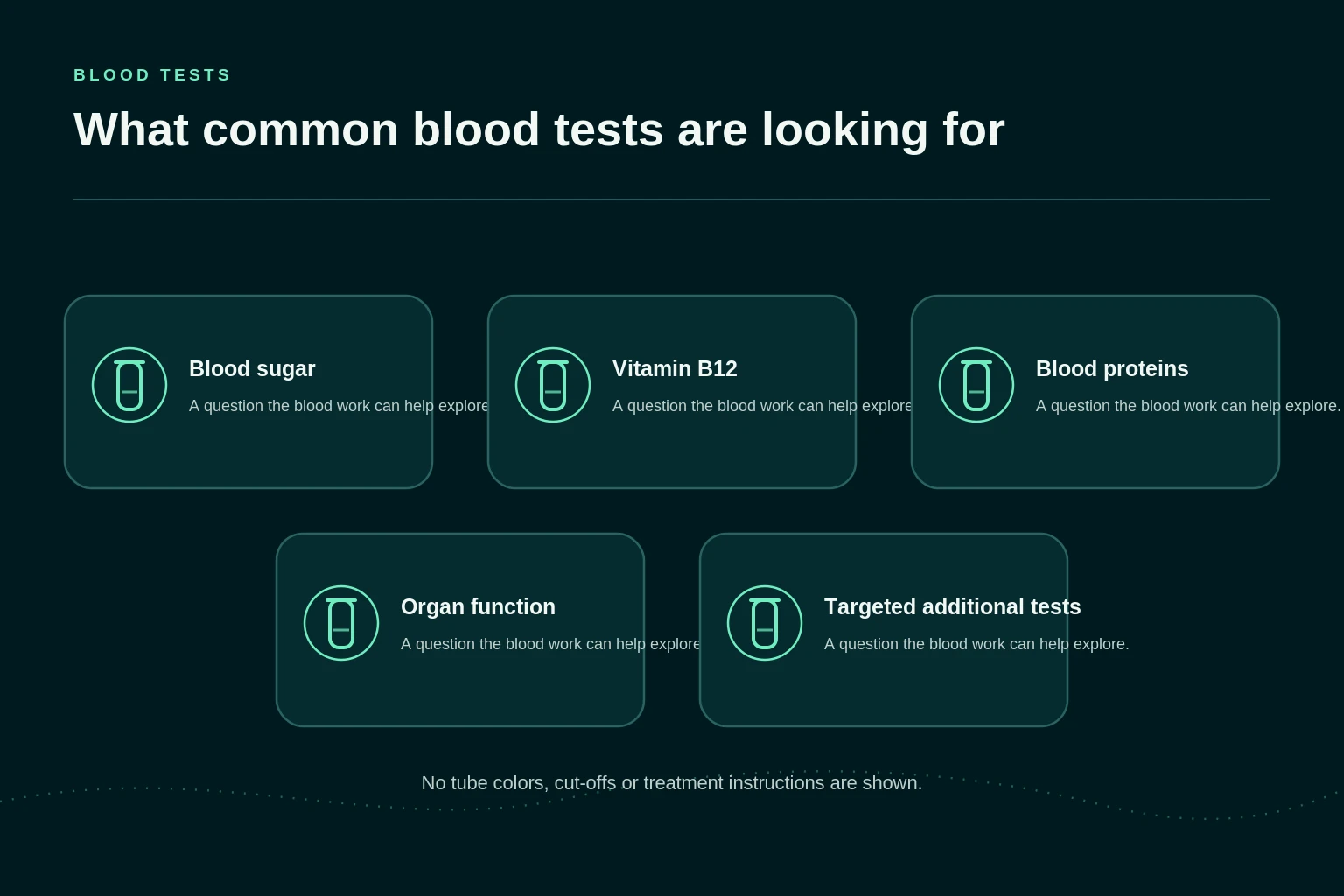
The sources describe a fairly consistent order. It starts with a careful history, covering alcohol, medicines, supplements, diet and family. Then comes an examination. After that, a set of basic blood tests is done. CMAJ lists a blood count, salts, kidney and liver tests, fasting glucose and HbA1c, serum protein electrophoresis, and vitamin B12 with or without methylmalonic acid.1
On nerve conduction studies and EMG, the sources differ. CMAJ suggests them for most people with polyneuropathy, especially when the cause is not known. The JAMA review says the evidence supporting their use is lacking. Either way, both reviews say that unusual features call for a neurologist or neuromuscular specialist. CMAJ gives examples: onset over days or weeks, one-sidedness, not following the usual feet-first pattern, or mainly weakness.1, 5
Questions you can bring to your appointment
- My blood sugar is normal. Would a glucose tolerance test add anything in my case?
- Has my B12 been checked, and would methylmalonic acid help interpret it?
- Could any of my medicines or supplements play a part?
- Has a protein test (serum protein electrophoresis with immunofixation) been done?
- Does anything in my family history or my feet suggest an inherited neuropathy?
- Do I need nerve conduction studies or a referral to a neurologist?
- If no cause is found, how will we follow up, and what changes should make me get in touch sooner?
I’m not a doctor. I’ve written this from published research and guidance, and to help you prepare questions for your own care.
Sources
- Mirian A, Aljohani Z, Grushka D, Florendo-Cumbermack A. Diagnosis and management of patients with polyneuropathy. CMAJ 2023;195(6):E227–E233. doi:10.1503/cmaj.220936. https://www.cmaj.ca/content/195/6/E227
- National Institute of Neurological Disorders and Stroke (NINDS). Guillain-Barré Syndrome. Last reviewed 13 March 2026. https://www.ninds.nih.gov/health-information/disorders/guillain-barre-syndrome
- Hanewinckel R, van Oijen M, Ikram MA, van Doorn PA. The epidemiology and risk factors of chronic polyneuropathy. Eur J Epidemiol 2016;31(1):5–20. doi:10.1007/s10654-015-0094-6. https://pmc.ncbi.nlm.nih.gov/articles/PMC4756033/
- England JD, Gronseth GS, Franklin G, et al. Practice Parameter: evaluation of distal symmetric polyneuropathy: role of laboratory and genetic testing (an evidence-based review). Report of the AAN, AANEM and AAPM&R. Neurology 2009;72(2):185–192. doi:10.1212/01.wnl.0000336370.51010.a1. https://www.neurology.org/doi/10.1212/01.wnl.0000336370.51010.a1
- Callaghan BC, Price RS, Feldman EL. Distal Symmetric Polyneuropathy: A Review. JAMA 2015;314(20):2172–2181. doi:10.1001/jama.2015.13611. https://doi.org/10.1001/jama.2015.13611
- Callaghan BC, Gao L, Li Y, et al. Diabetes and obesity are the main metabolic drivers of peripheral neuropathy. Ann Clin Transl Neurol 2018;5(4):397–405. doi:10.1002/acn3.531. https://pmc.ncbi.nlm.nih.gov/articles/PMC5899909/
- Kirthi V, Perumbalath A, Brown E, et al. Prevalence of peripheral neuropathy in pre-diabetes: a systematic review. BMJ Open Diabetes Res Care 2021;9(1):e002040. doi:10.1136/bmjdrc-2020-002040. https://pmc.ncbi.nlm.nih.gov/articles/PMC8137250/
- Taams NE, Drenthen J, Hanewinckel R, Ikram MA, van Doorn PA. Prevalence and Risk Factor Profiles for Chronic Axonal Polyneuropathy in the General Population. Neurology 2022;99(20):e2234–e2240. doi:10.1212/WNL.0000000000201168. https://pure.eur.nl/en/publications/prevalence-and-risk-factor-profiles-for-chronic-axonal-polyneurop/
- National Institute of Neurological Disorders and Stroke (NINDS). Peripheral Neuropathy. Last reviewed 13 March 2026. https://www.ninds.nih.gov/health-information/disorders/peripheral-neuropathy
- Mayo Clinic Staff. Peripheral neuropathy: Symptoms and causes. Mayo Clinic, 19 May 2026. https://www.mayoclinic.org/diseases-conditions/peripheral-neuropathy/symptoms-causes/syc-20352061
- Hammi C, Yeung B. Neuropathy. StatPearls [Internet]. StatPearls Publishing; last update 15 October 2022. NBK542220. https://www.ncbi.nlm.nih.gov/books/NBK542220/
- NIH Office of Dietary Supplements. Vitamin B12: Fact Sheet for Health Professionals. Updated 2 July 2025. https://ods.od.nih.gov/factsheets/VitaminB12-HealthProfessional/
- Kulkantrakorn K, Chunhachatrachai P, Kulkantrakorn W. Nitrous oxide abuse and associated neurological diseases. BMC Neurol 2024;24:461. doi:10.1186/s12883-024-03966-9. https://doi.org/10.1186/s12883-024-03966-9
- American Cancer Society. Peripheral Neuropathy. Last revised 20 May 2025. https://www.cancer.org/cancer/side-effects/pain/peripheral-neuropathy.html
- NIH Office of Dietary Supplements. Vitamin B6: Fact Sheet for Health Professionals. Updated 16 June 2023. https://ods.od.nih.gov/factsheets/VitaminB6-HealthProfessional/
- Mayo Clinic Staff. Monoclonal gammopathy of undetermined significance (MGUS): Symptoms and causes. Mayo Clinic, 16 September 2026. https://www.mayoclinic.org/diseases-conditions/mgus/symptoms-causes/syc-20352362
- National Institute of Neurological Disorders and Stroke (NINDS). Charcot-Marie-Tooth Disease. Last reviewed 2 September 2026. https://www.ninds.nih.gov/health-information/disorders/charcot-marie-tooth-disease
- Zis P, Sarrigiannis PG, Rao DG, et al. Chronic idiopathic axonal polyneuropathy: a systematic review. J Neurol 2016;263(10):1903–1910. doi:10.1007/s00415-016-8082-7. https://link.springer.com/article/10.1007/s00415-016-8082-7
Sources checked on 25 September 2026.
Related reading

Restless legs or neuropathy? Similar symptoms, different assessments
Written by someone living with neuropathy: how restless legs syndrome differs from neuropathy, why the two are so often confused, how often they occur together, how each is assessed, and questions to take to your doctor.

Cold feet: nerve symptoms, circulation and when to seek help
Written by someone living with neuropathy: why feet can feel cold without being cold, when cold feet point to circulation instead, the warning signs that need urgent help, and a description aid for your appointment.

Numb hands and weak grip: neuropathy or another nerve problem?
Written by someone living with neuropathy: why numb hands and a weak grip can be a trapped nerve, a neck problem or polyneuropathy, the warning signs, and a description aid to take to your doctor.