
Genetic testing for neuropathy is not a routine test for everyone with numb or painful feet. It is most useful when the picture points to an inherited cause: high arches or curled toes, thin lower legs, symptoms that began young and change very slowly, or relatives with similar problems. A doctor, ideally together with genetic counselling, helps decide which test fits and what a result would mean.1, 2, 3
I have neuropathy myself, and I know how tempting it is to hope that one blood test will finally explain everything. This page is about who is likely to benefit from genetic testing, what the tests look for, what the results can and cannot tell you, and how to prepare your family history. Charcot-Marie-Tooth disease and hereditary transthyretin amyloidosis each have their own pages on this site.
Who may benefit from genetic testing for neuropathy?
The American Academy of Neurology’s practice parameter on laboratory and genetic testing, first published in 2009 and reaffirmed in 2025, says genetic testing may be considered when a neuropathy has no known cause and looks like a hereditary neuropathy. For people whose neuropathy does not look hereditary, it found too little evidence to say whether routine genetic testing is useful.3
So the question is less “could my neuropathy be genetic?” and more “does my neuropathy look like the inherited kind?”. The CMAJ review describes thin calf muscles, hammer toes and high-arched feet (pes cavus) as signs of a long-standing neuropathy that are often seen in hereditary forms. It adds that someone whose reflexes are missing everywhere, without other problems on examination, may need a referral because the cause could be hereditary.1
A review in Practical Neurology notes that many people with inherited neuropathy have few tingling or painful sensations, so they often come to a doctor only when weakness starts to get in the way of daily life. NINDS says Charcot-Marie-Tooth disease usually starts in the teens or early adulthood but can appear at any age, and GeneReviews describes the typical course as slowly progressive.5, 6, 2
Other patterns that can point to a genetic cause
Some inherited neuropathies look quite different. Hereditary neuropathy with liability to pressure palsies (HNPP) typically causes repeated episodes of numbness and weakness in one nerve or several, often painless, at places where nerves are easily pressed, such as the elbow, wrist or the outside of the knee.7
Another example is a slowly worsening loss of feeling, often with poor balance, that starts in adulthood. GeneReviews describes a recessive condition caused by an expansion in the RFC1 gene, with onset after the age of 35 and a chronic cough that can come years before the nerve symptoms. In a study from neuropathy clinics in Italy and the UK, 43 of 125 people (34 percent) whose purely sensory neuropathy had been labelled “idiopathic” turned out to have this cause.8, 9
Hereditary transthyretin amyloidosis can cause a slowly progressive neuropathy affecting feeling and strength and/or the autonomic nerves, and it can also affect the heart. GeneReviews lists treatments aimed specifically at this disease, which is one reason a genetic diagnosis can change what happens next.10
When it is usually not the first step
The CMAJ review says that in distal symmetric polyneuropathy, nearly 60 percent of people have an identified cause after the history and examination, and screening blood tests find a cause in another 10 percent. As I read the guidance, the ordinary work-up comes first, and genetic testing is added when the pattern suggests an inherited form.1, 3
Doesn’t a family history settle it?
Not on its own, in either direction. GeneReviews explains that a person with Charcot-Marie-Tooth disease can have no known family history, because relatives may be only mildly affected, because the condition may be recessive, or because the change in the gene arose for the first time in that person. Practical Neurology says that examining family members can help, when that is possible.2, 5
The opposite is also true. Neuropathy is common and has many causes that are not inherited, so one relative with neuropathy does not prove that yours is genetic, or that you share the same cause. That is my own reasoning, and it is exactly the kind of question a genetics specialist can help untangle.
Even when a condition is inherited, it does not pass on the same way in every family. GeneReviews describes dominant forms, where each child of an affected parent has a 50 percent chance of inheriting the change, recessive forms, where brothers and sisters of an affected person each have a 25 percent chance of being affected, and X-linked forms. For hereditary transthyretin amyloidosis, it notes that how often carriers become ill varies a lot between populations.2, 10
NHGRI, the US genome research institute, points out that a positive result does not always mean you will develop a disease. The US patient organisation CMT Association adds that results cannot reliably predict how the disease will progress or how severe it will become, and that symptoms can vary widely even among people with the same genetic change.11, 12
What does a genetic test for neuropathy look for?
For suspected Charcot-Marie-Tooth disease, GeneReviews recommends starting with a test for a duplication or deletion of the PMP22 gene, since the duplication alone accounts for up to half of all cases. If that is normal, the next step is a panel that looks at several genes at once, and whole exome or genome sequencing may be considered if the panel finds nothing.2
No single test covers everything. GeneReviews notes that the RFC1 repeat expansion cannot be found by sequence-based gene panels or exome sequencing, so it needs its own test. A review in Nature Reviews Neurology describes the growing challenge of interpreting the variants that broad sequencing returns, and how the clinical picture can be combined with genetic and other evidence to judge them.8, 13
How often does testing find an answer?
It depends a great deal on the type of neuropathy and on who is tested. At one specialist inherited-neuropathy centre in the UK, 1,515 people with a clinical diagnosis of Charcot-Marie-Tooth disease or a related disorder were assessed between 2009 and 2023, and 76.9 percent received a genetic diagnosis. The rate was 96.8 percent in the demyelinating type (CMT1) but less than 50 percent in the axonal type (CMT2), in purely motor forms and in complex neuropathies.14
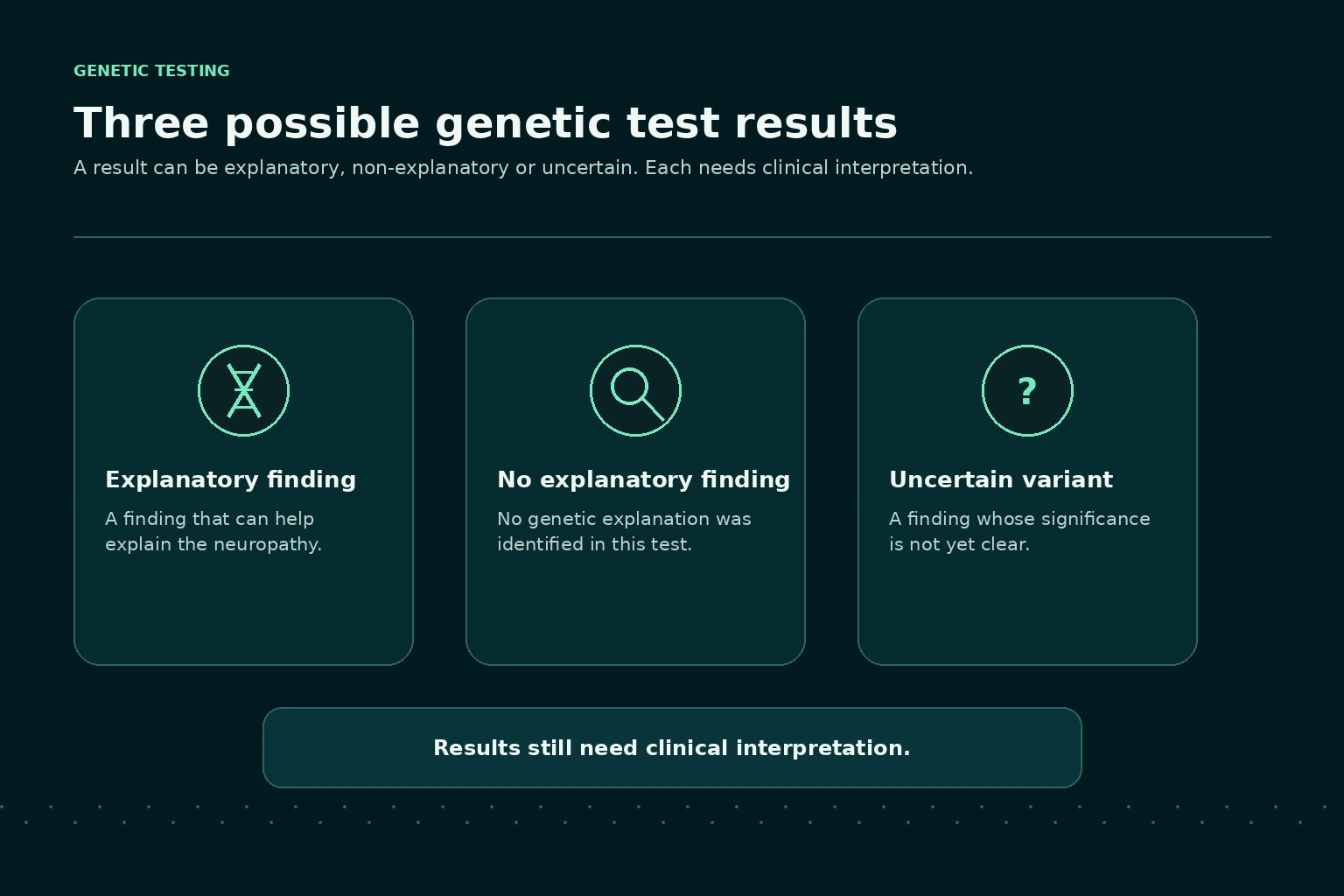
In a study of 220 consecutive people tested with gene panels at two specialist centres in London and Iowa, 30 percent got a definite diagnosis. Another 33 percent had a variant of uncertain significance, a change whose meaning was not clear. The yield was 73 percent in demyelinating neuropathy, where the common PMP22 change had already been ruled out, and 22 percent in the axonal or intermediate types.15
These are expert centres with carefully selected people, so the figures don’t tell you your own chances. What they do show is that a genetic test can give a clear answer, a partial answer or no answer at all.
What can a result mean: positive, negative or uncertain?
Laboratories usually describe a genetic finding with one of five terms from the American College of Medical Genetics and Genomics: pathogenic, likely pathogenic, uncertain significance, likely benign or benign. The same guidance says laboratories suggest that doctors check back with them from time to time, because what is known about a variant of uncertain significance can change.16
MedlinePlus explains that a negative result means the laboratory did not find a change known to affect health, but that a test can miss a disease-causing change because many tests cannot detect every kind of genetic change. The CMT Association says that when testing does not find the genetic cause, this does not rule out Charcot-Marie-Tooth disease; the responsible gene may not have been included in the test, or may not have been discovered yet.17, 12
A clear answer can still help. According to the CMT Association, a result can confirm a clinical diagnosis, identify the subtype, which may matter for research or clinical trials, give insight into medical management and support informed family planning. For HNPP, GeneReviews advises avoiding long periods of pressure on nerves, such as sitting with the legs crossed, and notes that the cancer medicine vincristine has been reported to make HNPP worse.12, 7
Why genetic counselling matters
GeneReviews describes genetic counselling as giving people and families information about the nature, inheritance and implications of genetic disorders, so they can make informed medical and personal decisions. The National Society of Genetic Counselors lists what a counsellor can help with: your genetic risk based on your family history, whether testing might be right for you, what a result may mean for you and your family, and support while you decide.2, 18
MedlinePlus stresses that genetic testing is voluntary, and that deciding whether to be tested is personal and complex. NHGRI notes that a result can have implications for blood relatives, and GeneReviews describes how, once a family’s genetic change is known, relatives at risk can be offered their own testing. The NHS suggests that people who have, or whose partner has, a family history of Charcot-Marie-Tooth disease and are thinking about having a baby see their GP, who can refer them for genetic counselling.19, 11, 10, 20
Rules on how genetic information may be used, for example by insurers or employers, differ from country to country. MedlinePlus describes the US law as one example, and notes that it does not cover life, disability or long-term care insurance. Ask your genetics team what applies where you live before you test.21
What about home DNA tests?
I would not use a consumer DNA kit to answer the neuropathy question. MedlinePlus says further testing through a healthcare provider is usually needed before results from such tests can be used to diagnose a condition or make healthcare decisions. The US Food and Drug Administration says they are not a substitute for a traditional health care evaluation and that not all genetic tests look for all the variants that can contribute to disease.22, 23
The American College of Medical Genetics and Genomics recommends that results be interpreted and delivered by a board-certified genetics professional and warns about misinterpretation. In one US laboratory study of 49 samples sent for confirmation, mostly for cancer-risk genes, 40 percent of the variants reported in consumer raw data were false positives.24, 25
Family history to prepare before your appointment
MedlinePlus suggests gathering health information across three generations, noting when problems started, talking to relatives and using records where you can. Here is how I would adapt that for neuropathy. It is fine to write “don’t know” in places; relatives decide for themselves what they want to share.26

| What to write down | Why it can matter |
|---|---|
| Who: parents, brothers and sisters, children, grandparents, aunts, uncles, cousins, nieces and nephews | Three generations make an inheritance pattern easier to see |
| Anyone with high arches, curled toes, thin lower legs, weak ankles or trouble walking | Foot shape and wasting are classic clues to long-standing, often inherited neuropathy |
| Anyone with repeated numbness or weakness after pressure, such as leaning on an elbow | This pattern can point to HNPP |
| Anyone with balance problems starting in adulthood together with a long-lasting cough | A combination described in the RFC1 condition |
| Neuropathy together with heart problems, and which country or region the family comes from | Relevant to hereditary transthyretin amyloidosis, where risk differs between populations |
| The age when symptoms began, and how fast they changed | Early onset and very slow change fit inherited forms better |
| Diagnoses, nerve tests or genetic results relatives already have | A known family variant makes testing more targeted |
| Other possible causes in relatives, such as diabetes, heavy drinking or chemotherapy | Helps your doctor judge whether a relative’s neuropathy is likely to be inherited |
Questions you could ask
- Does my neuropathy look like an inherited form, and why or why not?
- Which test would you start with, and what would it not be able to find?
- How would the result change my care, or the care of my relatives?
- Can I see a genetic counsellor before and after the test?
- What happens if the result is negative or uncertain? Will an uncertain variant be reviewed again later?
- What rules apply to genetic information and insurance where I live?
I’m not a doctor. I’ve written this from published research and guidance, and to help you prepare questions for your own care.
Sources
- Mirian A, Aljohani Z, Grushka D, Florendo-Cumbermack A. Diagnosis and management of patients with polyneuropathy. CMAJ 2023;195(6):E227–E233. doi:10.1503/cmaj.220936. https://www.cmaj.ca/content/195/6/E227
- Bird TD. Charcot-Marie-Tooth Hereditary Neuropathy Overview. GeneReviews [Internet]. University of Washington, Seattle; initial posting 28 September 1998, last revision 20 November 2025. NBK1358. https://www.ncbi.nlm.nih.gov/books/NBK1358/
- England JD, Gronseth GS, Franklin G, et al. Practice Parameter: Evaluation of distal symmetric polyneuropathy: role of laboratory and genetic testing (an evidence-based review). Neurology 2009;72(2):185–192. doi:10.1212/01.wnl.0000336370.51010.a1. American Academy of Neurology guideline page (reaffirmed 8 February 2025). https://www.aan.com/Guidelines/home/GuidelineDetail/315
- National Institute of Neurological Disorders and Stroke (NINDS). Guillain-Barré Syndrome. Last reviewed 13 March 2026. https://www.ninds.nih.gov/health-information/disorders/guillain-barre-syndrome
- Practical Neurology (US HealthConnect; no author byline shown in the online version). Inherited Neuropathies: Giant Axonal Neuropathy, Charcot-Marie-Tooth Disease, and Hereditary Transthyretin Amyloidosis. Cover Focus, August 2023. https://practicalneurology.com/diseases-diagnoses/neuromuscular/inherited-neuropathies-giant-axonal-neuropathy-charcot-marie-tooth-disease-and-hereditary-transthyretin-amyloidosis/32026/
- National Institute of Neurological Disorders and Stroke (NINDS). Charcot-Marie-Tooth Disease. Last reviewed 2 September 2026. https://www.ninds.nih.gov/health-information/disorders/charcot-marie-tooth-disease
- Chrestian N. Hereditary Neuropathy with Liability to Pressure Palsies. GeneReviews [Internet]. University of Washington, Seattle; last update 27 August 2020. NBK1392. https://www.ncbi.nlm.nih.gov/books/NBK1392/
- Cortese A, Reilly MM, Houlden H. RFC1 CANVAS / Spectrum Disorder. GeneReviews [Internet]. University of Washington, Seattle; initial posting 25 November 2020. NBK564656. https://www.ncbi.nlm.nih.gov/books/NBK564656/
- Currò R, Salvalaggio A, Tozza S, Gemelli C, Dominik N, et al. RFC1 expansions are a common cause of idiopathic sensory neuropathy. Brain 2021;144(5):1542–1550. doi:10.1093/brain/awab072. https://academic.oup.com/brain/article/144/5/1542/6272840
- Sekijima Y, Nakamura K. Hereditary Transthyretin Amyloidosis. GeneReviews [Internet]. University of Washington, Seattle; last update 30 May 2024. NBK1194. https://www.ncbi.nlm.nih.gov/books/NBK1194/
- National Human Genome Research Institute (NHGRI). Genetic Testing FAQ. Last updated 13 February 2019. https://www.genome.gov/FAQ/Genetic-Testing
- Charcot-Marie-Tooth Association. CMT Genetic Testing. Undated. https://cmtausa.org/genetic-testing/
- Pipis M, Rossor AM, Laura M, Reilly MM. Next-generation sequencing in Charcot–Marie–Tooth disease: opportunities and challenges. Nat Rev Neurol 2019;15:644–656. doi:10.1038/s41582-019-0254-5. https://www.nature.com/articles/s41582-019-0254-5
- Record CJ, Pipis M, Skorupinska M, et al. Whole genome sequencing increases the diagnostic rate in Charcot-Marie-Tooth disease. Brain 2024;147(9):3144–3156. doi:10.1093/brain/awae064. https://academic.oup.com/brain/article/147/9/3144/7628356
- Cortese A, Wilcox JE, Polke JM, et al. Targeted next-generation sequencing panels in the diagnosis of Charcot-Marie-Tooth disease. Neurology 2020;94(1). doi:10.1212/WNL.0000000000008672. Author copy (version of record), UCL Discovery. https://discovery-pp.ucl.ac.uk/10088139/1/Cortese_Targeted%20next-generation%20sequencing%20panels%20in%20the%20diagnosis%20of%20Charcot-Marie-Tooth%20disease_VoR.pdf
- Richards S, Aziz N, Bale S, et al. Standards and guidelines for the interpretation of sequence variants: a joint consensus recommendation of the American College of Medical Genetics and Genomics and the Association for Molecular Pathology. Genet Med 2015;17(5):405–423. doi:10.1038/gim.2015.30. https://www.nature.com/articles/gim201530
- MedlinePlus Genetics, US National Library of Medicine. What do the results of genetic tests mean? Last updated 28 July 2021. https://medlineplus.gov/genetics/understanding/testing/interpretingresults/
- National Society of Genetic Counselors. About Genetic Counselors. Undated. https://www.nsgc.org/About/About-Genetic-Counselors
- MedlinePlus Genetics, US National Library of Medicine. What is genetic testing? Last updated 28 July 2021. https://medlineplus.gov/genetics/understanding/testing/genetictesting/
- NHS. Charcot-Marie-Tooth disease. Page last reviewed 5 October 2022 (next review was due 5 October 2025). https://www.nhs.uk/conditions/charcot-marie-tooth-disease/
- MedlinePlus Genetics, US National Library of Medicine. What is genetic discrimination? Last updated 28 July 2021. https://medlineplus.gov/genetics/understanding/testing/discrimination/
- MedlinePlus Genetics, US National Library of Medicine. What is direct-to-consumer genetic testing? Last updated 2 June 2026. https://medlineplus.gov/genetics/understanding/dtcgenetictesting/directtoconsumer/
- US Food and Drug Administration. Direct-to-Consumer Tests. Content current as of 20 December 2019. https://www.fda.gov/medical-devices/in-vitro-diagnostics/direct-consumer-tests
- ACMG Board of Directors. Direct-to-consumer genetic testing: a revised position statement of the American College of Medical Genetics and Genomics. Genet Med 2016;18(2):207–208. doi:10.1038/gim.2015.190. https://www.nature.com/articles/gim2015190
- Tandy-Connor S, Guiltinan J, Krempely K, et al. False-positive results released by direct-to-consumer genetic tests highlight the importance of clinical confirmation testing for appropriate patient care. Genet Med 2018;20(12):1515–1521. doi:10.1038/gim.2018.38. https://www.nature.com/articles/gim201838
- MedlinePlus Genetics, US National Library of Medicine. Why is it important to know my family health history? Last updated 12 May 2021. https://medlineplus.gov/genetics/understanding/inheritance/familyhistory/
Sources checked on 26 September 2026.
Related reading

Restless legs or neuropathy? Similar symptoms, different assessments
Written by someone living with neuropathy: how restless legs syndrome differs from neuropathy, why the two are so often confused, how often they occur together, how each is assessed, and questions to take to your doctor.

Cold feet: nerve symptoms, circulation and when to seek help
Written by someone living with neuropathy: why feet can feel cold without being cold, when cold feet point to circulation instead, the warning signs that need urgent help, and a description aid for your appointment.

Numb hands and weak grip: neuropathy or another nerve problem?
Written by someone living with neuropathy: why numb hands and a weak grip can be a trapped nerve, a neck problem or polyneuropathy, the warning signs, and a description aid to take to your doctor.