
Charcot–Marie–Tooth disease (CMT) is a group of inherited conditions that damage the long nerves running out to the feet, legs, hands and arms. It is the most common inherited neuropathy, affecting roughly 1 in 2,500 people. It usually starts in the feet and lower legs, gets worse slowly, and varies a great deal from person to person, even within one family.1, 2, 3
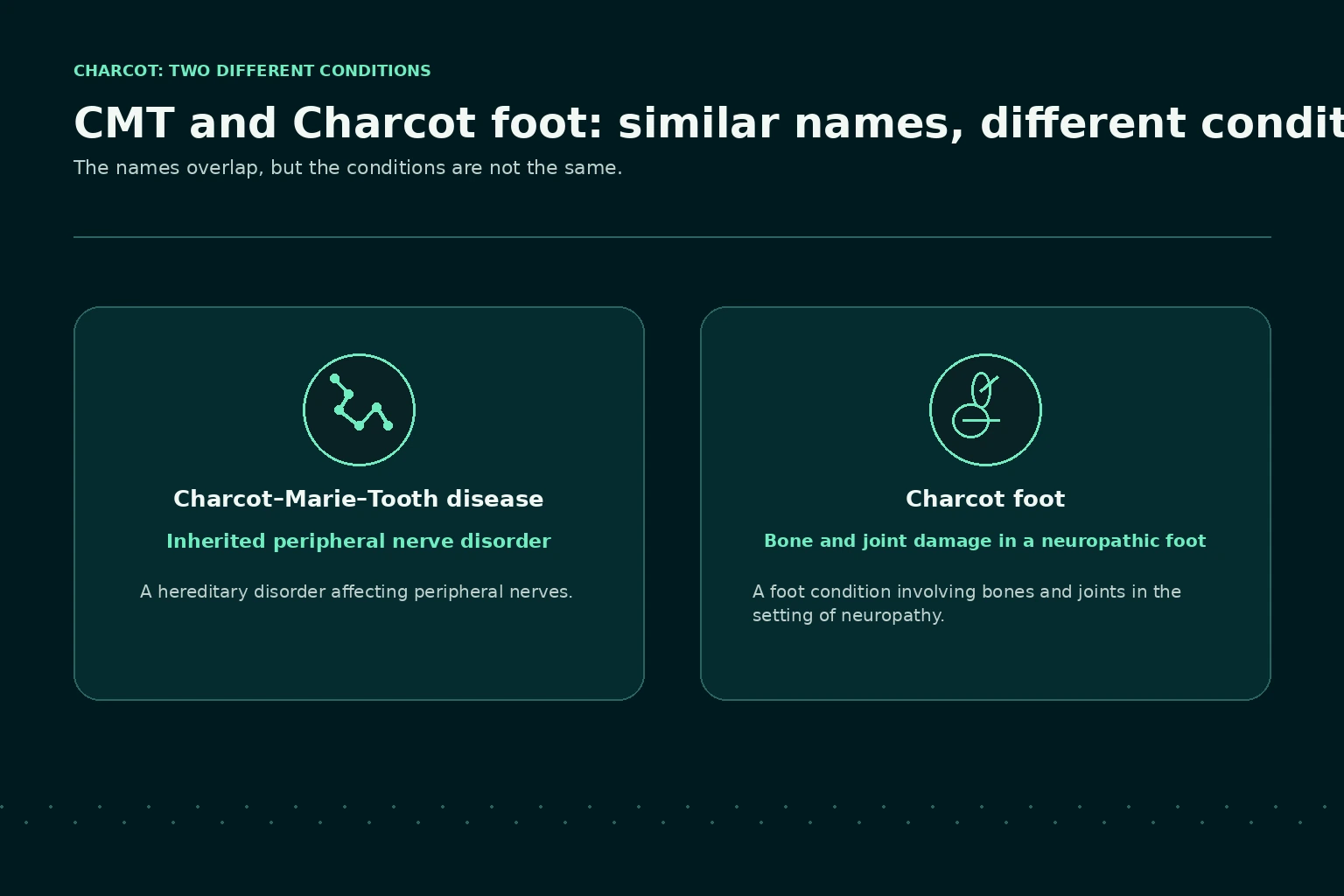
I have neuropathy myself, and I write these pages to make the research easier to read. This page explains what CMT is, how it is inherited and what helps. It also clears up a common mix-up: CMT is not Charcot foot, a foot complication seen mostly in diabetes.
What is Charcot–Marie–Tooth disease?
NINDS, the US neurology institute, describes CMT as a group of genetic conditions that affect the nerves connecting the brain and spinal cord to the rest of the body. It is also called hereditary motor and sensory neuropathy: it affects nerves for both movement and feeling.1, 3
A 2026 review in Nature Reviews Disease Primers says all forms share a progressive loss of nerve fibres, longest nerves first. That causes weakness far out in the limbs, deformities, absent reflexes and reduced feeling.2
CMT1, CMT2 and the other letters
CMT is traditionally sorted by how fast nerve signals travel on a nerve conduction study. In CMT1, the demyelinating type, the insulating myelin is affected, and GeneReviews sets the speed below 35 metres per second. In CMT2, the axonal type, the nerve fibre itself is affected and the speed is above 45. In between is intermediate. My article on axonal and demyelinating neuropathy explains these report words.6
How is CMT inherited?
GeneReviews, a medical genetics reference, says CMT can be inherited in three main ways, and that a change can also arise for the first time in one person.6
- Autosomal dominant. One changed copy of the gene is enough. Each child of a parent with dominant CMT has a 50 percent chance of inheriting it.6
- Autosomal recessive. Both parents pass on a changed copy. Each brother or sister of an affected person has a 25 percent chance of being affected and a 50 percent chance of being a carrier without symptoms.6
- X-linked. The gene sits on the X chromosome. In CMT1X, a father passes the change to all his daughters but to none of his sons. Women tend to be less severely affected than men, and some have no symptoms.7
- De novo (new). The change is new in that person, so there may be no family history. How often this happens depends on the gene.6
Gene, variant and type: the words on a report
A gene carries the instructions for a protein, and a variant is a change in a gene. I say “variant” rather than “mutation”, as GeneReviews speaks of “pathogenic variants”, meaning disease-causing changes. The type, such as CMT1A, names the form a particular change causes.6
- CMT1A (PMP22 duplication). The most common type. An extra copy of the PMP22 gene makes too much of a myelin protein. This duplication accounts for up to half of all CMT.1, 6
- CMT1X (GJB1). The second most common form, caused by variants in the GJB1 gene on the X chromosome, and at least 10 to 20 percent of CMT.1, 7
- CMT2A (MFN2). By far the most common cause of dominant CMT2. It affects the legs more than the arms, and the hands become involved as it progresses.8
- HNPP. A related condition, most often caused by losing one copy of PMP22. It causes repeated episodes of numbness and weakness in single nerves at pressure points, such as near the knee, elbow or wrist. About half of the episodes recover fully over days to months.1, 9
What are the typical symptoms of CMT?
NINDS lists these typical signs:1
- weakness in the feet and lower legs, which can make it hard to lift the foot (foot drop)
- high arches and curled toes (hammer toes)
- trouble feeling heat, cold and touch
- possible weakness and wasting in the hands, making small precise movements hard
- balance problems.
StatPearls, a medical reference, adds tripping, falls, sprained ankles and difficulty with buttons and writing. It says 20 to 30 percent have muscle and joint pain.3
Why does CMT vary so much, even within one family?
NINDS says weakness usually starts in the teens or early adulthood but can appear at any age. The NHS says symptoms often begin between 5 and 15, but sometimes not until middle age or later.1, 10
StatPearls notes big differences both within and between families in age at onset, weakness and loss of feeling. So a parent’s course does not tell you what yours will be.3
The course is usually slow, and GeneReviews says fewer than 5 percent need a wheelchair. The NHS says CMT is not life threatening and most people have a normal life expectancy.6, 10
CMT or Charcot foot: same name, different conditions
Both carry the name of the French neurologist Jean-Martin Charcot. He described nerve-related joint damage in 1868, and “Charcot foot” grew out of a paper he co-wrote in 1883.11
The international diabetes foot guideline IWGDF describes active Charcot neuro-osteoarthropathy as a red, warm, swollen foot with bone changes on imaging, in someone with diabetes and neuropathy. Fractures and dislocations can leave a lasting deformity. It can occur in anyone with peripheral neuropathy, though the guideline is written for diabetes.12
| Feature | Charcot–Marie–Tooth disease (CMT) | Charcot foot (Charcot neuro-osteoarthropathy) |
|---|---|---|
| What it is | A group of inherited nerve diseases | A complication in a foot that already has neuropathy, where bones and joints are damaged |
| Cause | A variant in one of many genes | Neuropathy, most often from diabetes |
| What you notice | Weakness and reduced feeling in the feet and lower legs, later the hands; balance problems | A red, warm, swollen foot, sometimes without pain |
| Foot shape | High arches and curled toes that develop over years | Fractures and dislocations can leave a lasting deformity |
| Time course | Slowly progressive | An active, inflamed phase that needs prompt treatment |
| How urgent | Not an emergency; regular follow-up | Suspected cases referred to a specialist foot service within one working day |
| Main treatment | Exercise, physiotherapy, orthoses, foot surgery for some | Offloading the foot, usually in a non-removable knee-high device |
As I read it, high arches that develop over years belong to CMT. What matters is a new change: a foot that turns warm, swollen or red.
How is CMT diagnosed?
GeneReviews says diagnosis starts with the history, examination and a three-generation family history. NINDS lists nerve conduction studies, electromyography (EMG), genetic testing and sometimes a nerve biopsy.6, 1
A genetic test can confirm the type. GeneReviews recommends testing PMP22 first. My article on genetic testing covers who benefits, uncertain results and what tests miss.6
What helps with CMT today?
NINDS says there is no cure, but treatments can help manage symptoms. The 2026 Nature Reviews article says disease-modifying therapies are not yet available for any form of CMT, and a July 2026 review confirms that none is approved while several are being tested.1, 2, 13
Exercise and physiotherapy
Spanish clinical guidelines from 2025 say studies show benefits of exercise, but there is no agreement on type or amount. Aerobic training improved strength in adults; in children, training the muscles that lift the foot slowed weakness.14
A 2023 systematic review of six trials found moderate-quality evidence only for that effect in children with CMT1A; the rest was low or very low quality.15
GeneReviews describes daily heel-cord stretching to prevent a tight Achilles tendon and gripping exercises for weak hands, and notes that extra weight makes walking harder.6
Orthoses and occupational therapy
GeneReviews says many people need ankle-foot orthoses (AFOs) to correct foot drop and help walking. StatPearls says orthoses improve posture and walking balance, and recommends occupational therapy for daily tasks.6, 3
Surgery
Surgery may be needed for severe high arches, and sometimes for the spine or hips. The Spanish guidelines describe moving a tendon to the top of the foot as a highly effective way to help lift it.6, 3, 14
Pain
For severe nerve pain, doctors may prescribe medicines used for nerve pain; the Spanish guidelines advise avoiding opioids.1, 14
Medicines to be careful with
The US prescribing information for the cancer medicine vincristine says it should not be given to people with the demyelinating form of CMT.16
A 2023 systematic review found that vincristine, and possibly paclitaxel, can occasionally cause more severe nerve damage in CMT, with no convincing evidence for other drugs. The authors stress that people with CMT should not be denied effective treatment, and that nerves should be monitored.17
The CMT Association says medication decisions should be made with a qualified healthcare provider. So tell every doctor who treats you that you have CMT, and please do not stop a prescribed medicine on your own.18
What about research and new medicines?
A Cochrane review of six trials found high-quality evidence that vitamin C (ascorbic acid) does not improve the course of CMT1A in adults. A single, smaller trial in children found no benefit either.19
PXT3003, a combination of baclofen, naltrexone and sorbitol, showed a benefit at the high dose in an earlier trial, but the confirmatory trial, PREMIER, did not meet its main goal.13
NINDS describes research into gene editing, and a clinical trial of the drug govorestat for a form called SORD-CMT. In September 2026 I found no approved medicine that slows CMT.1
Thinking about children or family planning
If CMT runs in your or your partner’s family and you are thinking about a baby, the NHS suggests asking your doctor for a referral to genetic counselling. The 2025 guidelines say counselling should be offered both before and after a genetic test, even when the result is negative. My genetic testing article goes further.10, 14
Living with CMT
The Nature Reviews article says CMT lowers quality of life physically, emotionally and socially, most of all physically.2
Much of what helps happens between appointments: staying active, stretching, using orthoses and keeping a healthy weight, as StatPearls and GeneReviews encourage.3, 6

Those of us who live with neuropathy know slow change is easy to miss. Noting what has become harder over a year, such as stairs or buttons, helps at your next visit.
Questions to take to your appointment
- Which type of CMT do I have, and how was it confirmed?
- How is it inherited in my family, and should relatives be offered counselling?
- Would an ankle-foot orthosis, physiotherapy or occupational therapy help me now?
- Are any of my current or future medicines a concern with CMT?
- Which changes in my feet mean I should contact you straight away?
What remains uncertain
- Why severity differs so much within families. The sources I read describe it but do not explain it.3
- Which exercise works best, and how much. Better trials are needed.14, 15
- Whether any medicine will slow CMT. None is approved, and PXT3003 did not meet its main goal in its confirmatory trial.13
- How risky most nerve-toxic drugs are in CMT. Convincing evidence exists only for vincristine and possibly paclitaxel.17
I’m not a doctor. I’ve written this from published research and guidance, and to help you prepare questions for your own care.
Sources
- National Institute of Neurological Disorders and Stroke (NINDS). Charcot-Marie-Tooth Disease. Last reviewed 2 September 2026. https://www.ninds.nih.gov/health-information/disorders/charcot-marie-tooth-disease
- Burns J, Timmerman V, Laurá M, et al. Charcot–Marie–Tooth disease and related neuropathies. Nature Reviews Disease Primers 2026;12:3. doi:10.1038/s41572-025-00679-2. https://www.nature.com/articles/s41572-025-00679-2
- Nagappa M, Sharma S, Taly AB. Charcot-Marie-Tooth Disease. StatPearls [Internet]. StatPearls Publishing; last updated 22 June 2024. NBK562163. https://www.ncbi.nlm.nih.gov/books/NBK562163/
- National Institute for Health and Care Excellence. Diabetic foot problems: prevention and management. NICE guideline NG19. Published 26 August 2015; last updated 11 October 2019. https://www.nice.org.uk/guidance/ng19/chapter/recommendations
- Mirian A, Aljohani Z, Grushka D, Florendo-Cumbermack A. Diagnosis and management of patients with polyneuropathy. CMAJ 2023;195(6):E227–E233. doi:10.1503/cmaj.220936. https://www.cmaj.ca/content/195/6/E227
- Bird TD. Charcot-Marie-Tooth Hereditary Neuropathy Overview. GeneReviews [Internet]. University of Washington, Seattle; initial posting 28 September 1998, last revision 20 November 2025. NBK1358. https://www.ncbi.nlm.nih.gov/books/NBK1358/
- Abrams CK. GJB1 Disorders: Charcot-Marie-Tooth Neuropathy (CMT1X) and Central Nervous System Phenotypes. GeneReviews [Internet]. University of Washington, Seattle; initial posting 18 June 1998, last revision 25 April 2024. NBK1374. https://www.ncbi.nlm.nih.gov/books/NBK1374/
- Züchner S. MFN2 Hereditary Motor and Sensory Neuropathy. GeneReviews [Internet]. University of Washington, Seattle; initial posting 18 February 2005, last revision 27 March 2025. NBK1511. https://www.ncbi.nlm.nih.gov/books/NBK1511/
- Chrestian N. Hereditary Neuropathy with Liability to Pressure Palsies. GeneReviews [Internet]. University of Washington, Seattle; last update 27 August 2020. NBK1392. https://www.ncbi.nlm.nih.gov/books/NBK1392/
- NHS. Charcot-Marie-Tooth disease. Page last reviewed 5 October 2022 (next review was due 5 October 2025). https://www.nhs.uk/conditions/charcot-marie-tooth-disease/
- Sanders LJ, Edmonds ME, Jeffcoate WJ. Who was first to diagnose and report neuropathic arthropathy of the foot and ankle: Jean-Martin Charcot or Herbert William Page? Diabetologia 2013;56:1873–1877. doi:10.1007/s00125-013-2961-6. https://link.springer.com/article/10.1007/s00125-013-2961-6
- Wukich DK, et al.; International Working Group on the Diabetic Foot. Guidelines on the diagnosis and treatment of active Charcot neuro-osteoarthropathy in persons with diabetes mellitus (IWGDF 2023). Diabetes/Metabolism Research and Reviews 2024;40(3):e3646. doi:10.1002/dmrr.3646. https://iwgdfguidelines.org/wp-content/uploads/2023/07/IWGDF-2023-08-Charcot-Guideline.pdf
- Park JM. Update on Charcot-Marie-Tooth Disease: Evolving Genetic Classification, Trial Readiness, and Emerging Therapies. Annals of Clinical Neurophysiology, published 29 July 2026. doi:10.14253/acn.26002. https://www.e-acn.org/journal/view.php?doi=10.14253%2Facn.26002
- Sivera Mascaró R, et al. Clinical practice guidelines for the diagnosis and management of Charcot-Marie-Tooth disease. Neurología (English Edition) 2025;40(3):290–305. doi:10.1016/j.nrleng.2024.02.008. https://www.sciencedirect.com/science/article/pii/S2173580824000476
- Conde RM, Senem I, Dos Santos M, de Lima Osório F, Marques Júnior W. Effectiveness of exercise therapy for individuals diagnosed with Charcot–Marie–Tooth disease: A systematic review of randomized clinical trials. Journal of the Peripheral Nervous System 2023;28(2):169–178. doi:10.1111/jns.12548. https://onlinelibrary.wiley.com/doi/10.1111/jns.12548
- Hospira, Inc. Vincristine Sulfate Injection, USP – prescribing information. DailyMed, US National Library of Medicine; label revised December 2025. https://dailymed.nlm.nih.gov/dailymed/drugInfo.cfm?setid=49596de6-ab18-49d1-9e5b-30968fc21c36
- Cavaletti G, Forsey K, Alberti P. Toxic medications in Charcot–Marie–Tooth patients: A systematic review. Journal of the Peripheral Nervous System 2023;28(3):295–307. doi:10.1111/jns.12566. Copy hosted by the CMT Association. https://cmtausa.org/wp-content/uploads/2025/12/J-Peripheral-Nervous-Sys-2023-Cavaletti-Toxic-medications-in-Charcot-Marie-Tooth-patients-A-systematic-review.pdf
- Charcot–Marie–Tooth Association (CMTA). Neurotoxic Medications. Undated. https://cmtausa.org/neurotoxic-medications/
- Gess B, Baets J, De Jonghe P, Reilly MM, Pareyson D, Young P. Ascorbic acid for the treatment of Charcot-Marie-Tooth disease. Cochrane Database of Systematic Reviews, 11 December 2015, CD011952 (Cochrane summary). https://www.cochrane.org/evidence/CD011952_vitamin-c-charcot-marie-tooth-cmt-disease-hereditary-motor-and-sensory-neuropathy
Sources checked on 26 September 2026.
Related reading

Restless legs or neuropathy? Similar symptoms, different assessments
Written by someone living with neuropathy: how restless legs syndrome differs from neuropathy, why the two are so often confused, how often they occur together, how each is assessed, and questions to take to your doctor.

Cold feet: nerve symptoms, circulation and when to seek help
Written by someone living with neuropathy: why feet can feel cold without being cold, when cold feet point to circulation instead, the warning signs that need urgent help, and a description aid for your appointment.

Numb hands and weak grip: neuropathy or another nerve problem?
Written by someone living with neuropathy: why numb hands and a weak grip can be a trapped nerve, a neck problem or polyneuropathy, the warning signs, and a description aid to take to your doctor.