Burning feet at night can make it hard to fall asleep and even harder to stop worrying. I have neuropathy myself, so I know how long those hours can feel. The short answer is that burning feet have several possible causes. Nerve damage in the feet (peripheral neuropathy) is the most common one, but a skin infection, a trapped nerve at the ankle, a circulation problem or a rare condition called erythromelalgia can also be behind it. The burning itself does not tell you which. That takes an assessment.1, 3, 17
This page won’t diagnose you. What it can do is explain why the burning often feels worse in bed, why ice and heat are risky ways to cope, and what to write down before you see a doctor.
Why do burning feet at night feel worse in bed?
You are not imagining the pattern. The US National Institute of Neurological Disorders and Stroke (NINDS) says neuropathic pain is sometimes worse at night and can disrupt sleep. It also notes that some people feel pain from the touch of their bedsheets. Advice and clinical reviews on diabetic nerve pain say the symptoms are often worse at night.6, 7, 9
A 2024 review on diabetic nerve pain describes studies where pain intensity rose gradually from morning to evening. It cites a survey in which more than half of the people asked had more pain at night. The authors are open that the reasons still need more research.10 In daily life, the evening is also when there is less to distract you, and when your feet are under warm covers. Those are reasonable guesses, not proven explanations.
Poor sleep and pain can also feed each other. A 2025 review of sleep and nerve pain describes how neuropathic pain often makes it harder to fall asleep and causes more night waking, while poor sleep in turn can lower pain thresholds.11

Neuropathy is one possibility, not the only one
Mayo Clinic writes that burning feet are most often a sign of peripheral neuropathy.1 That is worth knowing, but it does not mean every burning foot is neuropathy. The same sources list several other causes.
When the nerves are the cause
Nerve-related burning usually starts in the toes or soles of both feet and can spread slowly upwards. According to a 2023 review in the Canadian Medical Association Journal (CMAJ), the most common causes of polyneuropathy are diabetes, a history of heavy alcohol use, kidney problems and some medicines, including chemotherapy.5
NINDS and Mayo Clinic add low vitamin B12, an underactive thyroid, HIV and inherited conditions such as Charcot-Marie-Tooth disease.1, 6
Burning is especially typical when the thinnest nerve fibres are affected, called small fiber neuropathy. A clinical review describes burning pain in the feet as often the most bothersome symptom, frequently worst at night, with sheets or clothes against the skin feeling painful.8
Other things that can make feet burn
- Athlete’s foot, a fungal skin infection, is on Mayo Clinic’s list of causes of burning feet.1
- Tarsal tunnel syndrome, where a nerve is squeezed on the inside of the ankle.1
- Erythromelalgia, a rare condition with burning pain, redness and hot skin, mainly in the feet. Flares are often triggered by warmth and often come at night.12, 13
- Poor circulation (peripheral arterial disease). In its most serious form it causes a burning pain in the feet even at rest. That pain is often worse when lying flat, can wake you at night and may ease if you hang your leg over the edge of the bed.17, 18
- Other causes named by Cleveland Clinic include Morton’s neuroma, poorly fitting shoes and skin reactions to materials (contact dermatitis).3
Restless legs syndrome is worth mentioning because it also peaks at night. The main feature there is a strong urge to move your legs, with sensations such as aching, pulling or crawling that ease when you move.20, 21
A clinical review notes that people with small fiber neuropathy may also describe restless legs at night, so the two can be hard to tell apart on your own.8
What if your nerve test was normal?
Standard nerve conduction studies measure the larger nerve fibres. The small fibres that carry pain and temperature cannot be captured by that test. The CMAJ review states that people with purely small-fibre neuropathy will have normal results on these electrical tests.5, 8
So a normal result rules out some things, but it does not settle the question of burning feet on its own. Other tests, such as a small skin biopsy, are sometimes used to look at the thin fibres.8 I’ve written more about this in a separate article on normal nerve tests.
Why ice, cold water and heat can be risky
When your feet burn at 2 a.m., it is tempting to put them in cold water or on something icy. The sources are clear that this can cause harm. For erythromelalgia, the NHS advises using a fan or a cool (not cold) gel pack for a short time, and not cooling your feet with cold water or ice, because this can damage your skin.13
A clinical review describes how repeated ice-water soaking can lead to softened skin, infection, ulcers and, in severe cases, tissue death.12
Heat carries its own risk. If your feet have reduced feeling, you may not notice when water or a heat source is too hot. Foot-care advice for people with diabetes says not to use a hot water bottle or heating pad on your feet, and to test bath water with your hand, elbow or a thermometer first. For people with diabetes at risk of foot problems, the international diabetic foot guideline (IWGDF) says water for washing feet should always be below 37°C.14, 15, 16 I think the same caution makes sense for anyone whose feet burn or feel numb.
Some gentler steps are mentioned in the sources. Advice for people with diabetic nerve damage suggests a bed cradle that keeps sheets and blankets off the feet, and checking your feet every day for cuts, blisters and red areas so you spot problems early.7, 14, 16
What can a doctor do about burning feet?
The first aim is to find and treat the cause where possible. A clinical review stresses treating the underlying cause of small fiber neuropathy, and NINDS notes that some neuropathies can improve when the cause is corrected.6, 8
For the pain itself, the UK’s NICE guideline on neuropathic pain lists a few medicines as initial options: amitriptyline, duloxetine, gabapentin or pregabalin. It also mentions capsaicin cream for people with pain in a limited area who want to avoid tablets.22 Which option suits you depends on your other conditions and medicines, so that is a conversation for you and your doctor. I won’t give doses or suggest changes here.
A night log to take to your appointment
A few nights of notes can say more than trying to remember everything in a short appointment. The questions below follow what the sources say doctors ask about.2, 4
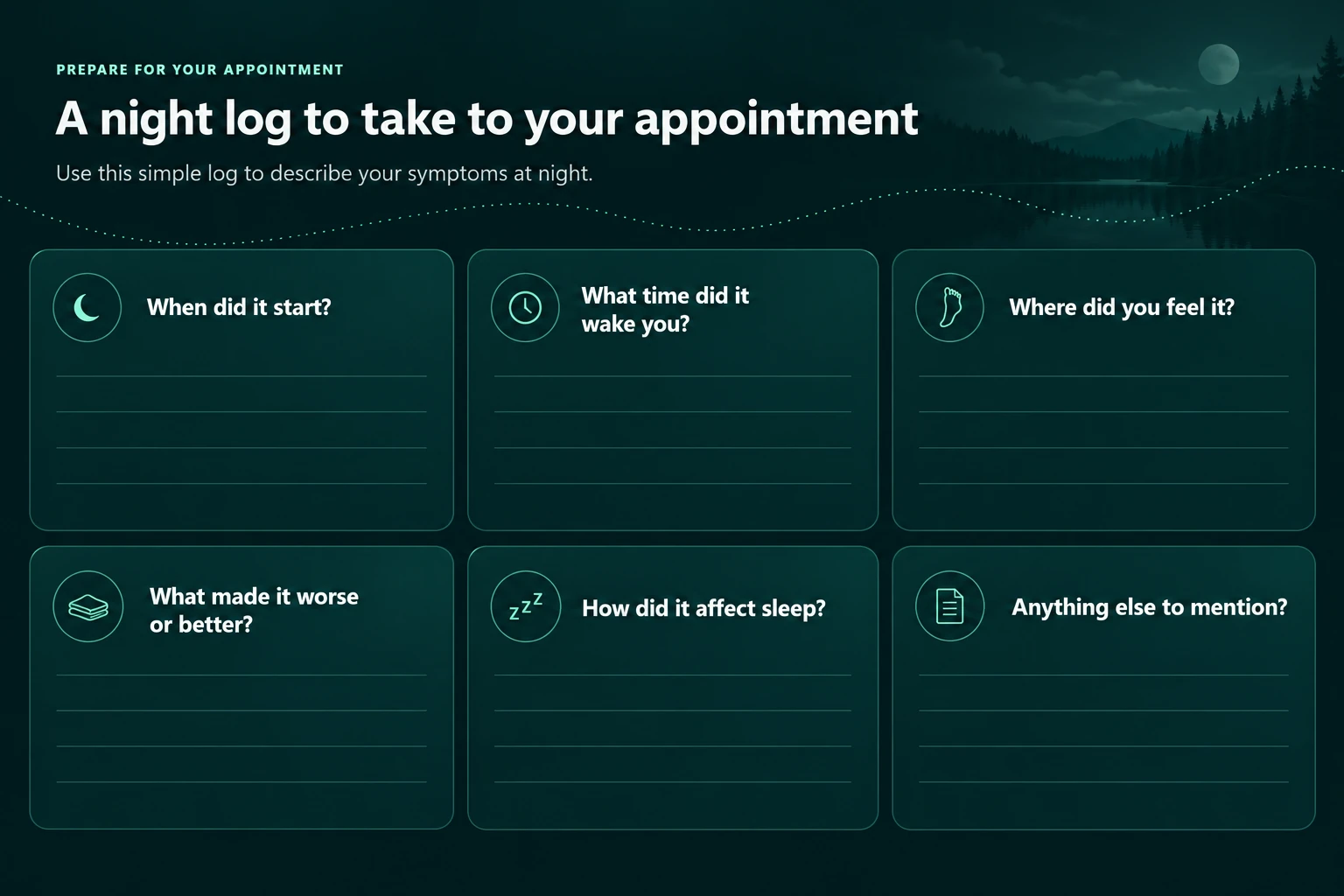
| What to note | Examples |
|---|---|
| Where it burns | Toes, soles, heels, between the toes, one foot or both, how far up the leg |
| When it starts and ends | Evening, when you lie down, after a few hours of sleep, better in the morning |
| What the skin looks like | Red, hot, pale, cold, dry or cracked skin, itching between the toes, wounds |
| What changes it | Walking, standing, hanging your leg over the bed, bedcovers, warmth, cooling |
| Other symptoms | Numbness, weakness, poor balance, an urge to move your legs, symptoms in your hands |
| Background | Diabetes, kidney or thyroid disease, alcohol, all medicines and supplements, chemotherapy, family history |
| Sleep | How long it takes to fall asleep, how often you wake, how you feel during the day |
Mayo Clinic suggests booking an appointment if the burning continues after several weeks, is getting stronger, has started to spread up your legs, or if you start losing feeling in your toes or feet.2
I’m not a doctor. I’ve written this from published research and guidance, and to help you prepare questions for your own care.
Sources
- Mayo Clinic Staff. Burning feet: Causes. Mayo Clinic, 11 January 2018. https://www.mayoclinic.org/symptoms/burning-feet/basics/causes/sym-20050809
- Mayo Clinic Staff. Burning feet: When to see a doctor. Mayo Clinic, 11 January 2018. https://www.mayoclinic.org/symptoms/burning-feet/basics/when-to-see-doctor/sym-20050809
- Cleveland Clinic. Burning Feet (Grierson-Gopalan) Syndrome. Last reviewed 17 July 2023. https://my.clevelandclinic.org/health/symptoms/17773-burning-feet-syndrome
- Castelli G, Desai KM, Cantone RE. Peripheral Neuropathy: Evaluation and Differential Diagnosis. American Family Physician 2020;102(12):732–739, 15 December 2020. https://www.aafp.org/pubs/afp/issues/2020/1215/p732.html
- Mirian A, Aljohani Z, Grushka D, Florendo-Cumbermack A. Diagnosis and management of patients with polyneuropathy. CMAJ 2023;195(6):E227–E233, 13 February 2023. https://www.cmaj.ca/content/195/6/E227
- National Institute of Neurological Disorders and Stroke (NINDS). Peripheral Neuropathy. Last reviewed 13 March 2026. https://www.ninds.nih.gov/health-information/disorders/peripheral-neuropathy
- National Institute of Diabetes and Digestive and Kidney Diseases (NIDDK). Peripheral Neuropathy. Last reviewed February 2018. https://www.niddk.nih.gov/health-information/diabetes/overview/preventing-problems/nerve-damage-diabetic-neuropathies/peripheral-neuropathy
- Cascio MA, Mukhdomi T. Small Fiber Neuropathy. StatPearls Publishing (NCBI Bookshelf), updated 12 December 2022. https://www.ncbi.nlm.nih.gov/books/NBK582147/
- Bodman MA, Dreyer MA, Varacallo MA. Diabetic Peripheral Neuropathy. StatPearls Publishing (NCBI Bookshelf), updated 25 February 2024. https://www.ncbi.nlm.nih.gov/books/NBK442009/
- Yang B, Wei W, Fang J, Xue Y, Wei J. Diabetic Neuropathic Pain and Circadian Rhythm: A Future Direction Worthy of Study. Journal of Pain Research 2024;17:3005–3020. https://www.dovepress.com/diabetic-neuropathic-pain-and-circadian-rhythm-a-future-direction-wort-peer-reviewed-fulltext-article-JPR
- Ho A, Drew VJ, Kim T. What Links Sleep and Neuropathic Pain?: A Literature Review on the Neural Circuits for Sleep and Pain Control. Nature and Science of Sleep 2025;17:813–838. https://www.dovepress.com/what-links-sleep-and-neuropathic-pain-a-literature-review-on-the-neura-peer-reviewed-fulltext-article-NSS
- Jha SK, Karna B, Goodman MB. Erythromelalgia. StatPearls Publishing (NCBI Bookshelf), updated 1 May 2023. https://www.ncbi.nlm.nih.gov/books/NBK557787/
- NHS. Erythromelalgia. Page last reviewed 18 August 2023. https://www.nhs.uk/conditions/erythromelalgia/
- National Institute of Diabetes and Digestive and Kidney Diseases (NIDDK). Diabetes & Foot Problems. Reviewed January 2017. https://www.niddk.nih.gov/health-information/diabetes/overview/preventing-problems/foot-problems
- MedlinePlus (US National Library of Medicine). Diabetes – taking care of your feet. Reviewed 18 May 2026. https://medlineplus.gov/ency/patientinstructions/000081.htm
- Schaper NC, van Netten JJ, Apelqvist J, et al. Practical guidelines on the prevention and management of diabetes-related foot disease (IWGDF 2023 update). International Working Group on the Diabetic Foot, 2023. https://iwgdfguidelines.org/wp-content/uploads/2023/07/IWGDF-2023-01-Practical-Guidelines.pdf
- NHS. Peripheral arterial disease (PAD). Page last reviewed 10 April 2026. https://www.nhs.uk/conditions/peripheral-arterial-disease-pad/
- Cleveland Clinic. Chronic Limb-Threatening Ischemia. Last reviewed 3 March 2026. https://my.clevelandclinic.org/health/diseases/23120-critical-limb-ischemia
- Cleveland Clinic. Acute Limb Ischemia (ALI). Last reviewed 6 November 2025. https://my.clevelandclinic.org/health/diseases/acute-limb-ischemia
- National Institute of Neurological Disorders and Stroke (NINDS). Restless Legs Syndrome. Last reviewed 13 March 2026. https://www.ninds.nih.gov/health-information/disorders/restless-legs-syndrome
- NHS. Restless legs syndrome. Page last reviewed 22 September 2025. https://www.nhs.uk/conditions/restless-legs-syndrome/
- National Institute for Health and Care Excellence (NICE). Neuropathic pain in adults: pharmacological management in non-specialist settings (CG173). NCBI Bookshelf copy, last updated 22 September 2020. https://www.ncbi.nlm.nih.gov/books/NBK552848/
Sources checked on 24 September 2026.
Related reading

Restless legs or neuropathy? Similar symptoms, different assessments
Written by someone living with neuropathy: how restless legs syndrome differs from neuropathy, why the two are so often confused, how often they occur together, how each is assessed, and questions to take to your doctor.

Cold feet: nerve symptoms, circulation and when to seek help
Written by someone living with neuropathy: why feet can feel cold without being cold, when cold feet point to circulation instead, the warning signs that need urgent help, and a description aid for your appointment.

Numb hands and weak grip: neuropathy or another nerve problem?
Written by someone living with neuropathy: why numb hands and a weak grip can be a trapped nerve, a neck problem or polyneuropathy, the warning signs, and a description aid to take to your doctor.