
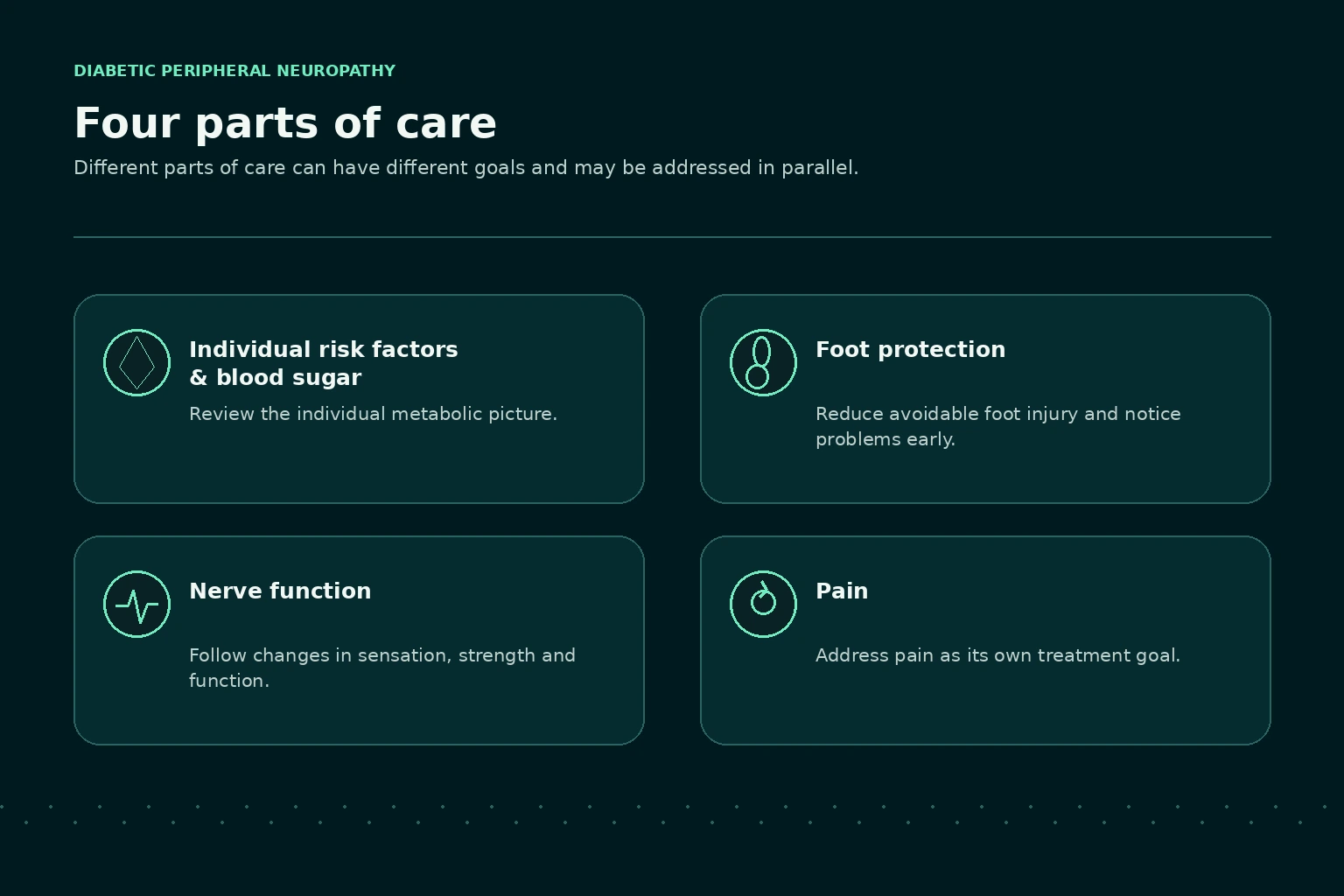
Diabetic peripheral neuropathy is nerve damage caused by diabetes, usually starting in both feet with numbness, tingling, burning or pain. It is common: a Canadian review estimates that about 40 to 50 percent of people with diabetes develop a detectable neuropathy within ten years. As I read the guidance, care has four separate goals: steady glucose, protected feet, followed nerve function and pain relief that improves daily life.1, 2
I have neuropathy myself, and I write these pages so that it is easier to see the whole picture and ask good questions. This page gives the overview. Other pages on this site go deeper into foot care, individual pain medicines and neuropathy that is not caused by diabetes.
What is diabetic peripheral neuropathy?
The US National Institute of Diabetes and Digestive and Kidney Diseases (NIDDK) describes peripheral neuropathy as nerve damage that typically affects the feet and legs and sometimes the hands and arms, and says up to one-half of people with diabetes have it. A review in Nature Reviews Disease Primers describes the typical pattern as a loss of feeling that begins furthest from the body in the legs.6, 7
The American Diabetes Association (ADA) Standards of Care for 2026 note that up to half of cases may cause no symptoms at all. As I understand it, that is why the checks below matter even if your feet feel fine.1
Symptoms of diabetic neuropathy
NIDDK lists burning, tingling like pins and needles, numbness, pain and weakness, and says the symptoms are often worse at night. Loss of feeling and loss of balance can follow. StatPearls, a medical reference, describes how some people have severe pain that is worse at night.6, 8
Diabetes can also affect the autonomic nerves, which run the body’s automatic functions. Mayo Clinic mentions losing the usual warning signs of low blood sugar and drops in blood pressure when you stand up, and a review in Endotext adds problems such as a slow-emptying stomach, erectile dysfunction and changes in sweating. These are worth mentioning to your diabetes team even if they seem unrelated to your feet.9, 10
Not every neuropathy in diabetes is diabetic neuropathy
This is easy to miss. The Endotext review stresses that other causes, such as chronic inflammatory demyelinating polyneuropathy (CIDP) or a monoclonal gammopathy, should be excluded, and the CMAJ review includes vitamin B12 among the basic tests for polyneuropathy.10, 2
B12 matters especially if you take metformin. The UK medicines regulator MHRA describes low vitamin B12 as a common side effect of metformin and advises testing B12 when a deficiency is suspected, for example in someone on metformin who develops new neuropathy. The ADA 2026 standards also list B12 deficiency, especially with long-term metformin, among the other causes of neuropathy to consider. I would never stop a diabetes medicine on my own because of this; it is a question to raise.11, 1
Can you prevent diabetic neuropathy? Glucose and other risk factors
Glucose control matters, but the effect differs between the two main types of diabetes. A Cochrane review found that tighter glucose control clearly lowered the risk of developing neuropathy in type 1 diabetes. In type 2 diabetes the effect was smaller and not statistically certain. The same review found that tighter control increased the risk of severe low blood sugar, so as I read it the target needs to be set for you personally.12
The Nature Reviews authors put it this way: glucose control effectively halts progression in type 1 diabetes, while the effect is more modest in type 2. The ADA 2026 standards describe the effect in type 2 as a modest slowing of progression without reversal of the nerve loss.7, 1
Other factors count too. NIDDK advises managing blood glucose, blood pressure and cholesterol, and Mayo Clinic lists smoking, overweight, kidney disease and a long duration of diabetes among the risk factors. As I read it, prevention in type 2 diabetes is about the whole picture, not blood sugar alone.6, 9
Exercise is being studied as well. A review in Current Diabetes Reports describes possible benefits of aerobic exercise and of spending less time sitting, based on animal studies and early human trials. I read that as a reason to stay active in a way that suits your feet, not as a proven nerve treatment.13
Protecting your feet
This is where diabetic neuropathy differs most from many other neuropathies. NIDDK explains that when you lose feeling, you may not notice a pebble in your sock or a blister, which can lead to sores. Endotext notes that the risk of a first foot ulcer is seven times higher with moderate to severe loss of sensation.14, 5
The IWGDF guideline builds prevention on five parts: identifying the at-risk foot, regular inspection and examination, education, suitable footwear and treatment of risk factors. It encourages people with any raised risk to wash and check their feet daily.4
Your feet should be examined at diagnosis and at least once a year, according to NICE. The check includes a 10-gram monofilament test of foot sensation. How often after that depends on your risk: NICE suggests every three to six months at moderate risk and every one to two months at high risk. IWGDF uses a slightly different scale, so ask which system your clinic follows and which risk group you are in.3, 4

Treatment goals for painful diabetic neuropathy
Here I think it helps to be realistic. The American Academy of Neurology guideline says a pain reduction of about 30 percent is considered a success in clinical trials, and that the goal of treatment is to reduce, and not necessarily to eliminate, pain. It also asks doctors to look for mood and sleep problems, and advises against opioids for this condition.15
The medicine groups most often named are certain antidepressants (tricyclics and SNRIs), gabapentinoids and sodium-channel blockers. NICE CG173 offers a choice of amitriptyline, duloxetine, gabapentin or pregabalin as a first treatment for neuropathic pain, and capsaicin cream for localised pain in people who want to avoid oral medicines. Which one fits depends on your other conditions and side effects, and separate pages on this site cover the individual medicines.15, 16
The UK OPTION-DM trial compared three treatment pathways built from these medicines. On average, pain fell from 6.6 to 3.3 out of 10 in all three. In people whose pain was not controlled well enough on one medicine, adding a second lowered pain by about one more point, against 0.2 points for staying on one. The pathways worked about equally well and differed mainly in side effects, such as dizziness, nausea and dry mouth.17
What I think is most important: NIDDK notes that these medicines do not change the nerve damage, and Endotext says that apart from glucose and cardiovascular risk management there is no approved treatment to prevent or reverse diabetic neuropathy. Pain relief and nerve protection are two different goals.6, 10
A goals matrix for diabetic peripheral neuropathy
This is my own summary of how the four areas fit together. It is a way to organise questions for your care team, not a plan to follow on your own.
| Area | The goal | What is realistic | What is checked | How often |
|---|---|---|---|---|
| Glucose and risk factors | Lower the risk that neuropathy starts or gets worse | Clear benefit in type 1; smaller and less certain in type 2; avoid severe low blood sugar | HbA1c against a personal target, blood pressure, blood fats, smoking | At your regular diabetes reviews |
| Feet | Prevent sores, ulcers and amputation, and catch Charcot foot early | Risk can be graded and lowered with daily checks, footwear and education | Monofilament and other sensation tests, pulses, skin, foot shape, your risk group | At least yearly; more often at higher risk; your own check daily |
| Nerve function | Find neuropathy early and rule out other causes | Damage is usually not reversed; the aim is to find it and slow it | Sensation, balance, autonomic symptoms, vitamin B12 if you take metformin | ADA: from diagnosis of type 2, from five years after type 1, then at least yearly |
| Pain | Less pain, better sleep and daily function | About 30 percent less pain counts as success; the aim is to reduce pain, not necessarily remove it | Pain, sleep, daily activities, mood, side effects, whether treatment is still needed | At each review after starting or changing treatment |
NICE CG173 lists what each review of pain treatment should cover: pain control, the effect on daily life including sleep, physical and mental wellbeing, side effects and whether treatment is still needed. I find it useful to go through the same list before an appointment.16
Questions you could ask
- Do my symptoms fit diabetic neuropathy, or should other causes be checked?
- Has my vitamin B12 been checked, given that I take metformin?
- What is my personal HbA1c target, and how do we avoid low blood sugar?
- Which foot risk group am I in, and how often should my feet be examined?
- What should I look for when I check my feet, and who do I call if I find something?
- What would count as success for my pain treatment, and when do we review it?
- Could some of my other symptoms, such as dizziness on standing or stomach problems, be related?
I’m not a doctor. I’ve written this from published research and guidance, and to help you prepare questions for your own care.
Sources
- American Diabetes Association Professional Practice Committee for Diabetes. 12. Retinopathy, Neuropathy, and Foot Care: Standards of Care in Diabetes – 2026. Diabetes Care 2026;49(Suppl. 1):S261–S276. doi:10.2337/dc26-S012. https://doi.org/10.2337/dc26-S012
- Mirian A, Aljohani Z, Grushka D, Florendo-Cumbermack A. Diagnosis and management of patients with polyneuropathy. CMAJ 2023;195(6):E227–E233. doi:10.1503/cmaj.220936. https://www.cmaj.ca/content/195/6/E227
- National Institute for Health and Care Excellence. Diabetic foot problems: prevention and management. NICE guideline NG19. Published 26 August 2015; last updated 11 October 2019. https://www.nice.org.uk/guidance/ng19/chapter/recommendations
- Schaper NC, van Netten JJ, Apelqvist J, Bus SA, Fitridge R, Game F, Monteiro-Soares M, Senneville E; IWGDF Editorial Board. Practical guidelines on the prevention and management of diabetes-related foot disease (IWGDF 2023 update). Diabetes/Metabolism Research and Reviews 2024;40(3):e3657. doi:10.1002/dmrr.3657. https://iwgdfguidelines.org/wp-content/uploads/2023/07/IWGDF-2023-01-Practical-Guidelines.pdf
- Boulton AJM, Whitehouse RW. The Diabetic Foot. In: Feingold KR, et al., editors. Endotext. MDText.com; updated 28 July 2023. NBK409609. https://www.ncbi.nlm.nih.gov/books/NBK409609/
- National Institute of Diabetes and Digestive and Kidney Diseases (NIDDK). Peripheral Neuropathy. Last reviewed February 2018. https://www.niddk.nih.gov/health-information/diabetes/overview/preventing-problems/nerve-damage-diabetic-neuropathies/peripheral-neuropathy
- Feldman EL, Callaghan BC, Pop-Busui R, Zochodne DW, Wright DE, Bennett DL, Bril V, Russell JW, Viswanathan V. Diabetic neuropathy. Nature Reviews Disease Primers 2019;5:41. doi:10.1038/s41572-019-0092-1. https://www.nature.com/articles/s41572-019-0092-1
- Bodman MA, Dreyer MA, Varacallo MA. Diabetic Peripheral Neuropathy. StatPearls [Internet]. StatPearls Publishing; updated 25 February 2024. NBK442009. https://www.ncbi.nlm.nih.gov/books/NBK442009/
- Mayo Clinic. Diabetic neuropathy – Symptoms and causes. https://www.mayoclinic.org/diseases-conditions/diabetic-neuropathy/symptoms-causes/syc-20371580
- Anandhanarayanan A, Teh K, Goonoo M, Tesfaye S, Selvarajah D. Diabetic Neuropathies. In: Feingold KR, et al., editors. Endotext. MDText.com; updated 15 March 2022. NBK279175. https://www.ncbi.nlm.nih.gov/books/NBK279175/
- Medicines and Healthcare products Regulatory Agency (MHRA). Metformin and reduced vitamin B12 levels: new advice for monitoring patients at risk. Drug Safety Update, 20 June 2022. https://www.gov.uk/drug-safety-update/metformin-and-reduced-vitamin-b12-levels-new-advice-for-monitoring-patients-at-risk
- Callaghan BC, Little AA, Feldman EL, Hughes RAC. Enhanced glucose control for preventing and treating diabetic neuropathy. Cochrane Database of Systematic Reviews 2012;(6):CD007543. doi:10.1002/14651858.CD007543.pub2. https://www.cochrane.org/CD007543/ENDOC_enhanced-glucose-control-for-preventing-and-treating-diabetic-neuropathy
- Singleton JR, Smith AG, Marcus RL. Exercise as Therapy for Diabetic and Prediabetic Neuropathy. Current Diabetes Reports 2015;15:120. doi:10.1007/s11892-015-0682-6. https://link.springer.com/article/10.1007/s11892-015-0682-6
- National Institute of Diabetes and Digestive and Kidney Diseases (NIDDK). Diabetes & Foot Problems. Last reviewed January 2017. https://www.niddk.nih.gov/health-information/diabetes/overview/preventing-problems/foot-problems
- Price R, Smith D, Franklin G, et al. Oral and Topical Treatment of Painful Diabetic Polyneuropathy: Practice Guideline Update Summary: Report of the AAN Guideline Subcommittee. Neurology 2022;98(1):31–43. doi:10.1212/WNL.0000000000013038. https://www.aan.com/Guidelines/home/GetGuidelineContent/1055
- National Institute for Health and Care Excellence. Neuropathic pain in adults: pharmacological management in non-specialist settings. Clinical guideline CG173. Published 20 November 2013; last updated April 2025. https://www.nice.org.uk/guidance/cg173
- Tesfaye S, Sloan G, Petrie J, et al. Optimal pharmacotherapy pathway in adults with diabetic peripheral neuropathic pain: the OPTION-DM RCT. Health Technology Assessment 2022;26(39):1–100. doi:10.3310/rxuo6757. See also Lancet 2022;400:680–690, doi:10.1016/S0140-6736(22)01472-6. https://www.ncbi.nlm.nih.gov/books/NBK585241/
Sources checked on 26 September 2026.
Related reading

Restless legs or neuropathy? Similar symptoms, different assessments
Written by someone living with neuropathy: how restless legs syndrome differs from neuropathy, why the two are so often confused, how often they occur together, how each is assessed, and questions to take to your doctor.

Cold feet: nerve symptoms, circulation and when to seek help
Written by someone living with neuropathy: why feet can feel cold without being cold, when cold feet point to circulation instead, the warning signs that need urgent help, and a description aid for your appointment.

Numb hands and weak grip: neuropathy or another nerve problem?
Written by someone living with neuropathy: why numb hands and a weak grip can be a trapped nerve, a neck problem or polyneuropathy, the warning signs, and a description aid to take to your doctor.