
Autonomic testing in neuropathy checks the nerves that run the body’s automatic work: heart rate, blood pressure and sweating. A standard set usually includes slow deep breathing, blowing hard against resistance, a tilt table or standing test, and a sweat test, while your heart rate and blood pressure are recorded beat by beat. As I understand it, the tests show whether these nerves are affected, which parts and roughly how much. They do not show why.1, 2
I have neuropathy myself, and the word “autonomic” confused me for a long time. This page explains what each test looks at, what it feels like, how results are read and what they cannot tell you. The wider question of how neuropathy is diagnosed, and the skin biopsy for small nerve fibres, have their own pages on this site.
What does the autonomic nervous system do?
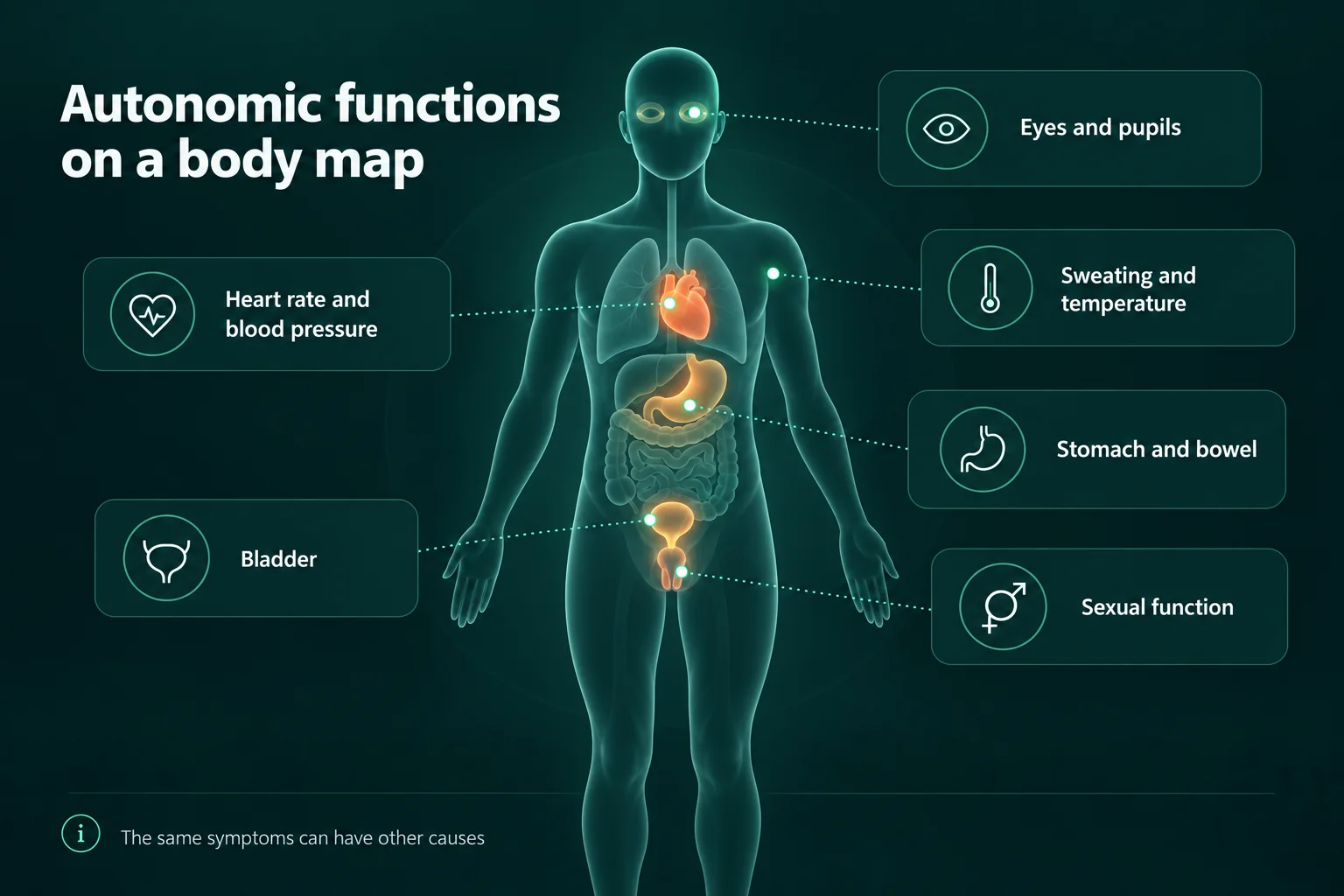
StatPearls, a reference for clinicians, describes the autonomic nervous system as the part of the peripheral nervous system that regulates involuntary processes. It has sympathetic, parasympathetic and enteric divisions. In everyday terms, it adjusts your heart rate and blood vessels when you stand up, controls sweating, and helps run digestion, the bladder and sexual function.5
Neuropathy can damage these nerves as well as the ones for feeling and movement. Mayo Clinic lists symptoms such as dizziness and fainting when standing because blood pressure drops, sweating too much or too little, bladder problems, feeling full after a few bites, diarrhoea or constipation, sexual problems and exercise intolerance. It names diabetes as the most common cause of autonomic neuropathy.6
A review of polyneuropathy in the Canadian Medical Association Journal (CMAJ) points out that autonomic symptoms caused by neuropathy may be missed, because these symptoms can have many other causes. When small sensory fibres are affected, it notes, autonomic symptoms often start in the feet, with sweating changes or unstable circulation.7
When might autonomic testing for neuropathy be suggested?
The CMAJ review says the American Academy of Neurology (AAN) recommends that doctors consider autonomic testing, covering sweat, heart-rate and blood-vessel responses, when they suspect an autonomic neuropathy.7
A 2026 consensus statement endorsed by the American Autonomic Society and the American Association of Neuromuscular & Electrodiagnostic Medicine (AANEM) says orthostatic testing, which means testing how your body copes with being upright, is often crucial for finding out why someone gets lightheaded on standing. It is needed to tell apart conditions such as postural tachycardia syndrome (POTS), orthostatic hypotension caused by nerve damage, and orthostatic hypotension from other causes such as low blood volume.1
In diabetes, the American Diabetes Association’s 2026 Standards of Care recommend asking about symptoms and looking for signs of autonomic neuropathy from the diagnosis of type 2 diabetes, and from five years after the diagnosis of type 1, at least once a year after that. That is a check for symptoms and signs, not necessarily a full lab test.8
NeuropathyCommons, a patient resource from Mass General Brigham, also lists autonomic function testing among the tests used when small fiber polyneuropathy is suspected, alongside skin biopsy.2
What is in a standard autonomic test?
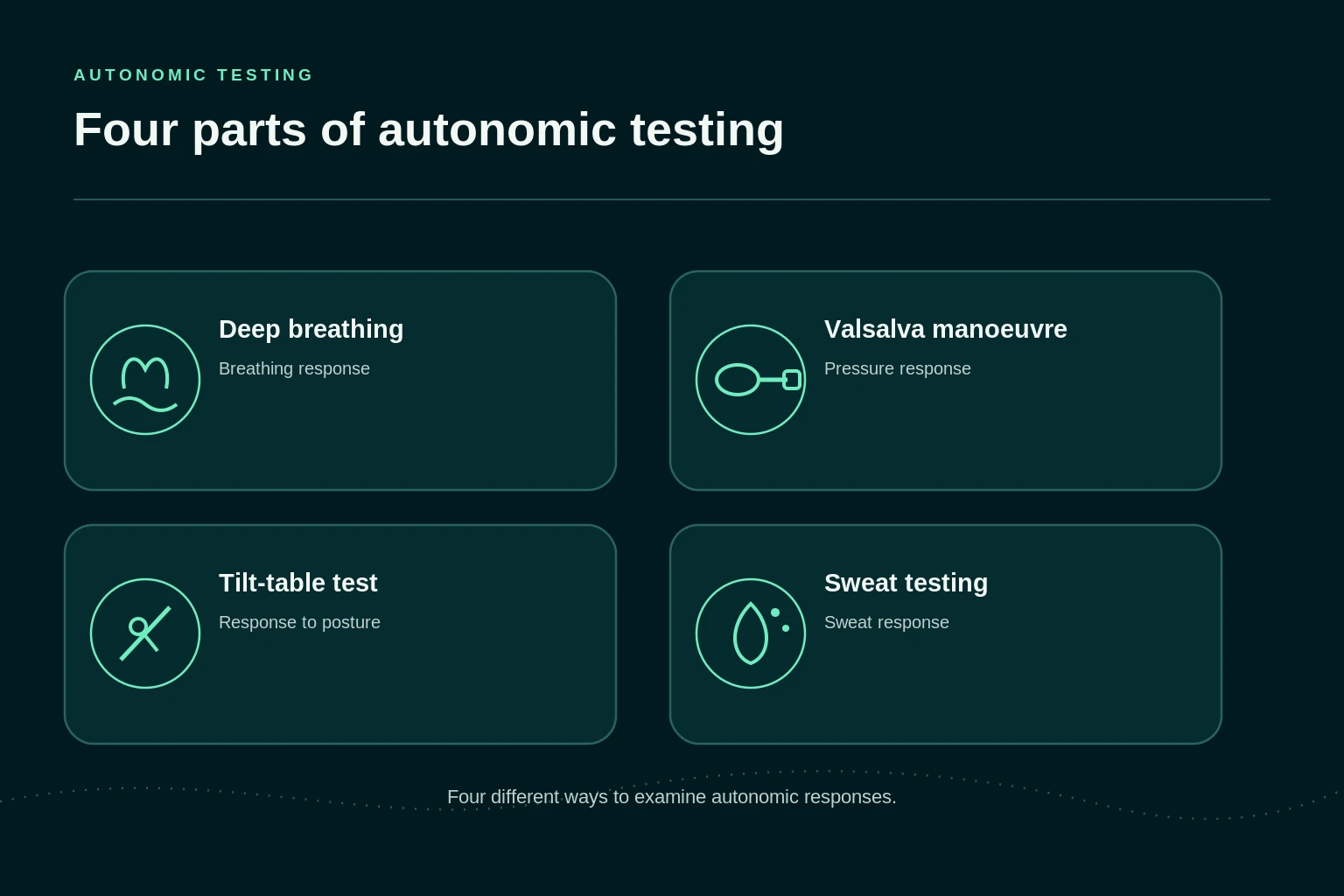
The 2026 consensus describes a standard autonomic reflex screen with four parts: an orthostatic challenge (tilt), the Valsalva manoeuvre, heart-rate variability with deep breathing, and a sweat test. It says continuous beat-to-beat heart rate and blood pressure monitoring is a technical requirement, and that ordinary cuff readings alone are not enough.1
An earlier consensus from 2021, endorsed by the American Autonomic Society, the AAN and the International Federation of Clinical Neurophysiology, makes the key point simply: no single test alone is enough to show how much autonomic failure there is or where.9
Deep breathing: how the vagus nerve steers your heart rate
Your heart rate normally rises and falls a little with each breath. In this test you breathe slowly and deeply, about six breaths a minute, while the heart rate is recorded. The size of the swing reflects cardiovagal function, the parasympathetic control of the heart through the vagus nerve. The 2021 consensus calls it the most widely used method, easy to do and highly reproducible. Penn Medicine says it takes less than ten minutes.1, 9, 10
The 2021 consensus notes that heart-rate variability declines with age, and a review on cardiovascular autonomic neuropathy in diabetes stresses that age-related normal ranges for the heart-rate tests are strictly required.9, 11
The Valsalva manoeuvre: blowing against resistance
Here you blow into a mouthpiece against resistance for about 15 seconds. The 2021 consensus describes holding a pressure of 40 mmHg for 15 seconds. The strain briefly changes the blood flow back to the heart, and the test looks at how heart rate and blood pressure react and recover. The Valsalva ratio reflects the vagus nerve, while the blood pressure pattern, including how quickly pressure recovers afterwards, shows whether the sympathetic nerves tighten the blood vessels as they should.9
Tilt table or standing test: blood pressure when you are upright
You lie on a special table, and after a rest the table tilts you to about 70 degrees, close to standing, while heart rate and blood pressure are recorded. In the standard autonomic screen the tilt lasts about ten minutes. Penn Medicine gives about ten minutes at a 70-degree angle.1, 10
The 2021 consensus defines orthostatic hypotension as a sustained drop in the upper (systolic) blood pressure of at least 20 mmHg or the lower (diastolic) of at least 10 mmHg within three minutes of standing or tilt. POTS is defined as a sustained rise in heart rate of at least 30 beats per minute within ten minutes, or at least 40 in people under 20, without orthostatic hypotension. Your own doctor makes the diagnosis from the whole picture, not from one number.9
A tilt test to find out why someone faints is often longer. A European consensus on tilt testing describes up to 45 minutes at 60 to 80 degrees for that question, and Johns Hopkins describes 20 to 45 minutes upright. So the length depends on what your doctor wants to know.12, 13
A simpler version is the active standing test: blood pressure is measured while you lie down and then several times after you stand up. The European consensus calls a bedside active standing test with ordinary blood pressure readings the recommended screening test for classic orthostatic hypotension.12
Sweat tests: QSART and the thermoregulatory sweat test
Sweat glands are controlled by thin sympathetic nerve fibres, so sweat tests are one way to see whether those small autonomic nerves work. In QSART, the quantitative sudomotor axon reflex test, small capsules are placed on the forearm, upper and lower leg and foot. A weak electrical current carries a substance called acetylcholine into the skin, and the amount of sweat is measured. The 2021 consensus says QSART tests the function of the sympathetic nerve fibres that end at the sweat glands.9, 14
Cleveland Clinic says QSART takes about 45 minutes to an hour, may feel like tickling, prickling or mild burning under the electrodes, and can leave red or darker skin that usually fades within a few hours. Penn Medicine’s description says you won’t feel pain from the current, so experiences seem to vary.10, 15
In the thermoregulatory sweat test, you are coated with a powder that changes colour when you sweat, and you lie in a chamber where the temperature slowly rises while digital photos document the pattern. The 2021 consensus notes that comparing this test with QSART may make it possible to tell whether a sweating problem lies before or after the nerve relay stations (ganglia) on the way to the sweat glands, that is, preganglionic or postganglionic.9, 14
Other tests you may hear about
- Sympathetic skin response (SSR) records an electrical response from the skin of the palms and soles. The 2026 consensus says it is hard to interpret because of technical variation, low specificity and poor reproducibility, and does not recommend it for standard autonomic testing except as screening in selected cases.1
- Electrochemical skin conductance (such as Sudoscan) measures sweat function on the palms and soles. A 2020 study, using a 3-minute scan, found modest accuracy for detecting loss of the nerve fibres around sweat glands, and the diabetes review says there is no agreed position on its role.11, 16
- Skin biopsy measures the density of small nerve fibres in the skin; the CMAJ review calls it the gold standard test for small-fibre neuropathy. As I see it, it shows structure rather than function, and it has its own page on this site.7
- Organ-specific tests, such as gastric-emptying tests for slow digestion or urine and bladder tests, may be used when symptoms point there. Mayo Clinic describes both.14
What is the visit like?
Most of this is simple lying, breathing and blowing while sensors record. NeuropathyCommons describes sweat electrodes on the arm, leg and foot, heart rate and blood pressure during deep breathing and while blowing into a tube, and then five minutes lying down, ten minutes upright and five minutes lying down again. Penn Medicine says the whole session can take up to two hours, and that people can generally go back to normal activities straight afterwards.2, 10
Feeling lightheaded during the tilt is part of what is being studied. Cleveland Clinic says fainting during tilt testing is rare, and that staff are right there and can lower the table so you recover quickly. Johns Hopkins lists fainting, dizziness, headache, nausea and changes in heart rate or blood pressure among the possible effects of a tilt test. The European consensus says tilt testing is safe and major complications are very rare, and that it should be run by a doctor, technician or nurse trained in fainting (syncope) and resuscitation.12, 13, 17
University Hospitals in Cleveland suggests having someone drive you, because the testing may cause dizziness or fainting.18
Preparing: follow your own lab’s letter
Almost every lab sends its own preparation instructions, and they differ a lot. As examples only: University Hospitals asks for no caffeine or nicotine for 3 hours and no alcohol for 14 hours before, and says to eat and drink normally. Penn Medicine’s page describes avoiding caffeine, nicotine and alcohol for 24 hours and fasting for 4 hours. Cleveland Clinic’s QSART page asks for no caffeine for 8 hours. All three ask you not to put lotion or cream on your skin before the test.10, 15, 18
Some medicines can affect the results. The 2021 consensus tells doctors that certain medicines may be paused before testing only when that is safe for the patient, and the European tilt consensus notes that it depends on the situation. So please don’t stop or change any medicine on your own for a test. Ask the lab or the doctor who referred you what applies to you, and tell them about everything you take. University Hospitals also asks people with a pacemaker to contact the lab first.9, 12, 18
How are the results read?
Results are compared with normal values that depend on age, and for some tests on the equipment used. The 2026 consensus says the validated normal ranges for the standard battery cover ages 10 to 70, with separate ranges for children and teenagers. Cleveland Clinic notes that QSART normal values vary with the equipment.1, 15
Some labs sum the results into a score. The Composite Autonomic Severity Score (CASS) runs from 0 to 10, with up to 4 points for blood-pressure (adrenergic) failure and up to 3 each for sweat and heart-rate (cardiovagal) failure, adjusted for age and sex. According to the 2021 consensus, 3 or less means mild, 4 to 6 moderate and 7 to 10 severe autonomic failure.9, 19
In diabetes, the diabetes review describes a staging from the Toronto consensus: one abnormal heart-rate test suggests possible or early cardiovascular autonomic neuropathy, two abnormal results confirm it, and orthostatic hypotension marks a severe or advanced stage.11
The 2026 consensus says the standard battery is supported by both inter-rater and test-retest reliability. It is more cautious about automated testing systems, which it says can give misleading results because of poor signal quality, artefacts, medicine effects and other confounders, and which it does not consider appropriate unless a trained physician carefully reviews the raw data.1
What autonomic tests can and cannot tell you
They can show whether the autonomic nerves are affected, which systems are involved (heart rate, blood vessels, sweating) and roughly how much. An older AAN assessment from 1996 described the role of testing as diagnosing autonomic neuropathy and determining its severity and distribution, and stated that the non-invasive tests have an extremely high value-to-risk ratio.20
They cannot tell you the cause. Finding the reason usually needs your history, examination, blood tests and sometimes other investigations. A normal result also doesn’t mean your symptoms are imagined; dizziness, sweating changes and stomach or bladder problems have many possible causes, as the CMAJ review points out. As I see it, the tests are one part of a conversation with your doctor, not a verdict.7
Autonomic tests at a glance
This is my own simplified summary of what the sources describe.
| Test | What it examines | Question it helps answer |
|---|---|---|
| Deep breathing | Vagus nerve control of heart rate (parasympathetic) | Is the heart’s automatic rhythm control reduced? |
| Valsalva manoeuvre | Vagus nerve and the sympathetic nerves that tighten blood vessels | Do heart rate and blood pressure react and recover normally? |
| Tilt table or active standing | Blood pressure and heart-rate control when upright | Orthostatic hypotension? POTS? Why do I faint? |
| QSART | Small sympathetic nerve fibres to the sweat glands | Do the small nerves to the sweat glands work, for example in small fiber neuropathy? |
| Thermoregulatory sweat test | The whole sweating pathway | Where on the body is sweating reduced? |
| Sympathetic skin response, skin conductance | Sweat-gland responses in the palms and soles | Screening in selected cases; limited on their own |
Questions you can ask
- What question do you want the autonomic tests to answer in my case?
- Which tests are included, and how long will the visit take?
- Will the tilt be a short screening tilt or a longer one for fainting?
- Should I do anything about my medicines before the test, or keep taking them as usual?
- Can I eat, drink coffee or use skin cream beforehand?
- Should someone come with me or drive me home?
- Which normal values will my results be compared with, and when will I get them?
- If the results are abnormal, what does that change for my care? And if they are normal, what next?
I’m not a doctor. I’ve written this from published research and guidance, and to help you prepare questions for your own care.
Sources
- Cortez MM, Cook G, Miglis MG, Raj SR, Robbins NM, Singer W, Sletten DM, Stino AM, et al. Utility and best practices for clinical diagnostic testing of the autonomic nervous system: A Consensus Statement Endorsed by the American Autonomic Society and the American Association of Neuromuscular & Electrodiagnostic Medicine. Clin Auton Res 2026. Published 21 September 2026. doi:10.1007/s10286-026-01238-9. https://link.springer.com/article/10.1007/s10286-026-01238-9
- NeuropathyCommons, Mass General Brigham. Diagnosing Peripheral Neuropathy (tests for small fiber polyneuropathy). Undated (page copyright 2022). https://neuropathycommons.org/neuropathy/tests-diagnosing-small-fiber-polyneuropathy
- NHS. Fainting. Page last reviewed 17 August 2026. https://www.nhs.uk/conditions/fainting/
- National Institute of Neurological Disorders and Stroke (NINDS). Guillain-Barré Syndrome. Last reviewed 13 March 2026. https://www.ninds.nih.gov/health-information/disorders/guillain-barre-syndrome
- Sánchez-Manso JC, Gujarathi R, Varacallo MA. Autonomic Dysfunction. StatPearls [Internet]. StatPearls Publishing; last update 4 August 2023. NBK430888. https://www.ncbi.nlm.nih.gov/books/NBK430888/
- Mayo Clinic Staff. Autonomic neuropathy – Symptoms and causes. Mayo Clinic, 7 July 2022. https://www.mayoclinic.org/diseases-conditions/autonomic-neuropathy/symptoms-causes/syc-20369829
- Mirian A, Aljohani Z, Grushka D, Florendo-Cumbermack A. Diagnosis and management of patients with polyneuropathy. CMAJ 2023;195(6):E227–E233. doi:10.1503/cmaj.220936. https://www.cmaj.ca/content/195/6/E227
- American Diabetes Association Professional Practice Committee for Diabetes. 12. Retinopathy, Neuropathy, and Foot Care: Standards of Care in Diabetes—2026. Diabetes Care 2026;49(Suppl 1):S261–S276. doi:10.2337/dc26-S012. https://doi.org/10.2337/dc26-S012
- Cheshire WP, Freeman R, Gibbons CH, et al. Electrodiagnostic assessment of the autonomic nervous system: A consensus statement endorsed by the American Autonomic Society, American Academy of Neurology, and the International Federation of Clinical Neurophysiology. Clin Neurophysiol 2021;132(2):666–682. doi:10.1016/j.clinph.2020.11.024. https://www.sciencedirect.com/science/article/pii/S138824572030585X
- Penn Medicine. Autonomic Testing. Page updated 11 June 2026. https://www.pennmedicine.org/treatments/autonomic-testing
- Spallone V. Update on the Impact, Diagnosis and Management of Cardiovascular Autonomic Neuropathy in Diabetes: What Is Defined, What Is New, and What Is Unmet. Diabetes Metab J 2019;43(1):3–30. doi:10.4093/dmj.2018.0259. https://www.e-dmj.org/journal/view.php?number=627
- Thijs RD, et al. Recommendations for tilt table testing and other provocative cardiovascular autonomic tests in conditions that may cause transient loss of consciousness: Consensus statement of the European Federation of Autonomic Societies (EFAS) endorsed by the American Autonomic Society (AAS) and the European Academy of Neurology (EAN). Clin Auton Res 2021;31(3):369–384. doi:10.1007/s10286-020-00738-6. https://pmc.ncbi.nlm.nih.gov/articles/PMC8184725/
- Johns Hopkins Medicine. Tilt Table Testing. 23 May 2024. https://www.hopkinsmedicine.org/health/treatment-tests-and-therapies/tilt-table-testing
- Mayo Clinic Staff. Autonomic neuropathy – Diagnosis and treatment. Mayo Clinic, 7 July 2022. https://www.mayoclinic.org/diseases-conditions/autonomic-neuropathy/diagnosis-treatment/drc-20369834
- Cleveland Clinic. QSART: What It Is, Purpose, Procedure & Results. Last reviewed 7 March 2024. https://my.clevelandclinic.org/health/diagnostics/16398-quantitative-sudomotor-axon-reflex-test-qsart
- Porubcin MG, Novak P. Diagnostic Accuracy of Electrochemical Skin Conductance in the Detection of Sudomotor Fiber Loss. Front Neurol 2020;11:273. doi:10.3389/fneur.2020.00273. https://www.frontiersin.org/journals/neurology/articles/10.3389/fneur.2020.00273/full
- Cleveland Clinic. Tilt Table Test: Procedure Details and Results. Last reviewed 13 April 2026. https://my.clevelandclinic.org/health/diagnostics/17043-tilt-table-test
- University Hospitals (Cleveland, Ohio). Patient Guide to Prepare for Autonomic Lab Testing. Undated. https://www.uhhospitals.org/services/neurology-and-neurosurgery-services/conditions-and-treatments/autonomic-conditions/preparation
- Low PA. Composite autonomic scoring scale for laboratory quantification of generalized autonomic failure. Mayo Clin Proc 1993;68(8):748–752. doi:10.1016/S0025-6196(12)60631-4. Abstract. https://www.sciencedirect.com/science/article/abs/pii/S0025619612606314
- Therapeutics and Technology Assessment Subcommittee of the American Academy of Neurology. Assessment: Clinical autonomic testing. Neurology 1996;46:873–880. https://www.aan.com/Guidelines/home/GetGuidelineContent/39
Sources checked on 26 September 2026.
Related reading

Restless legs or neuropathy? Similar symptoms, different assessments
Written by someone living with neuropathy: how restless legs syndrome differs from neuropathy, why the two are so often confused, how often they occur together, how each is assessed, and questions to take to your doctor.

Cold feet: nerve symptoms, circulation and when to seek help
Written by someone living with neuropathy: why feet can feel cold without being cold, when cold feet point to circulation instead, the warning signs that need urgent help, and a description aid for your appointment.

Numb hands and weak grip: neuropathy or another nerve problem?
Written by someone living with neuropathy: why numb hands and a weak grip can be a trapped nerve, a neck problem or polyneuropathy, the warning signs, and a description aid to take to your doctor.