
Small fiber neuropathy is damage to the thinnest nerve fibres in the body, the ones that carry pain, heat and cold, and that help control things like sweating, blood pressure and digestion. I have neuropathy myself, and I wanted to write about this form because it is so easy to miss. It often causes burning, prickling or oddly painful feet, while strength, reflexes and a standard nerve conduction test can all be normal.1, 2
The short version: small fiber neuropathy is a real, measurable condition, but symptoms alone are not enough to confirm it. A diagnosis rests on a clinical examination and, where available, tests such as a small skin biopsy. The cause is found in roughly half of people, and treatment aims first at that cause and then at easing pain.3, 4, 12
What is small fiber neuropathy?
Your peripheral nerves contain fibres of different thickness. The thick, well-insulated fibres carry vibration, position sense and signals to muscles. Small fiber neuropathy affects the thin ones: the thinly myelinated A-delta fibres and the unmyelinated C fibres.3, 4
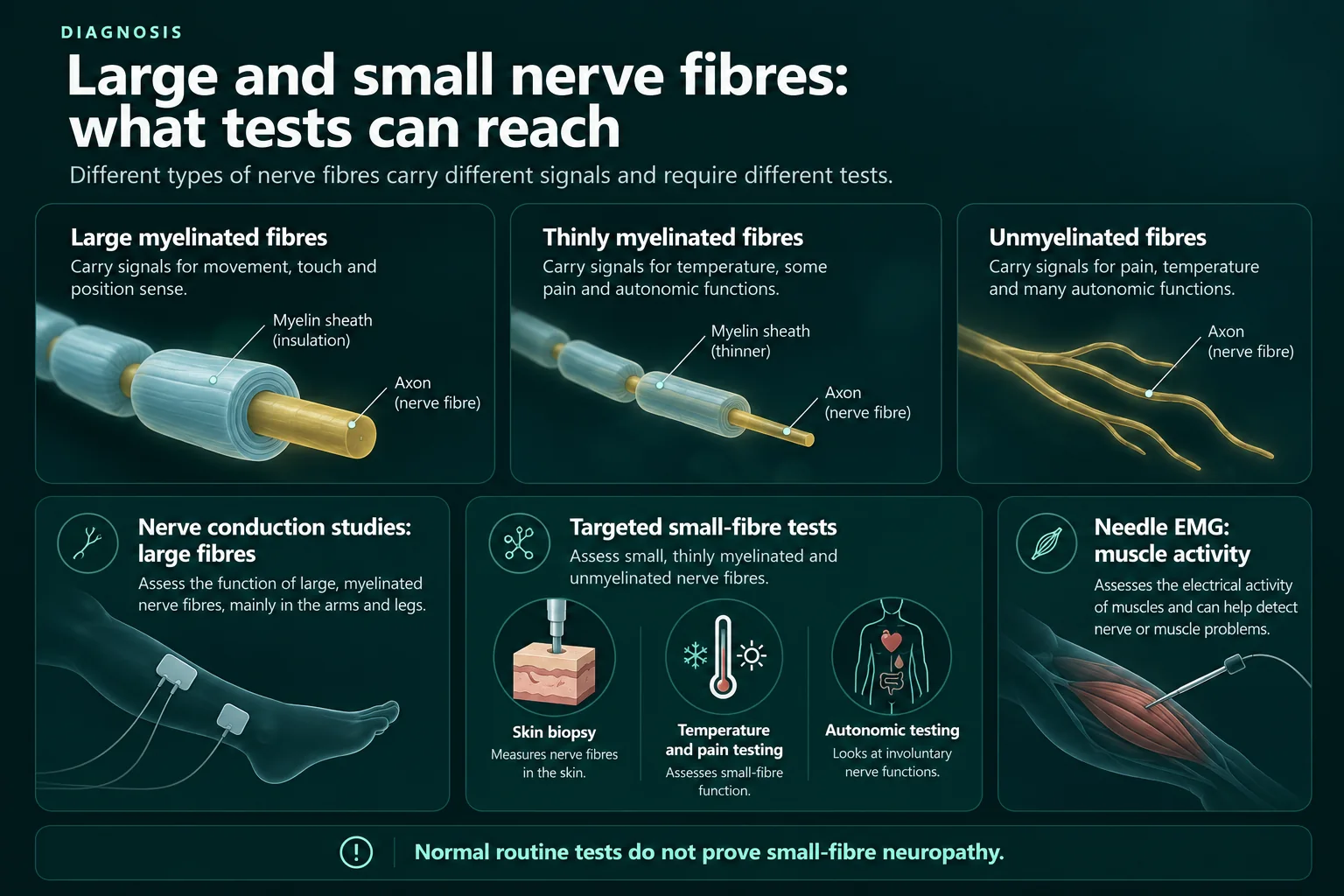
These thin fibres do two jobs. The sensory ones carry pain and temperature from the skin. The autonomic ones help run functions you don’t think about, such as sweating, heart rate, blood pressure, bowel and bladder. Small fiber neuropathy can affect one group, the other, or both.1, 13
In most people it is length-dependent. The longest nerves are affected first, so symptoms start in the feet and may later move upwards and reach the hands. In some people the pattern is patchy instead, and symptoms can show up in the face, the trunk, the scalp or the arms before, or at the same time as, the feet.1, 5
Small fiber neuropathy can be the only type of nerve damage someone has, but in some people the larger fibres become involved too, sometimes years later.1, 16
What does small fiber neuropathy feel like?
The symptoms people describe most are burning, tingling, numbness, itching, and sensations that feel like sunburn or frostbite. Many of us know the bedsheet problem. A review in the Cleveland Clinic Journal of Medicine says sensitivity to bedsheets on the feet is reported so often that researchers use it as an outcome in clinical trials.4
Other sensory symptoms include pain from light touch that shouldn’t hurt (allodynia), a deep ache, and itch that has a nerve cause rather than a skin cause.2
Autonomic symptoms
According to the same review, autonomic symptoms occur in nearly half of people with small fiber neuropathy.4 They can include:
- sweating too much or too little
- dry eyes or a dry mouth
- dizziness or light-headedness when you stand up
- a racing or pounding heart
- stomach and bowel problems, such as constipation
- bladder problems and sexual problems1, 5
What the symptoms can’t tell you
Here is the tricky part. In small fiber neuropathy alone, strength, balance, vibration sense and position sense usually stay normal.4 That is why a quick check at the doctor’s office can look reassuring.
At the same time, none of these symptoms is specific. Burning feet can have other causes, and I’ve written about those in a separate article.
In a large Italian study, 38 people had symptoms but no clinical signs on examination. Most of them had normal tests, and at follow-up 18 months later just over half said their symptoms had gone completely.12 Symptoms matter, but they are a reason to be examined, not a diagnosis.
What causes small fiber neuropathy?
Diabetes is the most common cause that can be identified. A clinical review estimates it accounts for about a third of all cases.4
Even earlier stages of raised blood sugar (prediabetes) are linked to small fiber neuropathy.17
Research reviews list many other conditions that are associated with it:4, 17
- Metabolic and nutritional: prediabetes and diabetes, vitamin B12 deficiency, an underactive thyroid
- Medicines and toxins: some chemotherapy drugs, certain antibiotics, alcohol
- Infections: HIV and hepatitis C
- Immune-related conditions: Sjögren’s syndrome, lupus, sarcoidosis, coeliac disease
- Inherited conditions: variants in sodium channel genes (such as SCN9A), Fabry disease and hereditary transthyretin (hATTR) amyloidosis
Some of these are rare, but a review in the Cleveland Clinic Journal of Medicine stresses that it is worth searching for a cause even though many cases turn out to be idiopathic, and several causes can be treated in their own right.4
Is small fiber neuropathy autoimmune?
Sometimes, but not automatically. NINDS writes that some types of small fiber polyneuropathy appear to be caused by problems in the immune response.8
Researchers also stress that having a risk factor at the same time as small fiber neuropathy does not necessarily mean it caused the neuropathy.18
Antibody tests are available, but their meaning is still debated. A 2023 review concluded that whether two of the most studied antibodies (against FGFR3 and TS-HDS) actually cause the disease remains unclear.20
When no cause is found
In a large share of people, no cause is identified, and the condition is then called idiopathic. Reviews put that share at about half.3 An unknown cause is common, and it doesn’t mean the symptoms are imagined.
Genetic findings are part of the picture. In a Dutch cohort of 921 people with small fiber neuropathy, about 17 % had a variant in one of the sodium channel genes.5
How is small fiber neuropathy diagnosed?
There is no single test that proves or rules out small fiber neuropathy. A 2021 review states plainly that no single method is sensitive enough to do that.13 Diagnosis builds on several pieces put together.
History and examination
The doctor asks where and how the symptoms started, about autonomic symptoms, medicines, alcohol and family history, and examines the feet and legs. Small fibre signs include reduced feeling for pinprick and for warm and cold, or pain from touch that shouldn’t hurt.1
Why a normal nerve conduction test doesn’t settle it
Standard nerve conduction studies and EMG only measure motor fibres and the large sensory fibres. The CMAJ review says people with purely small fibre neuropathy will have normal results on these tests.2
They are still useful, because they show whether motor and large sensory fibres are involved too.7 I’ve written a separate article about this.
Skin biopsy
A skin biopsy takes a tiny sample, usually 3 mm, from a specific spot on the lower leg under local anaesthetic. No stitches are needed. A laboratory counts the small nerve fibres in the outer layer of skin (the intraepidermal nerve fibre density) and compares the number with normal values for your age and sex.9, 10, 11
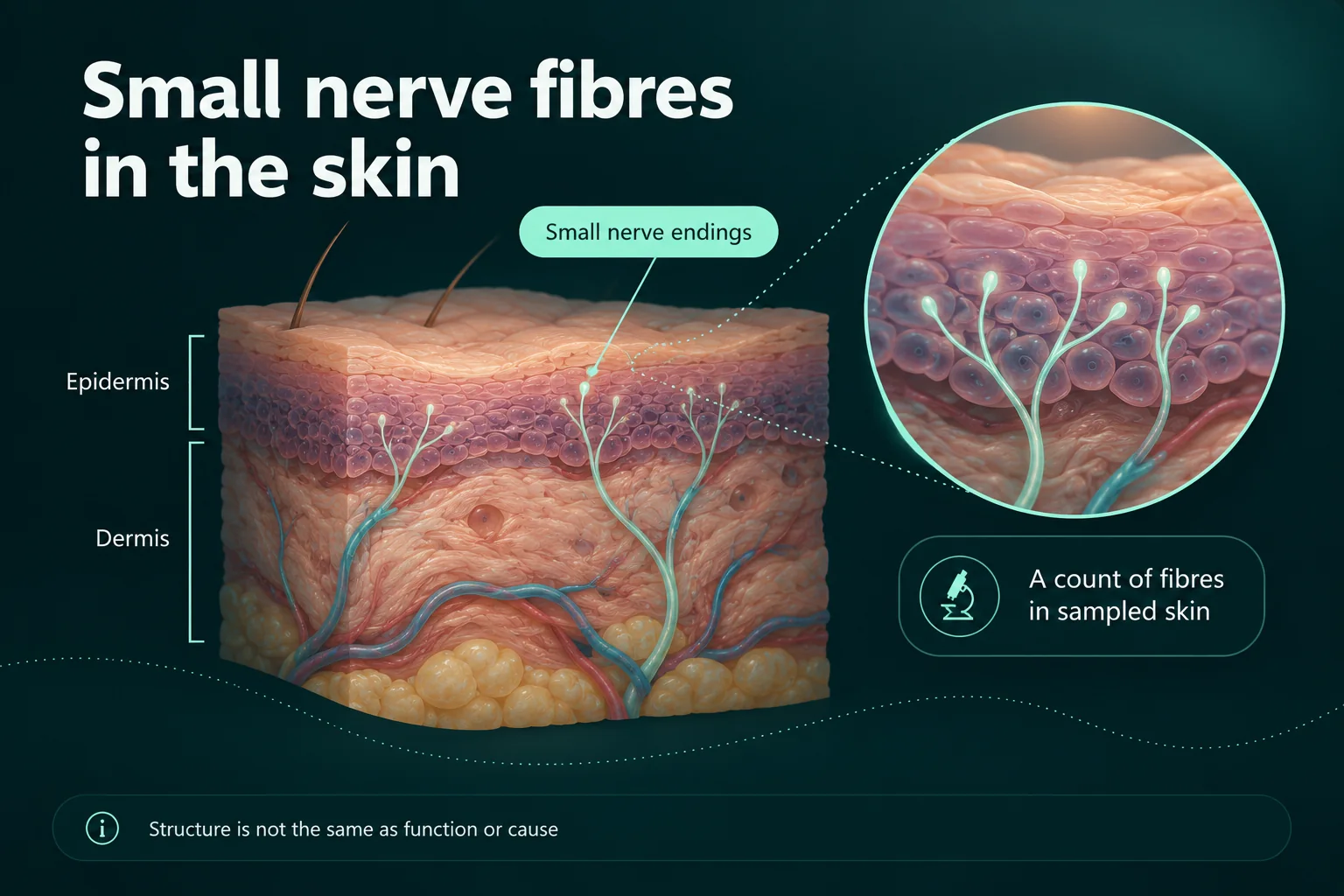
The European Federation of Neurological Societies and the Peripheral Nerve Society guideline gives a distal leg biopsy with this count its strongest recommendation (level A) as a reliable way to diagnose small fiber neuropathy. It also describes the procedure as safe, based on around 35,000 biopsies at ten laboratories without serious side effects.10
Skin biopsy has limits. The CMAJ review gives a sensitivity of 45–90 % and a specificity of 95–97 %, which means a normal result does not fully rule the condition out. The test is also labour-intensive and mainly available at academic centres.2, 13
Other tests
- Quantitative sensory testing (QST): measures the temperatures at which you start to feel warm, cold or pain. It depends on your own responses and attention, and it can’t tell whether a problem sits in the nerves or the brain.5
- Autonomic tests: measure things like sweating, heart rate and blood pressure responses.9
- Corneal confocal microscopy: a camera looks at the small nerves in the cornea of the eye. A 2025 meta-analysis of studies in many types of neuropathy (not including diabetic neuropathy) found corneal nerve fibres were reduced, but the authors say its diagnostic performance still needs to be established for each condition. A diagnostic review describes it as mainly a research tool with limited availability.13, 24
In one French study of 245 people, each test on its own either missed a fair number of cases or gave too many false alarms, while combining four tests (including skin biopsy and QST) gave a more reliable result.14
Blood tests to look for a cause
Once small fiber neuropathy is suspected, blood tests look for treatable causes. Reviews commonly list blood sugar and HbA1c, sometimes a glucose tolerance test, vitamin B12, thyroid tests, a blood count, kidney and liver tests, protein studies, and in some cases tests for coeliac disease, immune conditions, HIV or hepatitis C.4, 18 Which tests are right for you depends on your history.
Suspected or confirmed: a concept map
This is the part I think matters most to understand. Researchers use levels of certainty. The Besta criteria from Italy require at least two of three findings: clinical signs of small fibre damage, abnormal QST, and reduced nerve fibre density on skin biopsy.12
Another widely used system grades the diagnosis as possible, probable or definite.13
| Level | What it rests on | What it means for you |
|---|---|---|
| Symptoms only | Burning, prickling, sheet sensitivity or autonomic symptoms, without findings on examination | A reason to be examined. Not a diagnosis. Other causes need to be considered. |
| Possible | Symptoms or clinical signs of small fibre damage | Small fiber neuropathy is suspected. Further tests may be considered. |
| Probable | Symptoms or clinical signs, plus a normal nerve conduction test of the sural nerve (a sensory nerve in the lower leg) | A large fibre neuropathy is less likely. Small fibres remain the main suspect. |
| Definite | The above, plus reduced nerve fibre density on skin biopsy and/or abnormal temperature thresholds on QST | The diagnosis is confirmed by an objective test. The search for a cause continues. |
In the Italian validation study, the combination of clinical signs with an abnormal test led to a diagnosis more reliably than abnormal tests without clinical signs.12 In other words, the examination by a doctor counts, not just the lab result.
How is small fiber neuropathy treated?
Treatment has two tracks: treating the cause where one is found, and easing the symptoms.
Treating the cause
If there is an underlying condition, that comes first. The review in the Cleveland Clinic Journal of Medicine mentions managing diabetes, vitamin B12 replacement, treatment of Sjögren’s syndrome and a gluten-free diet for coeliac disease as examples.4
Treating nerve pain
For neuropathic pain in general, the UK’s NICE guideline lists amitriptyline, duloxetine, gabapentin or pregabalin as initial options, and capsaicin cream for people with localised pain who want to avoid or can’t take tablets.22
A 2025 international update from the neuropathic pain group of the International Association for the Study of Pain (NeuPSIG), published in The Lancet Neurology, reached a similar first-line list: tricyclic antidepressants, SNRIs and gabapentinoids. It also says openly that treatment outcomes are modest, and it sets out benefits, harms and uncertainties so that patients and doctors can choose together.23
These recommendations cover nerve pain in general, not small fiber neuropathy specifically. Which option suits you depends on your other conditions and medicines, so that is a conversation for you and your doctor. I won’t give doses or suggest changes here.
What about IVIG and other immune treatments?
This is where I want to be careful, because it comes up a lot online. In the first double-blind randomised trial, 60 Dutch people with painful idiopathic small fiber neuropathy received either intravenous immunoglobulin (IVIG) or placebo. Pain fell by at least one point in 40 % on IVIG and 30 % on placebo, and that difference was not statistically significant.19
That trial only included people without a known cause, so it does not answer every question about immune-related forms.20
A study suggesting benefit in apparently autoimmune cases was retrospective and had no comparison group, and its authors describe it as a basis for prospective trials.21 As far as I can tell from these sources, immune treatment is not standard treatment for small fiber neuropathy. It is a specialist question for specific situations.
Everyday measures
If walking is painful, the same review mentions stationary cycling, aqua therapy and swimming as alternatives.4 If your feet have reduced feeling for heat and pain, it makes sense to check them regularly for wounds and to be careful with hot water and heat sources. I’ve covered foot care in more detail in the article on burning feet at night.
Does small fiber neuropathy get worse over time?
For many people, it develops slowly and then levels off. StatPearls describes a slowly progressive course that reaches a plateau after some years. Cleveland Clinic writes that the condition itself won’t affect your life expectancy, although an underlying cause such as diabetes may.1, 6
Some people do go on to develop large fibre involvement as well. In one series, 13 % of 124 people did so over two years, and more than half improved or stayed stable.1, 4
In a US population study from Minnesota, large fibre neuropathy developed in 36 %, on average 5.3 years after the start of small fibre symptoms. Most people in that study had only mild disability.16
That is why follow-up matters. If symptoms spread, if weakness or balance problems appear, or if a new condition such as diabetes is found, the picture may need to be looked at again.
How common is it?
Estimates vary a lot, depending on how cases are found. A 2026 study from the Netherlands estimated a prevalence of about 70 per 100,000 adults, higher than an earlier Dutch minimum estimate of about 53 per 100,000.15
A US population study, which counted only people whose diagnosis was confirmed by testing, found 13.3 per 100,000.16 These are estimates, and many people are probably never tested.
Questions you might bring to your appointment
- Do my symptoms and your examination point to small fibres, large fibres or both?
- If my nerve conduction test was normal, is a small fibre test such as a skin biopsy or QST relevant for me, and is it available?
- Which blood tests have been done to look for a cause, and are any others worth considering?
- What is the goal of pain treatment for me, and how will we judge whether it works?
- What changes should make me get back in touch sooner?
I’m not a doctor. I’ve written this from published research and guidance, and to help you prepare questions for your own care.
Sources
- Cascio MA, Mukhdomi T. Small Fiber Neuropathy. In: StatPearls. StatPearls Publishing (NCBI Bookshelf), last updated 12 December 2022. https://www.ncbi.nlm.nih.gov/books/NBK582147/
- Mirian A, Aljohani Z, Grushka D, Florendo-Cumbermack A. Diagnosis and management of patients with polyneuropathy. CMAJ 2023;195(6):E227–E233. https://www.cmaj.ca/content/195/6/E227
- Terkelsen AJ, Karlsson P, Lauria G, Freeman R, Finnerup NB, Jensen TS. The diagnostic challenge of small fibre neuropathy: clinical presentations, evaluations, and causes. Lancet Neurology 2017;16(11):934–944. Aarhus University repository record. https://pure.au.dk/portal/en/publications/the-diagnostic-challenge-of-small-fibre-neuropathy-clinical-prese/
- Tavee JO. Office approach to small fiber neuropathy. Cleveland Clinic Journal of Medicine 2018;85(10):801–812. https://www.ccjm.org/content/85/10/801
- Sopacua M, Hoeijmakers JGJ, Merkies ISJ, Lauria G, Waxman SG, Faber CG. Small-fiber neuropathy: expanding the clinical pain universe. Journal of the Peripheral Nervous System 2019;24(1):19–33. Accepted manuscript, University of Milan repository. https://air.unimi.it/retrieve/dfa8b99c-a5e0-748b-e053-3a05fe0a3a96/Sopacua_et_al-2018-Journal_of_the_Peripheral_Nervous_System.pdf
- Cleveland Clinic. Small Fiber Neuropathy. Last reviewed 13 November 2023. https://my.clevelandclinic.org/health/diseases/17479-small-fiber-neuropathy
- Johns Hopkins Medicine, Peripheral Nerve Center. Small Fiber Sensory Neuropathy. Undated. https://www.hopkinsmedicine.org/neurology-neurosurgery/specialty-areas/peripheral-nerve/small-fiber-sensory-neuropathy
- National Institute of Neurological Disorders and Stroke (NINDS). Peripheral Neuropathy. Last reviewed 13 March 2026. https://www.ninds.nih.gov/health-information/disorders/peripheral-neuropathy
- Neuropathy Commons (Massachusetts General Hospital). Tests for diagnosing small-fiber polyneuropathy. Undated. https://neuropathycommons.org/neuropathy/tests-diagnosing-small-fiber-polyneuropathy
- Lauria G, Hsieh ST, Johansson O, et al. European Federation of Neurological Societies/Peripheral Nerve Society Guideline on the use of skin biopsy in the diagnosis of small fiber neuropathy. Report of a joint task force of the European Federation of Neurological Societies and the Peripheral Nerve Society. European Journal of Neurology 2010;17(7):903–912, e44–e49. Maastricht University repository record. https://cris.maastrichtuniversity.nl/en/publications/european-federation-of-neurological-societiesperipheral-nerve-soc/
- Lauria G, Bakkers M, Schmitz C, et al. Intraepidermal nerve fiber density at the distal leg: a worldwide normative reference study. Journal of the Peripheral Nervous System 2010;15(3):202–207. https://www.researchgate.net/publication/47643453_Intraepidermal_nerve_fiber_density_at_the_distal_leg_A_worldwide_normative_reference_study
- Devigili G, Rinaldo S, Lombardi R, et al. Diagnostic criteria for small fibre neuropathy in clinical practice and research. Brain 2019;142(12):3728–3736. https://academic.oup.com/brain/article/142/12/3728/5610119
- Raasing LRM, Vogels OJM, Veltkamp M, van Swol CFP, Grutters JC. Current view of diagnosing small fiber neuropathy. Journal of Neuromuscular Diseases 2021;8(2):185–207 (published online 18 December 2020). https://journals.sagepub.com/doi/10.3233/JND-200490
- Fabry V, Gerdelat A, Acket B, et al. Which method for diagnosing small fiber neuropathy? Frontiers in Neurology 2020;11:342. https://www.frontiersin.org/journals/neurology/articles/10.3389/fneur.2020.00342/full
- Kool D, Hoeijmakers JGJ, Faber CG, Merkies ISJ. Incidence and prevalence of small fibre neuropathy in the Netherlands: a multiple system estimation study. Journal of Neurology, Neurosurgery and Psychiatry 2026;97(8):e338181 (published 24 April 2026). https://pmc.ncbi.nlm.nih.gov/articles/PMC13479275/
- Johnson SA, Shouman K, Shelly S, et al. Small fiber neuropathy incidence, prevalence, longitudinal impairments, and disability. Neurology 2021;97(22):e2236–e2247. Mayo Clinic repository record. https://mayoclinic.elsevierpure.com/en/publications/small-fiber-neuropathy-incidence-prevalence-longitudinal-impairme/
- Furia A, Liguori R, Donadio V. Small-fiber neuropathy: an etiology-oriented review. Brain Sciences 2025;15(2):158. https://www.mdpi.com/2076-3425/15/2/158
- Lefaucheur JP, Gendre T, Sène D. A structured list of laboratory tests for screening the possible causes of small fiber neuropathy in clinical practice. Frontiers in Neurology 2025;16:1679316. https://www.frontiersin.org/journals/neurology/articles/10.3389/fneur.2025.1679316/full
- Geerts M, de Greef BTA, Sopacua M, et al. Intravenous immunoglobulin therapy in patients with painful idiopathic small fiber neuropathy. Neurology 2021;96(20):e2534–e2545. https://pmc.ncbi.nlm.nih.gov/articles/PMC8205474/
- Daifallah O, Farah A, Dawes JM. A role for pathogenic autoantibodies in small fiber neuropathy? Frontiers in Molecular Neuroscience 2023;16:1254854. https://www.frontiersin.org/journals/molecular-neuroscience/articles/10.3389/fnmol.2023.1254854/full
- Liu X, Treister R, Lang M, Oaklander AL. IVIg for apparently autoimmune small-fiber polyneuropathy: first analysis of efficacy and safety. Therapeutic Advances in Neurological Disorders 2018;11:1756285617744484. https://journals.sagepub.com/doi/10.1177/1756285617744484
- National Institute for Health and Care Excellence (NICE). Neuropathic pain in adults: pharmacological management in non-specialist settings (CG173). NCBI Bookshelf copy, last updated 22 September 2020. https://www.ncbi.nlm.nih.gov/books/NBK552848/
- Soliman N, Moisset X, Ferraro MC, et al. Pharmacotherapy and non-invasive neuromodulation for neuropathic pain: a systematic review and meta-analysis. Lancet Neurology 2025;24(5):413–428. https://www.sciencedirect.com/science/article/pii/S1474442225000687
- Petropoulos IN, Madani OA, Gad HY, et al. Corneal confocal microscopy to diagnose peripheral neuropathy: a systematic review and meta-analysis. European Journal of Neurology 2025;32(11):e70396. https://pmc.ncbi.nlm.nih.gov/articles/PMC12593550/
- Mayo Clinic. Guillain-Barre syndrome: symptoms and causes. 7 June 2024. https://www.mayoclinic.org/diseases-conditions/guillain-barre-syndrome/symptoms-causes/syc-20362793
- NHS (UK National Health Service). Peripheral neuropathy. Last reviewed 10 October 2022. https://www.nhs.uk/conditions/peripheral-neuropathy/
Sources checked on 24 September 2026.
Related reading

Restless legs or neuropathy? Similar symptoms, different assessments
Written by someone living with neuropathy: how restless legs syndrome differs from neuropathy, why the two are so often confused, how often they occur together, how each is assessed, and questions to take to your doctor.

Cold feet: nerve symptoms, circulation and when to seek help
Written by someone living with neuropathy: why feet can feel cold without being cold, when cold feet point to circulation instead, the warning signs that need urgent help, and a description aid for your appointment.

Numb hands and weak grip: neuropathy or another nerve problem?
Written by someone living with neuropathy: why numb hands and a weak grip can be a trapped nerve, a neck problem or polyneuropathy, the warning signs, and a description aid to take to your doctor.