
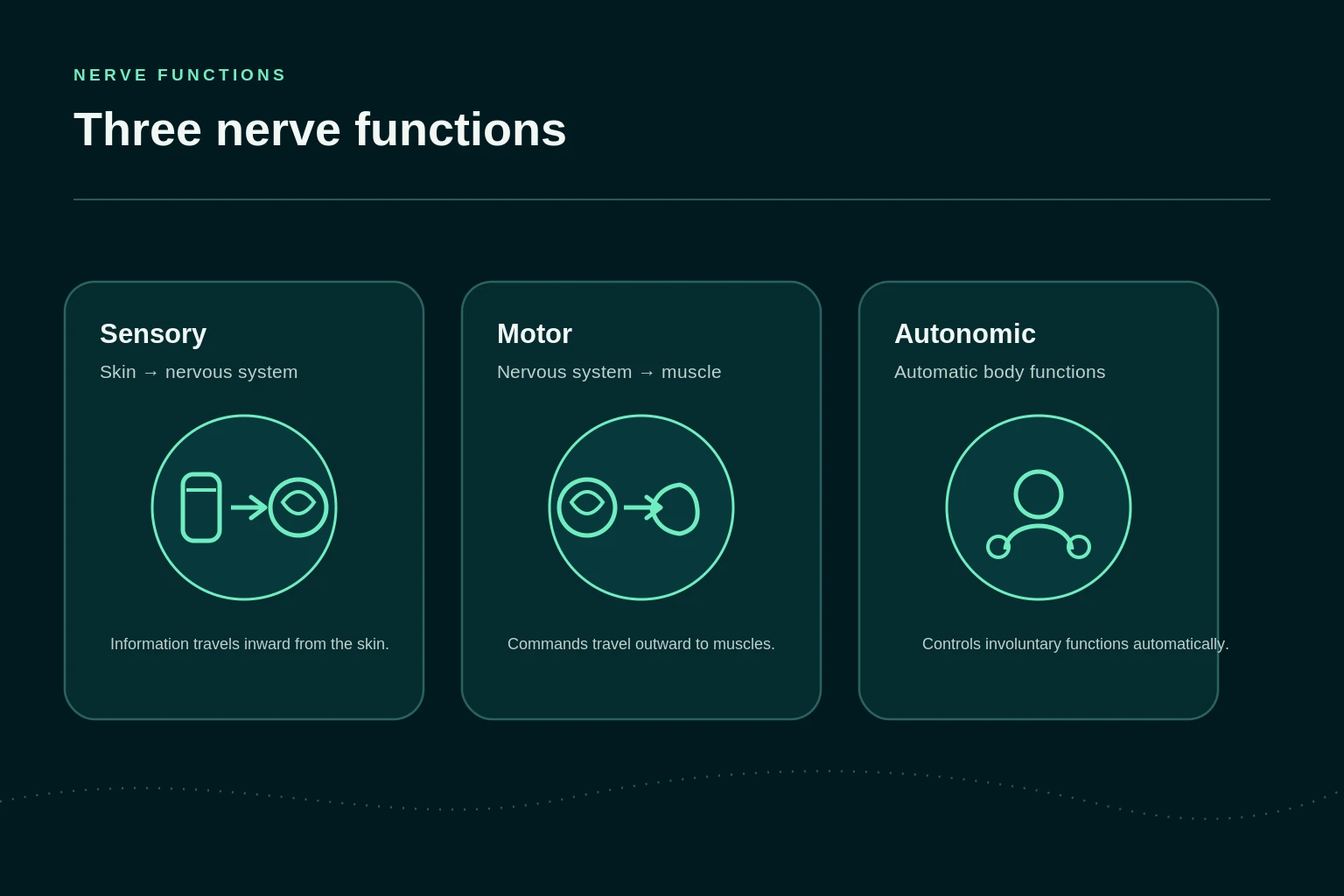
Sensory, motor and autonomic neuropathy are names for which kind of nerve is affected. Sensory nerves carry feeling, such as touch, temperature and pain. Motor nerves move the muscles you control. Autonomic nerves run the things you don’t think about, such as heartbeat, digestion and sweating. Most neuropathies affect all three to some degree, while others mostly affect one or two, so I read the label as naming the kind that is affected most, not the only kind.1
I have neuropathy myself, and I know these words can turn up in letters and reports without much explanation. This page is my attempt to explain them in plain language, so that you can ask better questions about your own situation. It is not a tool for sorting yourself into a category from a list of symptoms. That is a job for the person examining you.
What do sensory, motor and autonomic nerves do?
The peripheral nerves connect the brain and spinal cord to the rest of the body. The US National Institute of Neurological Disorders and Stroke (NINDS) describes three types:1
- Sensory nerves carry information such as a light touch, temperature, or pain from a cut.
- Motor nerves control the muscles we move on purpose, for example when we walk, grasp things or talk.
- Autonomic nerves control what happens without our thinking about it, such as breathing, digesting food, heartbeat and the work of our glands.
Cleveland Clinic adds that sensory nerves also tell the brain about the position of your body.4
Sensory, motor and autonomic neuropathy: a function map
The table is my own summary of the three kinds of nerve, what each does and what the sources describe when it is affected. It is a map for understanding the words, not a checklist for diagnosing yourself. Many of these symptoms have other causes too.
| Nerve type | What it does | What can happen when it is affected | Examples of how it can be tested |
|---|---|---|---|
| Sensory, large fibres | Vibration and position sense | Numbness, tingling, poorer balance, especially with the eyes shut | Examination, nerve conduction study |
| Sensory, small fibres | Pain and temperature | Burning, stabbing or electric pain, or reduced feeling for pain and temperature | Examination, skin biopsy (not seen on a nerve conduction study) |
| Motor | Movement of the muscles you control | Weakness, cramps, muscle twitching, muscle shrinking | Examination, nerve conduction study, EMG |
| Autonomic | Heart rate, blood pressure, digestion, bladder, sweating, sexual function | Dizziness on standing, sweating changes, constipation or diarrhoea, bladder and sexual problems | Heart rate and blood pressure tests, tilt table, sweat tests |
What does sensory neuropathy feel like?
Sensory nerve fibres come in different sizes. A review in the Canadian Medical Association Journal (CMAJ) explains that large-diameter fibres carry vibration and position sense, while small-diameter fibres carry pain and temperature.3
When the large fibres are affected, the American Diabetes Association lists numbness, tingling and poor balance. NINDS describes how losing position sense can make it hard to coordinate walking, fasten buttons or keep your balance with your eyes shut. When the small fibres are affected, the ADA lists burning, electric-shock-like and stabbing pain, and NINDS notes that damage can also mean you cannot feel pain or changes in temperature.1, 6
Small fibre neuropathy has its own page on this site, so I only touch on it here.
What does motor neuropathy look like?
NINDS lists muscle weakness, painful cramps, fasciculations (small, uncontrolled muscle twitches) and muscle shrinking, called atrophy, as signs of motor nerve damage.1
In the most common kind of polyneuropathy, weakness usually comes later than the sensory changes. CMAJ describes weakness appearing after sensory loss, first in lifting the toes and then in lifting the foot at the ankle.3
This is why motor-predominant symptoms stand out. CMAJ lists motor-predominant signs, together with fast onset and one-sidedness, among the features that should prompt urgent referral to a neuromuscular specialist.3
What does autonomic neuropathy involve?
Autonomic nerves reach many organs, so the symptoms can look unrelated to each other. CMAJ lists common autonomic symptoms such as feeling faint or dizzy on standing, slow stomach emptying (gastroparesis), constipation, diarrhoea, bladder problems, sexual dysfunction and blurry vision. The Merck Manual mentions a sudden fall in blood pressure when a person stands up. NINDS includes too much or too little sweating and heat intolerance.1, 3, 8
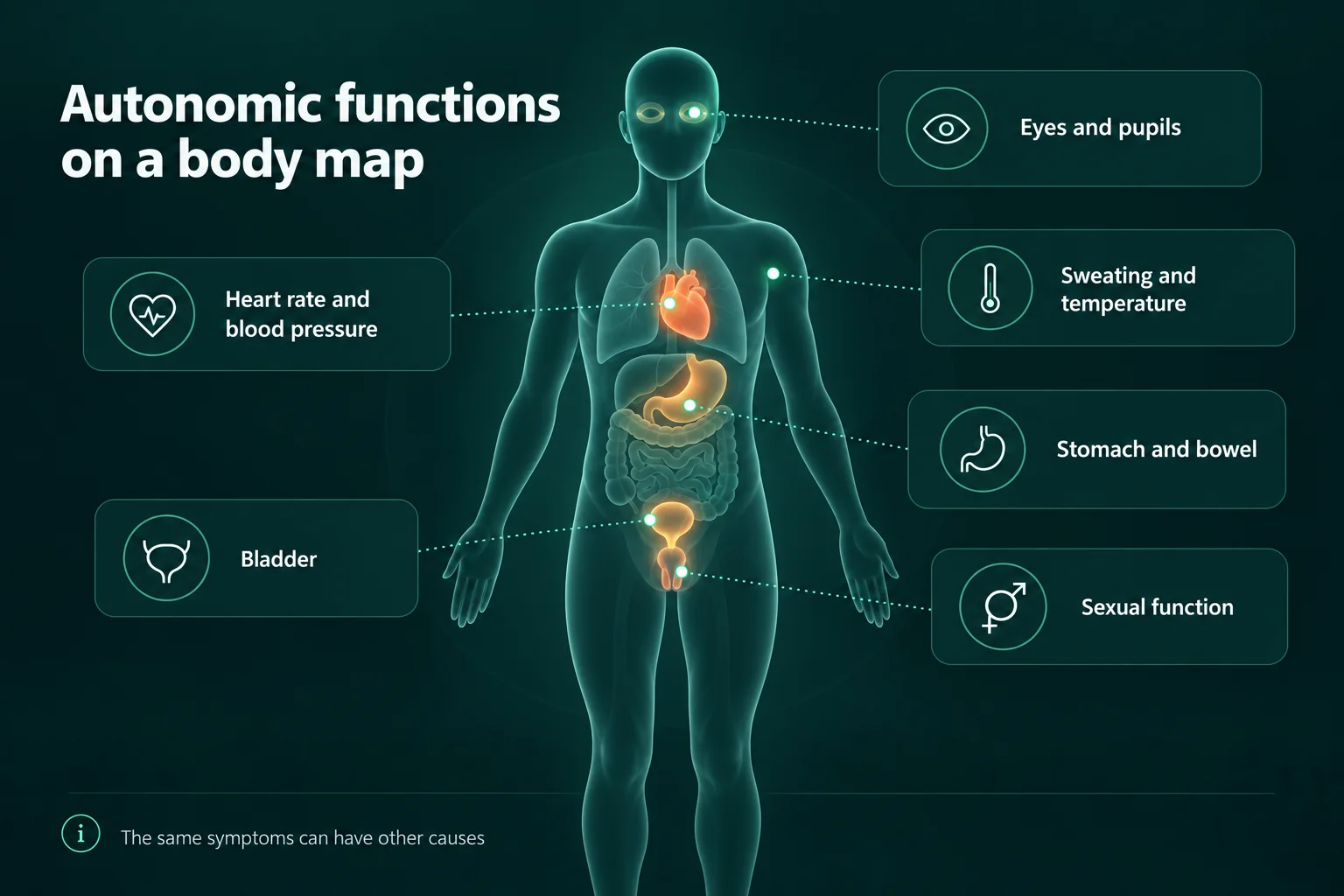
Diabetes is one well-known cause. The US National Institute of Diabetes and Digestive and Kidney Diseases (NIDDK) describes autonomic neuropathy as damage to the nerves that control your internal organs, and says it can also affect the ability to notice low blood sugar.9
Because these symptoms have many other possible causes, I would not try to decide on my own that they come from the nerves. Autonomic neuropathy gets its own, deeper article on this site.
Why most neuropathies are mixed
A report or letter might say “sensorimotor polyneuropathy”. That simply means both sensory and motor nerves are affected. NINDS says most neuropathies affect all three types of nerve fibre to varying degrees, while others mostly affect one or two types.1
CMAJ calls the most common subtype distal symmetric polyneuropathy. It is sensory-predominant and length-dependent, which means the longest nerves, those to the feet, are affected first. In diabetes, the American Diabetes Association describes this kind as accounting for about 75% of diabetic neuropathies and, within it, describes mixed small- and large-fibre involvement as the most common form.3, 6
As I read it, the word in front of “neuropathy” usually tells you what is most prominent. It does not always mean the other nerve types are completely untouched, although some neuropathies really are purely sensory or purely motor. Your doctor can tell you which applies to you.
What the pattern can point to
Which kind of nerve is mainly affected is one of the clues a specialist uses when thinking about causes. It is not a diagnosis on its own. Some examples from the sources:
- Mainly sensory: chemotherapy-induced neuropathy is described in a review as predominantly sensory, although motor and, less often, autonomic symptoms can occur. A separate group called sensory neuronopathies affects the sensory nerve cells in the dorsal root ganglia, next to the spinal cord, and can have paraneoplastic, immune-related, toxic or unknown causes.10, 11
- Mainly motor: multifocal motor neuropathy is described as a purely motor neuropathy with uneven weakness that often starts in the arms.12
- Motor and sensory together: NINDS says Charcot-Marie-Tooth disease, an inherited neuropathy, affects both sensory and motor nerves in the arms, hands, legs and feet.13
- Autonomic involvement: in hereditary transthyretin amyloidosis, a rare inherited condition, a review describes a mainly sensory neuropathy where autonomic symptoms are present in about three in four people. In Guillain-Barré syndrome, NINDS says the autonomic nervous system can also be disturbed, changing heart rate, blood pressure, digestion or sweating.14, 15
CMAJ lists diabetes as the most common cause of distal symmetric polyneuropathy, with alcohol use disorder, kidney problems and medicines such as chemotherapy among the other common causes.3
How are the different nerve functions tested?
No single test covers every kind of nerve fibre. According to NINDS, a nerve conduction study measures signal strength and speed along specific large motor and sensory nerves. CMAJ explains that if only the small sensory fibres are affected, the results will be normal, because these tests only assess motor and large sensory fibres. StatPearls makes the same point about electrodiagnostic testing in general: it cannot detect small fibre neuropathies.1, 3, 5
For small fibres, CMAJ describes a skin biopsy that counts nerve fibres in the skin as a validated, reproducible marker. For autonomic nerves, Mayo Clinic describes tests such as heart rate and blood pressure measurements during deep breathing and forceful breathing out, a tilt table test that follows blood pressure and heart rate when your position changes, and a sweat test called QSART.3, 7
Which tests make sense depends on your symptoms and examination. I cover the tests in more detail in my articles on diagnosis and on normal nerve test results.
Questions you can bring to your appointment
- Which kinds of nerve seem to be affected in my case: sensory, motor, autonomic, or a mix?
- Is it mainly large fibres, small fibres, or both?
- Does the pattern change which causes you want to look for?
- Do my symptoms such as dizziness, stomach or bladder problems need their own assessment?
- Which changes should make me get in touch sooner?
I’m not a doctor. I’ve written this from published research and guidance, and to help you prepare questions for your own care.
Sources
- National Institute of Neurological Disorders and Stroke (NINDS). Peripheral Neuropathy. Last reviewed 13 March 2026. https://www.ninds.nih.gov/health-information/disorders/peripheral-neuropathy
- Mayo Clinic Staff. Guillain-Barre syndrome: Symptoms and causes. Mayo Clinic, 7 June 2024. https://www.mayoclinic.org/diseases-conditions/guillain-barre-syndrome/symptoms-causes/syc-20362793
- Mirian A, Aljohani Z, Grushka D, Florendo-Cumbermack A. Diagnosis and management of patients with polyneuropathy. CMAJ 2023;195(6):E227–E233. doi:10.1503/cmaj.220936. https://www.cmaj.ca/content/195/6/E227
- Cleveland Clinic. Peripheral Neuropathy. Last reviewed 16 July 2026. https://my.clevelandclinic.org/health/diseases/14737-peripheral-neuropathy
- Novello BJ, Pobre T. Electrodiagnostic Evaluation of Peripheral Neuropathy. StatPearls [Internet]. StatPearls Publishing; last update 30 January 2023. NBK563169. https://www.ncbi.nlm.nih.gov/books/NBK563169/
- Pop-Busui R, Boulton AJM, Feldman EL, et al. Diabetic Neuropathy: A Position Statement by the American Diabetes Association. Diabetes Care 2017;40(1):136–154. doi:10.2337/dc16-2042. https://diabetesjournals.org/care/article/40/1/136/37160/Diabetic-Neuropathy-A-Position-Statement-by-the
- Mayo Clinic Staff. Autonomic neuropathy: Diagnosis & treatment. Mayo Clinic, 7 July 2022. https://www.mayoclinic.org/diseases-conditions/autonomic-neuropathy/diagnosis-treatment/drc-20369836
- Feldman AM. Polyneuropathy. Merck Manual Consumer Version. Last updated May 2026. https://www.merckmanuals.com/home/brain-spinal-cord-and-nerve-disorders/peripheral-nerve-and-related-disorders/polyneuropathy
- National Institute of Diabetes and Digestive and Kidney Diseases (NIDDK). What Is Diabetic Neuropathy? Last reviewed February 2018. https://www.niddk.nih.gov/health-information/diabetes/overview/preventing-problems/nerve-damage-diabetic-neuropathies/what-is-diabetic-neuropathy
- Starobova H, Vetter I. Pathophysiology of chemotherapy-induced peripheral neuropathy. Front Mol Neurosci 2017;10:174. doi:10.3389/fnmol.2017.00174. https://www.frontiersin.org/journals/molecular-neuroscience/articles/10.3389/fnmol.2017.00174/full
- Camdessanché J-P, Jousserand G, Ferraud K, et al. The pattern and diagnostic criteria of sensory neuronopathy: a case–control study. Brain 2009;132(7):1723–1733. doi:10.1093/brain/awp136. https://academic.oup.com/brain/article/132/7/1723/329113
- Lawson VH, Arnold WD. Multifocal motor neuropathy: a review of pathogenesis, diagnosis, and treatment. Neuropsychiatr Dis Treat 2014;10:567–576. doi:10.2147/NDT.S39592. https://www.dovepress.com/multifocal-motor-neuropathy-a-review-of-pathogenesis-diagnosis-and-tre-peer-reviewed-fulltext-article-NDT
- National Institute of Neurological Disorders and Stroke (NINDS). Charcot-Marie-Tooth Disease. Last reviewed 2 September 2026. https://www.ninds.nih.gov/health-information/disorders/charcot-marie-tooth-disease
- Vélez-Santamaría V, Nedkova-Hristova V, Morales de la Prida M, Casasnovas C. Hereditary transthyretin amyloidosis with polyneuropathy: monitoring and management. Int J Gen Med 2022;15:8677–8684. doi:10.2147/IJGM.S338430. https://www.dovepress.com/hereditary-transthyretin-amyloidosis-with-polyneuropathy-monitoring-an-peer-reviewed-fulltext-article-IJGM
- National Institute of Neurological Disorders and Stroke (NINDS). Guillain-Barré Syndrome. Last reviewed 13 March 2026. https://www.ninds.nih.gov/health-information/disorders/guillain-barre-syndrome
Sources checked on 25 September 2026.
Related reading

Restless legs or neuropathy? Similar symptoms, different assessments
Written by someone living with neuropathy: how restless legs syndrome differs from neuropathy, why the two are so often confused, how often they occur together, how each is assessed, and questions to take to your doctor.

Cold feet: nerve symptoms, circulation and when to seek help
Written by someone living with neuropathy: why feet can feel cold without being cold, when cold feet point to circulation instead, the warning signs that need urgent help, and a description aid for your appointment.

Numb hands and weak grip: neuropathy or another nerve problem?
Written by someone living with neuropathy: why numb hands and a weak grip can be a trapped nerve, a neck problem or polyneuropathy, the warning signs, and a description aid to take to your doctor.