
Prediabetes and neuropathy are linked in some studies, but the link is weaker and less certain than many pages suggest. Clinic studies often find prediabetes in people with unexplained neuropathy, while population studies find much less, and some find no extra neuropathy at all or find that weight and other factors explain much of the link. A prediabetes result is worth acting on, but it does not by itself explain nerve symptoms.1, 2, 3
I have neuropathy myself, and I write these pages to make the research easier to read and to help you ask good questions. This page is about what the studies can and cannot show. There are separate pages on this site about diabetic neuropathy and about neuropathy without diabetes.
What is prediabetes?
Prediabetes means blood sugar that is higher than normal but below the level for diabetes. The American Diabetes Association (ADA) defines it in its 2026 Standards of Care as any of these: HbA1c 5.7–6.4 percent (39–47 mmol/mol), fasting glucose 5.6–6.9 mmol/L (100–125 mg/dL), called impaired fasting glucose, or a glucose of 7.8–11.0 mmol/L (140–199 mg/dL) two hours into a glucose tolerance test, called impaired glucose tolerance.5
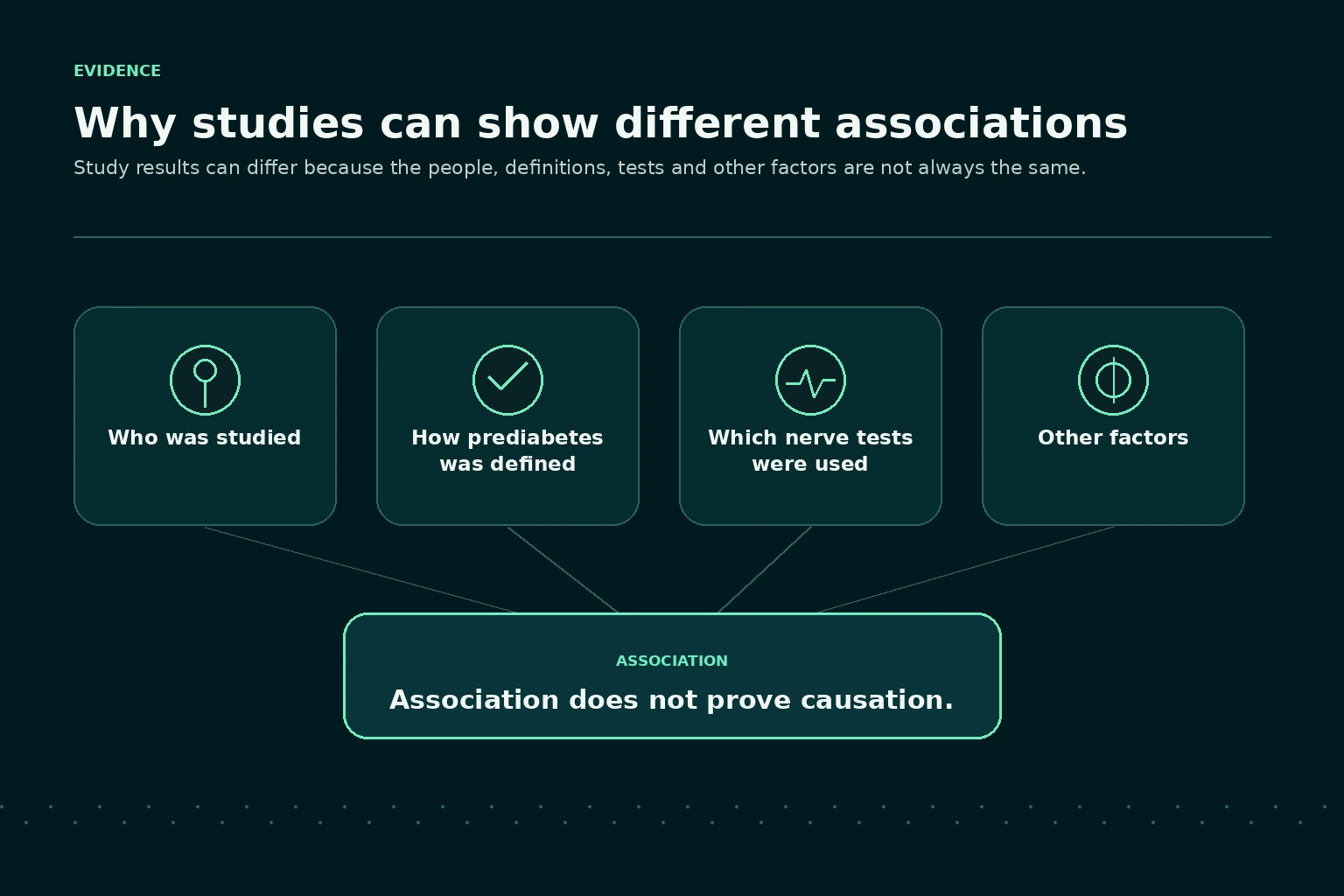
The limits are not the same everywhere. The ADA notes that the World Health Organization and several other diabetes organisations set the lower limit for impaired fasting glucose at 6.1 mmol/L (110 mg/dL). It also stresses that the risk of later diabetes rises gradually and does not start at an exact cut-off. As I read it, this is one reason studies of prediabetes and neuropathy are hard to compare: they do not always measure the same thing.5
What studies show about prediabetes and neuropathy
The idea of “prediabetic neuropathy” grew out of neuromuscular clinics. In a US study from 2001, 36 of 107 people with unexplained neuropathy (34 percent) had impaired glucose tolerance, nearly three times the rate the authors gave for age-matched control subjects. In many of them the glucose tolerance test was abnormal while fasting glucose and HbA1c were normal. The authors suggested that impaired glucose tolerance may cause or contribute to small fibre neuropathy.6
A systematic review from 2021 gathered 29 studies with 9,351 people who had prediabetes. The share with neuropathy ranged from 2 to 77 percent. Hospital-based studies usually found high figures and population studies mostly low ones, and studies that measured the thin small nerve fibres found more neuropathy. The authors judged the studies too different to combine into one number.1
A newer meta-analysis from 2025, with 26 studies and 41,821 participants, found that people with prediabetes on average had somewhat worse nerve test results than people with normal blood sugar. The differences between studies were very large, only 5 of the 26 studies adjusted for factors such as age, sex or weight, and the authors named different test methods, cut-off values and confounding factors as limitations.7
Studies that found little or no link
Population studies, which test people who were not selected because of symptoms, give a more mixed picture. A study in Olmsted County, Minnesota, used detailed nerve testing in 150 people with normal glucose, 174 with impaired glycaemia and 218 with newly found diabetes. Typical diabetes-type neuropathy with no other cause was found in 2.0 percent of those with normal glucose and 1.7 percent of those with impaired glycaemia. With a broader definition the figures were also almost the same, 12.7 and 12.6 percent, and the nerve test scores did not differ between these two groups.2
In the Rotterdam Study, where 1,256 middle-aged and older adults were screened with nerve conduction studies, diabetes was linked to polyneuropathy but impaired fasting glucose was not. A smaller study of 29 people with impaired and 39 with normal glucose tolerance, drawn from a population-based group, found no difference between them in small or large nerve fibre function.8, 9
The German KORA surveys found neuropathy in 13.0 percent of people with impaired glucose tolerance, 11.3 percent with impaired fasting glucose and 7.4 percent with normal glucose. The authors called this slightly increased, but in their analysis only diabetes differed clearly from the other groups.10
Association or cause? Why a link is not proof
An association means two things are found together more often than expected. It does not show that one causes the other. Prediabetes rarely comes alone: it often travels with age, a larger waist, high blood fats and high blood pressure. Any of these could explain part of a link, and neuropathy has many other causes of its own.
A British study shows how much this matters. Among 50 people with unexplained axonal neuropathy, 32 percent had impaired glucose tolerance or raised fasting glucose, against 14 percent of 50 controls. After adjusting for age and sex, the difference was no longer significant. Raised triglycerides, a kind of blood fat, stood out instead.11
Weight shows a similar pattern. In a US study of 102 obese and 53 lean people, polyneuropathy was found in 11.1 percent of obese people with normal blood sugar and 29 percent of obese people with prediabetes, against 3.8 percent of lean people. In the full analysis, age, diabetes and waist size were significantly linked to neuropathy but prediabetes was not, although the study was small and the authors still counted prediabetes among the likely drivers. In a study of 4,002 people in China, neuropathy was more common with prediabetes (6.29 percent) than with normal glucose (3.25 percent), but among the metabolic factors only diabetes and weight stood out as independent factors.3, 12
| What a study can find | Why it does not prove cause | Example from the research |
|---|---|---|
| More prediabetes among people with neuropathy | People seen in specialist clinics are not typical, and the comparison group may differ in other ways | 34 percent impaired glucose tolerance in a neuropathy clinic, compared with figures for age-matched controls |
| A difference that disappears after adjustment | Age, sex or another factor explained the difference | 32 versus 14 percent, no longer significant after adjusting for age and sex |
| A link that follows weight or blood fats rather than glucose | Prediabetes and neuropathy may share a third factor | Waist size or weight stood out as independent factors in the obesity and China studies, while prediabetes did not |
| Very different figures in different studies | Different definitions, tests and populations measure different things | Prevalence from 2 to 77 percent across 29 studies |
| Both measured at the same point in time | A single snapshot cannot show which came first | Most studies of prediabetes and neuropathy are cross-sectional |
Metabolic syndrome, weight and blood fats
Many researchers now look beyond blood sugar alone. In the Rotterdam Study, metabolic syndrome, a larger waist and high triglycerides were each linked to polyneuropathy, and the links held when people with diabetes were left out. A review in The Lancet Neurology from 2022 describes metabolic syndrome as a major risk factor for diabetic neuropathy.8, 13
In a large study of older Americans, neuropathy with symptoms became more common the more parts of metabolic syndrome a person had, yet diabetes and HbA1c were the only measures with a clear independent link to the main neuropathy outcome. The authors wrote that it remains unclear which parts drive the association. As I understand it, that is where the science stands: something in the metabolic picture seems to matter, but not exactly what.14
How glucose is checked when neuropathy is investigated
An evidence review from the American Academy of Neurology and two partner societies found that the blood tests most often abnormal in the most common type of neuropathy, distal symmetric polyneuropathy, are blood glucose, vitamin B12 with its metabolites, and a test for abnormal proteins in the blood called immunofixation. If routine tests show no diabetes, testing for impaired glucose tolerance may be considered. The evidence level was low, and the AAN reaffirmed the guidance in 2025.15
The CMAJ review lists fasting glucose and HbA1c among the basic tests, and recommends a two-hour glucose tolerance test if HbA1c is 6.0–6.4 percent. That fits the 2001 clinic study, where the tolerance test was often abnormal even when fasting glucose and HbA1c were normal.4, 6
Other causes still need to be checked
This is the part I think matters most. The authors of the Olmsted County study wrote that in people with impaired glycaemia and an atypical neuropathy, doctors should look for other explanations. The ADA lists causes to consider in people with diabetes, among them alcohol, some medicines such as chemotherapy, low vitamin B12, an underactive thyroid, kidney disease, some cancers, infections, inflammatory and inherited neuropathies and vasculitis. The same thinking applies, as I read it, when the finding is prediabetes.2, 16
Even after testing, a cause is not always found. The CMAJ review estimates that around 30 percent of cases remain unexplained, and in the Rotterdam Study 46 percent of polyneuropathies were idiopathic, meaning no cause was found.4, 17
Can lifestyle changes help the nerves?
For preventing diabetes, the evidence is strong. The ADA describes how the Diabetes Prevention Program lowered the risk of type 2 diabetes by 58 percent over three years with an intensive lifestyle programme, and for adults with overweight who are at high risk of type 2 diabetes it recommends a programme aiming for weight loss of at least 5–7 percent and at least 150 minutes a week of moderate physical activity. Avoiding diabetes matters for the nerves too, since diabetes is clearly linked to neuropathy.18
For the nerves themselves, the evidence is thin. In a US study, 32 people with impaired glucose tolerance and neuropathy received diet and exercise counselling for a year. Nerve fibre density in skin biopsies from the thigh improved, and the improvement was linked to less pain, but there was no control group. In the long-term follow-up of the Diabetes Prevention Program, a combined measure of kidney, eye and nerve damage did not differ overall between the lifestyle, metformin and placebo groups after about 15 years, although it was somewhat lower with lifestyle in women.19, 20
The ADA 2026 standards say there is no compelling evidence for glucose or lifestyle management as treatments for neuropathic pain in diabetes or prediabetes. As I read it, a healthier lifestyle is well worth it for your general and metabolic health, but it has not been proven to repair nerves. Pain treatment is a separate question to take up with your doctor.16
What remains uncertain about prediabetes and neuropathy
- Whether blood sugar at prediabetic levels damages nerves on its own, or whether weight, blood fats and age explain most of the link.3, 14
- How common neuropathy is in prediabetes, since the figures depend so much on who is tested and how.1
- Whether the small nerve fibre changes found with sensitive tests make a difference to daily life. In the 2021 review, most studies reported neuropathy in prediabetes that was mainly of small fibre origin.1
- Whether treating prediabetes prevents or improves neuropathy. In a European randomised trial, fewer people treated for a year with metformin or linagliptin than with placebo had abnormal results on an indirect skin test of small nerve fibre function, but that is not the same as fewer symptoms. As far as I have found, no randomised trial has shown less clinically diagnosed neuropathy, and the long-term Diabetes Prevention Program follow-up found no overall difference in combined nerve, eye and kidney damage.19, 20, 21
Questions you could ask
- Which test showed prediabetes: fasting glucose, HbA1c or a glucose tolerance test?
- Would a two-hour glucose tolerance test add anything in my case?
- Do my symptoms fit the pattern often described with prediabetes, or are there features that suggest another cause?
- Have vitamin B12, thyroid function, kidney function and a test for abnormal blood proteins been checked?
- Should my waist size, blood pressure and blood fats be looked at as well as my blood sugar?
- How and when should my blood sugar be followed up?
- If my symptoms change, what should make me get in touch sooner?
I’m not a doctor. I’ve written this from published research and guidance, and to help you prepare questions for your own care.
Sources
- Kirthi V, Perumbalath A, Brown E, et al. Prevalence of peripheral neuropathy in pre-diabetes: a systematic review. BMJ Open Diabetes Research & Care 2021;9(1):e002040. doi:10.1136/bmjdrc-2020-002040. https://drc.bmj.com/content/9/1/e002040
- Dyck PJ, Clark VM, Overland CJ, et al. Impaired glycemia and diabetic polyneuropathy: the OC IG Survey. Diabetes Care 2012;35(3):584–591. doi:10.2337/dc11-1421. https://pubmed.ncbi.nlm.nih.gov/22355020/
- Callaghan BC, Xia R, Reynolds E, et al. Association Between Metabolic Syndrome Components and Polyneuropathy in an Obese Population. JAMA Neurology 2016;73(12):1468–1476. doi:10.1001/jamaneurol.2016.3745. https://pubmed.ncbi.nlm.nih.gov/27802497/
- Mirian A, Aljohani Z, Grushka D, Florendo-Cumbermack A. Diagnosis and management of patients with polyneuropathy. CMAJ 2023;195(6):E227–E233. doi:10.1503/cmaj.220936. https://www.cmaj.ca/content/195/6/E227
- American Diabetes Association Professional Practice Committee. 2. Diagnosis and Classification of Diabetes: Standards of Care in Diabetes – 2026. Diabetes Care 2026;49(Suppl. 1):S27–S49. doi:10.2337/dc26-S002. https://doi.org/10.2337/dc26-S002
- Singleton JR, Smith AG, Bromberg MB. Increased prevalence of impaired glucose tolerance in patients with painful sensory neuropathy. Diabetes Care 2001;24(8):1448–1453. doi:10.2337/diacare.24.8.1448. https://pubmed.ncbi.nlm.nih.gov/11473085/
- Riahi R, Seindareh S, Aminorroaya A, Ghasemi M, Mehvari J, Maracy MR. The Relationship Between Prediabetes and Peripheral Neuropathy – A Systematic Review and Meta-Analysis. European Journal of Neurology 2025;32(7):e70283. doi:10.1111/ene.70283. https://pmc.ncbi.nlm.nih.gov/articles/PMC12235325/
- Hanewinckel R, Drenthen J, Ligthart S, et al. Metabolic syndrome is related to polyneuropathy and impaired peripheral nerve function: a prospective population-based cohort study. Journal of Neurology, Neurosurgery and Psychiatry 2016;87(12):1336–1342. doi:10.1136/jnnp-2016-314171. https://pubmed.ncbi.nlm.nih.gov/27656045/
- Pourhamidi K, Dahlin LB, Englund E, Rolandsson O. No difference in small or large nerve fiber function between individuals with normal glucose tolerance and impaired glucose tolerance. Diabetes Care 2013;36(4):962–964. doi:10.2337/dc12-1331. https://pubmed.ncbi.nlm.nih.gov/23223347/
- Ziegler D, Rathmann W, Dickhaus T, Meisinger C, Mielck A; KORA Study Group. Prevalence of polyneuropathy in pre-diabetes and diabetes is associated with abdominal obesity and macroangiopathy: the MONICA/KORA Augsburg Surveys S2 and S3. Diabetes Care 2008;31(3):464–469. doi:10.2337/dc07-1796. https://pubmed.ncbi.nlm.nih.gov/18039804/
- Hughes RAC, Umapathi T, Gray IA, et al. A controlled investigation of the cause of chronic idiopathic axonal polyneuropathy. Brain 2004;127(8):1723–1730. doi:10.1093/brain/awh192. https://pubmed.ncbi.nlm.nih.gov/15201191/
- Callaghan BC, Gao L, Li Y, et al. Diabetes and obesity are the main metabolic drivers of peripheral neuropathy. Annals of Clinical and Translational Neurology 2018;5(4):397–405. doi:10.1002/acn3.531. https://pubmed.ncbi.nlm.nih.gov/29687018/
- Elafros MA, Andersen H, Bennett DL, et al. Towards prevention of diabetic peripheral neuropathy: clinical presentation, pathogenesis, and new treatments. The Lancet Neurology 2022;21(10):922–936. doi:10.1016/S1474-4422(22)00188-0. https://pubmed.ncbi.nlm.nih.gov/36115364/
- Callaghan BC, Xia R, Banerjee M, et al.; Health ABC Study. Metabolic Syndrome Components Are Associated With Symptomatic Polyneuropathy Independent of Glycemic Status. Diabetes Care 2016;39(5):801–807. doi:10.2337/dc16-0081. https://pubmed.ncbi.nlm.nih.gov/26965720/
- England JD, Gronseth GS, Franklin G, et al. Practice Parameter: evaluation of distal symmetric polyneuropathy: role of laboratory and genetic testing (an evidence-based review). Report of the AAN, AANEM and AAPM&R. Neurology 2009;72(2):185–192. doi:10.1212/01.wnl.0000336370.51010.a1. Reaffirmed 8 February 2025. https://www.aan.com/Guidelines/home/GuidelineDetail/315
- American Diabetes Association Professional Practice Committee. 12. Retinopathy, Neuropathy, and Foot Care: Standards of Care in Diabetes – 2026. Diabetes Care 2026;49(Suppl. 1):S261–S276. doi:10.2337/dc26-S012. https://doi.org/10.2337/dc26-S012
- Hanewinckel R, Drenthen J, van Oijen M, Hofman A, van Doorn PA, Ikram MA. Prevalence of polyneuropathy in the general middle-aged and elderly population. Neurology 2016;87(18):1892–1898. doi:10.1212/WNL.0000000000003293. https://pubmed.ncbi.nlm.nih.gov/27683845/
- American Diabetes Association Professional Practice Committee. 3. Prevention or Delay of Diabetes and Associated Comorbidities: Standards of Care in Diabetes – 2026. Diabetes Care 2026;49(Suppl. 1):S50–S60. doi:10.2337/dc26-S003. https://doi.org/10.2337/dc26-S003
- Smith AG, Russell J, Feldman EL, et al. Lifestyle intervention for pre-diabetic neuropathy. Diabetes Care 2006;29(6):1294–1299. doi:10.2337/dc06-0224. https://pubmed.ncbi.nlm.nih.gov/16732011/
- Diabetes Prevention Program Research Group. Long-term effects of lifestyle intervention or metformin on diabetes development and microvascular complications over 15-year follow-up: the Diabetes Prevention Program Outcomes Study. The Lancet Diabetes & Endocrinology 2015;3(11):866–875. doi:10.1016/S2213-8587(15)00291-0. https://pubmed.ncbi.nlm.nih.gov/26377054/
- Gabriel R, Boukichou-Abdelkader N, Gilis-Januszewska A, et al. Reduction in the Risk of Peripheral Neuropathy and Lower Decrease in Kidney Function with Metformin, Linagliptin or Their Fixed-Dose Combination Compared to Placebo in Prediabetes: A Randomized Controlled Trial. Journal of Clinical Medicine 2023;12(5):2035. doi:10.3390/jcm12052035. https://www.mdpi.com/2077-0383/12/5/2035
Sources checked on 26 September 2026.
Related reading

Restless legs or neuropathy? Similar symptoms, different assessments
Written by someone living with neuropathy: how restless legs syndrome differs from neuropathy, why the two are so often confused, how often they occur together, how each is assessed, and questions to take to your doctor.

Cold feet: nerve symptoms, circulation and when to seek help
Written by someone living with neuropathy: why feet can feel cold without being cold, when cold feet point to circulation instead, the warning signs that need urgent help, and a description aid for your appointment.

Numb hands and weak grip: neuropathy or another nerve problem?
Written by someone living with neuropathy: why numb hands and a weak grip can be a trapped nerve, a neck problem or polyneuropathy, the warning signs, and a description aid to take to your doctor.