
Peripheral neuropathy vs polyneuropathy comes down to scope. Peripheral neuropathy is the broad term for damage to the nerves outside the brain and spinal cord. Polyneuropathy is one pattern within it: many nerves throughout the body are affected, most often in a similar way on both sides and starting in the feet, as I explain further down. So every polyneuropathy is a peripheral neuropathy, but not the other way round. When a single nerve is affected, as in carpal tunnel syndrome, it is called a mononeuropathy instead.1, 2
I have neuropathy myself, and the two words are often used as if they meant the same thing, in conversation and in many texts. This short page sorts out the terms, with a simple concept tree you can keep beside your own letters and test reports.
What does “peripheral neuropathy” cover?
The peripheral nerves are all the nerves outside the brain and spinal cord. They carry signals for feeling, for movement and strength, and for automatic functions such as blood pressure and sweating. The US National Institute of Neurological Disorders and Stroke (NINDS) describes peripheral neuropathy as the many conditions that involve damage to this system, and says more than 100 types have been identified.5
In other words, peripheral neuropathy is a heading, not one specific disease. The Merck Manual, a medical reference, sorts it by where the damage is: a single nerve (mononeuropathy), several separate nerves (multiple mononeuropathy, also called mononeuritis multiplex), many nerves diffusely (polyneuropathy), a nerve plexus (plexopathy) or a nerve root (radiculopathy).6
Peripheral neuropathy vs polyneuropathy: a simple concept tree
This is how I picture the terms. It is a simplification, and real cases don’t always fit neatly into one branch.
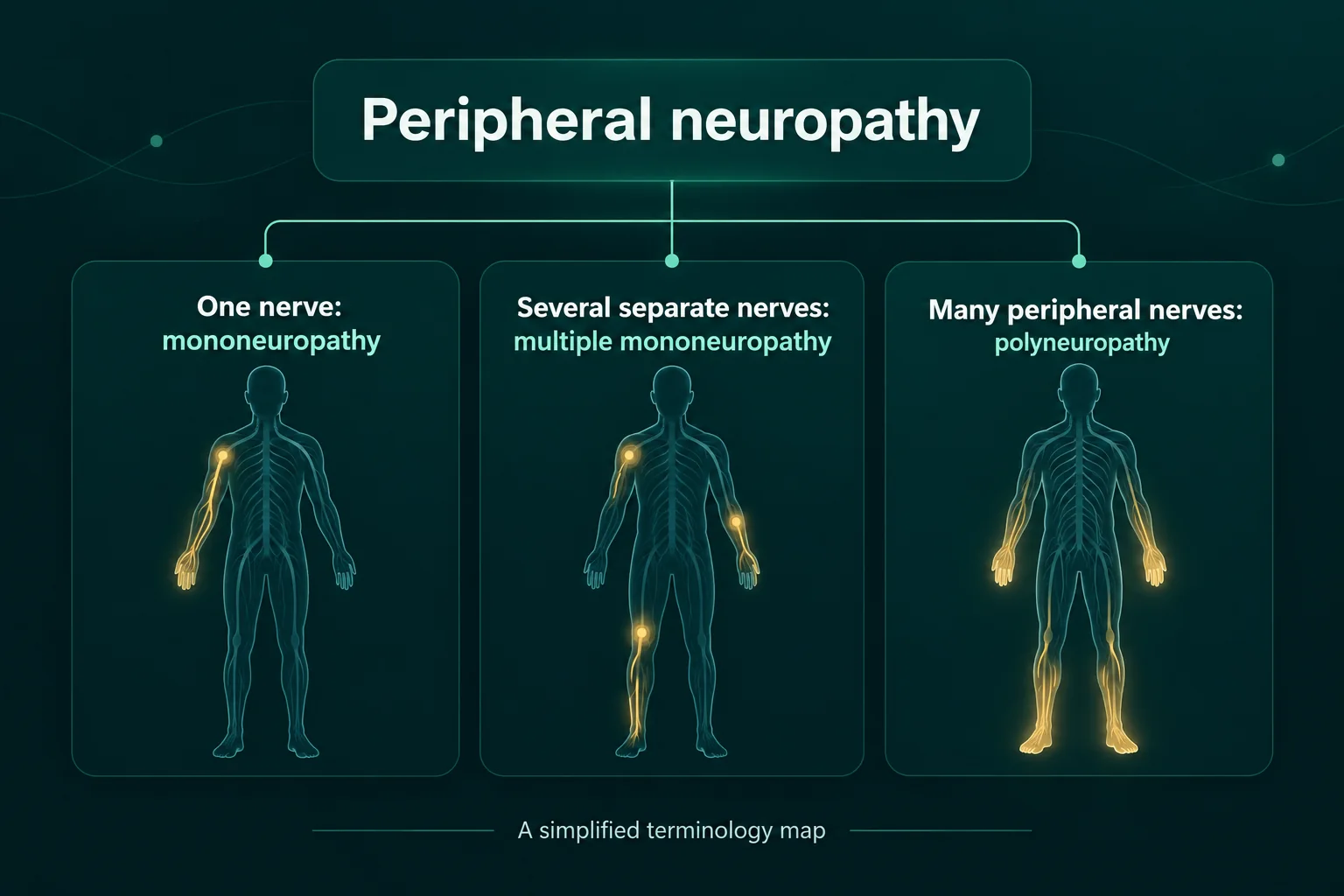
- Peripheral neuropathy: damage to nerves outside the brain and spinal cord
- Mononeuropathy: one nerve
- Multiple mononeuropathy (mononeuritis multiplex): two or more separate nerves in different areas
- Polyneuropathy: many nerves, usually in a symmetrical pattern
- Plexopathy and radiculopathy: a nerve plexus, or a nerve root near the spine
| Term | Nerves affected | Typical pattern | Examples of causes |
|---|---|---|---|
| Mononeuropathy | One | Numbness, tingling or weakness in the area that one nerve supplies | Pressure, entrapment or injury, as in carpal tunnel syndrome |
| Multiple mononeuropathy | Two or more separate nerves | Often uneven between the sides at first; nerves can be affected at once or one after another | Inflamed blood vessels (vasculitis), connective tissue diseases, diabetes |
| Polyneuropathy | Many, diffusely | Usually symmetrical, feet before hands, in a “stocking-glove” pattern | Diabetes is one of the most common causes |
What is a mononeuropathy?
A mononeuropathy means that one nerve is affected, and the numbness, tingling or weakness follows the area that nerve supplies. The Merck Manual names carpal tunnel syndrome (the median nerve at the wrist), ulnar nerve palsy at the elbow and peroneal nerve palsy near the knee as examples, and describes trauma, pressure, entrapment and compression as common causes.7
What is multiple mononeuropathy, and why does it matter?
In multiple mononeuropathy, two or more separate nerves are affected in different parts of the body. The Merck Manual describes it as often asymmetric at first, with nerves involved all at once or one after another, and notes that when many nerves are involved it can look like a polyneuropathy. Causes include diabetes and several inflammatory and connective tissue diseases.8
This is the branch where the pattern itself can be a warning sign. The review in the Canadian Medical Association Journal (CMAJ) says two patterns are highly suggestive of nerve damage caused by inflamed blood vessels (vasculitic neuropathy): a rapidly progressive, painful polyneuropathy, and several mononeuropathies at the same time. A 2024 review in Practical Neurology says vasculitic neuropathy needs rapid identification and treatment.4, 11
What makes polyneuropathy different?
Polyneuropathy affects many nerves in a diffuse way. The Merck Manual describes it as not confined to one nerve or one limb and typically fairly symmetrical on both sides. The most common kind, distal symmetric polyneuropathy, is length-dependent: the longest nerves are affected first, so symptoms usually begin in the feet and may later reach the hands, in what is often called a stocking-glove pattern.4, 9
An epidemiological review by Hanewinckel and colleagues found that polyneuropathy occurs in up to 50% of people with diabetes, that diabetes accounts for 18–49% of all polyneuropathy cases, and that in 20–30% of cases no cause is found.12
Why are the two terms so often mixed up?
I think it is mostly because polyneuropathy is so common. The CMAJ review puts its prevalence at about 1–3% of the general population, rising to roughly 7% in people over 65, and Hanewinckel’s review gives around 1% overall and up to 7% in older people. When the symmetrical, feet-first pattern is what most people know, the broad word and the specific word start to be used as if they were the same.4, 12
References don’t always draw the lines in the same place either. Cleveland Clinic’s peripheral neuropathy overview lists just two groups by the number of nerves: mononeuropathy, affecting one nerve, and polyneuropathy, affecting more than one. Mayo Clinic and the Merck Manual keep multiple mononeuropathy as a group of its own, and Cleveland Clinic’s page on mononeuropathy notes that it can be difficult for doctors to tell multiple mononeuropathy from polyneuropathy.1, 2, 6, 10
Does the difference matter for you?
I think it does, for two reasons. First, the pattern steers the search for a cause. A review in American Family Physician sorts symptoms into focal, multifocal or symmetrical patterns, and says people should be referred for nerve tests when symptoms are worrying, for example sudden in onset, asymmetrical, mainly affecting strength or automatic body functions, or quickly getting worse.13
Second, the terms tell you what a letter or report is actually saying. “Peripheral neuropathy” on its own says little about the pattern, while “distal symmetric polyneuropathy” or “ulnar mononeuropathy” says much more. The CMAJ review also describes other ways of classifying the same problem: by which kind of nerve fibre is involved, and by whether nerve tests show mainly axonal damage (the nerve fibre itself) or demyelinating damage (its insulating layer). Those are separate questions, which I cover in other articles.4
If you are unsure which term applies to you, these questions may help at your next appointment:
- Is my neuropathy in one nerve, in several separate nerves, or in many nerves in a symmetrical pattern?
- Did it start in my feet, and is it the length-dependent kind?
- Would nerve conduction tests help to clarify the pattern?
- Does the pattern change which causes you are looking for?
I’m not a doctor. I’ve written this from published research and guidance, and to help you prepare questions for your own care.
Sources
- Mayo Clinic Staff. Peripheral neuropathy – Symptoms and causes. Mayo Foundation for Medical Education and Research. Page dated 19 May 2026. https://www.mayoclinic.org/diseases-conditions/peripheral-neuropathy/symptoms-causes/syc-20352061
- Cleveland Clinic. Mononeuropathy. Last reviewed 5 May 2025. https://my.clevelandclinic.org/health/diseases/16014-mononeuropathy
- National Institute of Neurological Disorders and Stroke (NINDS). Guillain-Barré Syndrome. Last reviewed 13 March 2026. https://www.ninds.nih.gov/health-information/disorders/guillain-barre-syndrome
- Mirian A, Aljohani Z, Grushka D, Florendo-Cumbermack A. Diagnosis and management of patients with polyneuropathy. CMAJ 2023;195(6):E227–E233. doi:10.1503/cmaj.220936. https://www.cmaj.ca/content/195/6/E227
- National Institute of Neurological Disorders and Stroke (NINDS). Peripheral Neuropathy. Last reviewed 13 March 2026. https://www.ninds.nih.gov/health-information/disorders/peripheral-neuropathy
- Feldman AM. Overview of Peripheral Nervous System Disorders. Merck Manual Professional Version. Last updated May 2026. https://www.merckmanuals.com/professional/neurologic-disorders/peripheral-nervous-system-and-motor-unit-disorders/overview-of-peripheral-nervous-system-disorders
- Feldman AM. Mononeuropathies. Merck Manual Professional Version. Last updated May 2026. https://www.merckmanuals.com/professional/neurologic-disorders/peripheral-nervous-system-and-motor-unit-disorders/mononeuropathies
- Feldman AM. Multiple Mononeuropathy. Merck Manual Professional Version. Last updated May 2026. https://www.merckmanuals.com/professional/neurologic-disorders/peripheral-nervous-system-and-motor-unit-disorders/multiple-mononeuropathy
- Feldman AM. Polyneuropathy. Merck Manual Professional Version. Last updated May 2026. https://www.merckmanuals.com/professional/neurologic-disorders/peripheral-nervous-system-and-motor-unit-disorders/polyneuropathy
- Cleveland Clinic. Peripheral Neuropathy. Last updated 16 July 2026. https://my.clevelandclinic.org/health/diseases/14737-peripheral-neuropathy
- Witt AM, Kodal LS, Dysgaard T. Diagnosis and Treatment of Vasculitic Neuropathy. Practical Neurology, April 2024. https://practicalneurology.com/diseases-diagnoses/neuromuscular/diagnosis-and-treatment-of-vasculitic-neuropathy/32110/
- Hanewinckel R, van Oijen M, Ikram MA, van Doorn PA. The epidemiology and risk factors of chronic polyneuropathy. European Journal of Epidemiology 2016;31(1):5–20. doi:10.1007/s10654-015-0094-6. https://link.springer.com/article/10.1007/s10654-015-0094-6
- Castelli G, Desai KM, Cantone RE. Peripheral Neuropathy: Evaluation and Differential Diagnosis. American Family Physician 2020;102(12):732–739. https://www.aafp.org/pubs/afp/issues/2020/1215/p732.html
Sources checked on 25 September 2026.
Related reading

Restless legs or neuropathy? Similar symptoms, different assessments
Written by someone living with neuropathy: how restless legs syndrome differs from neuropathy, why the two are so often confused, how often they occur together, how each is assessed, and questions to take to your doctor.

Cold feet: nerve symptoms, circulation and when to seek help
Written by someone living with neuropathy: why feet can feel cold without being cold, when cold feet point to circulation instead, the warning signs that need urgent help, and a description aid for your appointment.

Numb hands and weak grip: neuropathy or another nerve problem?
Written by someone living with neuropathy: why numb hands and a weak grip can be a trapped nerve, a neck problem or polyneuropathy, the warning signs, and a description aid to take to your doctor.