
Yes, some medicines can damage the nerves in the feet and hands. This is called medication induced neuropathy, or drug-induced neuropathy. It is not a common cause: a neurology reference estimates that medicines and toxins cause roughly 2 to 4 percent of neuropathies. It still matters, because it is one of the forms that may get better, especially if it is found early. The safe way to look into it is a timeline and a medication review with your doctor or pharmacist, never stopping a medicine on your own.1
I have neuropathy myself, and I write these pages to make the research easier to read and to help you ask good questions. This page will not tell you which medicine to stop or change. It helps you gather the facts a doctor needs to judge whether one of your medicines could be involved.
What is medication induced neuropathy?
Peripheral neuropathy means damage to the nerves outside the brain and spinal cord. The CMAJ review notes that medications and chemotherapy agents can cause distal symmetric polyneuropathy, the most common pattern, which affects both sides evenly and starts furthest out, in the feet.2
The NHS lists some types of chemotherapy, some antibiotics taken for months (such as metronidazole or nitrofurantoin), the epilepsy medicine phenytoin when taken for a long time, amiodarone and thalidomide among the medicines that may sometimes cause peripheral neuropathy.6
A narrative review in Current Clinical Pharmacology names chemotherapy, antimicrobials, cardiovascular drugs, psychotropic medicines and anticonvulsants as the common groups, and lists existing neuropathy and diabetes as risk factors. That matters for those of us who already have neuropathy from another cause.7
Which medicines are linked to neuropathy?
I have grouped the medicines rather than listing every name, and graded them by what kind of source names the link: a regulator’s warning, the NHS plus specialist references, or specialist references only. The grading is my own simplification, not an official scale. Many people take these medicines without any nerve problems, and a medicine being in this table does not mean it caused your symptoms.
| Medicine group | Examples named in the sources | How firmly linked | Note |
|---|---|---|---|
| Fluoroquinolone antibiotics | Ciprofloxacin, levofloxacin, moxifloxacin | Regulator warning | Regulators in the US and Europe warn of nerve damage that can be long-lasting or permanent |
| Some other antibiotics, mainly with long use | Metronidazole, nitrofurantoin, linezolid | NHS and specialist references (metronidazole, nitrofurantoin); specialist references (linezolid) | The NHS mentions use over months |
| Tuberculosis medicine | Isoniazid | Specialist references | Linked to a lack of vitamin B6; StatPearls says prescribing B6 alongside it can prevent this |
| Heart and epilepsy medicines | Amiodarone, phenytoin | NHS and specialist references | For phenytoin, the NHS mentions long-term use |
| Some other older medicines | Colchicine (gout), disulfiram (alcohol), dapsone (infections and skin conditions) | Specialist references | Named in specialist lists of causes |
| Older HIV medicines | Nucleoside analogues such as didanosine and stavudine | Specialist references | The sources name older drugs in this group |
| Cancer treatments | Chemotherapy, thalidomide, bortezomib, immune checkpoint inhibitors | NHS and specialist references (some chemotherapy, thalidomide); specialist references (bortezomib, checkpoint inhibitors) | Covered in my separate article on chemotherapy-induced neuropathy |
| TNF inhibitors (for inflammatory diseases) | Infliximab, etanercept, adalimumab | Specialist references | Listed as a cause of demyelinating neuropathy, which affects the nerves’ insulating layer |
| Statins (cholesterol) | Statins as a group | Disputed | Listed in some references, but studies disagree |
| Vitamin B6 in large amounts | Pyridoxine, often in supplements | Specialist references and a study in volunteers | Covered in my separate article on vitamin B6 |
| Metformin (diabetes) | Metformin | Indirect, via low vitamin B12 (regulator advice) | Can lower vitamin B12; covered in my article on B12 deficiency |
Statins show why grading matters. The Merck Manual includes statins in its list of drugs linked to sensory neuropathy, but the MedLink Neurology review uses statins as a prime example of a drug link that is hard to establish, and a 2023 systematic review in the Journal of Pharmacy and Pharmacology found that long-term statin use was only minimally associated with neuropathy in people without diabetes. That is a question for your doctor, not one to settle alone.1, 9, 11
Some related causes have their own articles on this site, so I only mention them here: chemotherapy, too much vitamin B6 from supplements, and low vitamin B12. The UK Medicines and Healthcare products Regulatory Agency (MHRA) says that metformin can commonly reduce vitamin B12 levels, advises testing B12 when a deficiency is suspected, for example with new nerve symptoms, and tells people on metformin not to stop their treatment without first discussing it with their doctor. Merck also lists nitrous oxide among causes, which I touch on in the B12 article.9, 12
How do doctors judge whether a medicine is the cause?
There is often no simple test that proves a medicine caused the damage. MedLink notes that in some cases a time relationship between the medicine and the start of the neuropathy is the only evidence.1
A review from the American Academy of Physical Medicine and Rehabilitation says that linking a drug to neuropathy draws on criteria that include a time relationship, some dose response, and stabilisation or improvement after the drug is removed. As I understand it, doctors weigh these clues together:8
- Timing. Did the symptoms start or get worse after a medicine was started or its dose was changed? The WHO-UMC system for assessing suspected side effects asks whether there is a reasonable time relationship to taking the drug.14
- Dose and duration. Some links are described mainly with long use, such as antibiotics taken for months or phenytoin taken for a long time.6
- Other causes. The WHO-UMC system rates a link as less certain when the problem could also be explained by an illness or another drug. That is why diabetes, low vitamin B12 and other causes still need checking.14
- A doctor-led change. If the doctor stops or changes the medicine and the symptoms stabilise or improve, that supports the link. The change itself is the doctor’s decision.8
StatPearls, a medical reference, says that assessing neuropathy includes a detailed history and examination with a review of current and past medications.15
Why symptoms can get worse before they get better
In a small study of vitamin B6 nerve toxicity in volunteers, published in Neurology, symptoms kept progressing for two to three weeks after the vitamin was stopped, even when blood levels were back to normal. This is called “coasting”.13
With platinum chemotherapy, a 2025 review describes neuropathy that may worsen over several months after treatment ends. So, as I read it, some worsening soon after a change does not by itself settle the question either way.16
Recovery, when it happens, can be slow. Merck says that a causative medicine can be removed, but that recovery from polyneuropathy is slow and may be incomplete.9
A timeline you can fill in
A timeline turns vague memories into something a doctor can use, because timing is one of the first clues they look at. Write down only what happened and what you were told. The decisions about doses belong to your doctor.
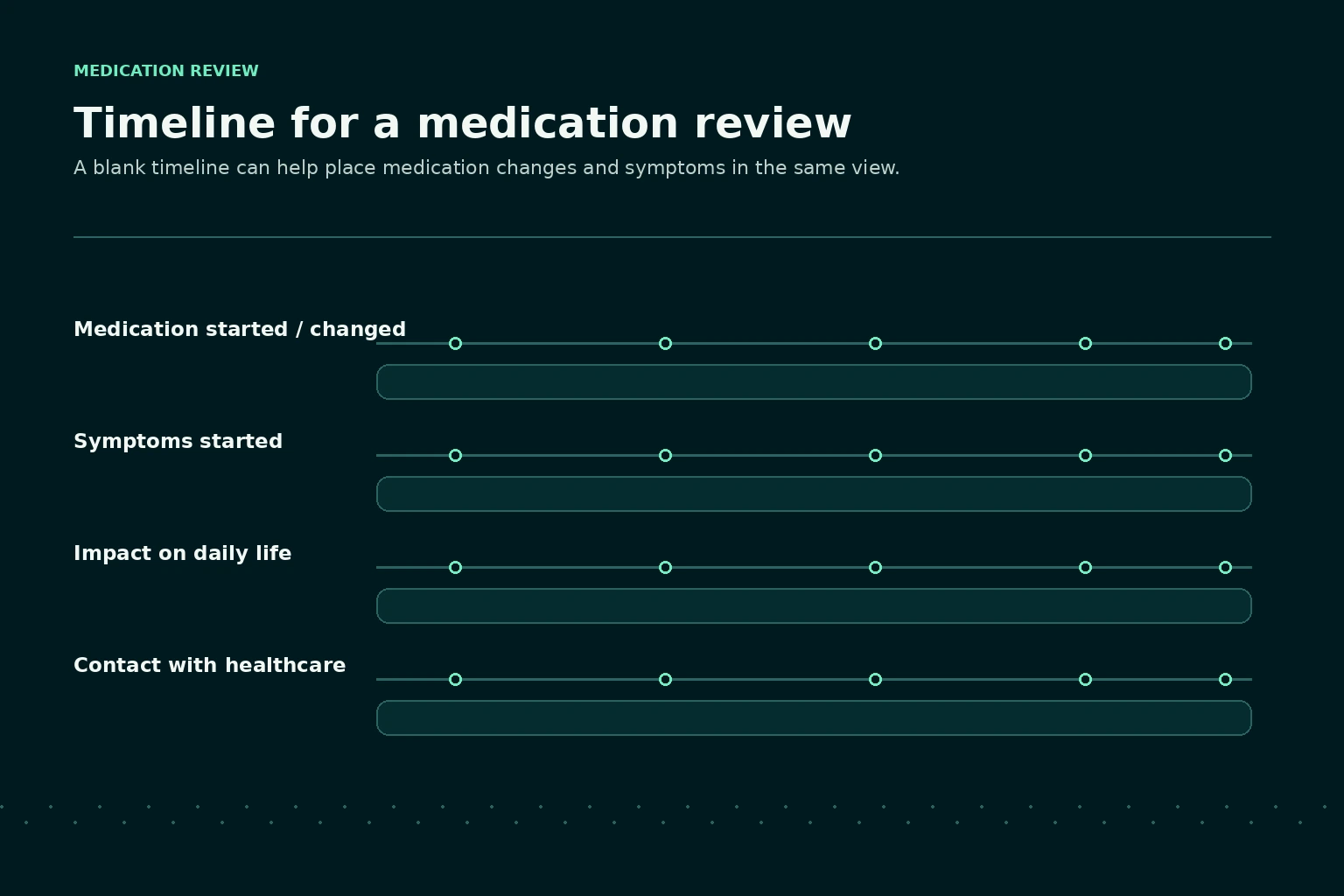
| Date | Medicine or supplement change (started, changed or stopped, as told by your doctor) | What you noticed | Notes |
|---|---|---|---|
| Example: month and year | Started a new medicine (name as on the pharmacy label) | Nothing new | Who prescribed it and why |
| Example: a few weeks later | No change | Tingling in both feet, worse at night | Also started a vitamin bought at a shop |
Go back as far as you can, ideally to several months before the symptoms began. Include short courses you have finished, such as antibiotics, and anything bought without a prescription. If you are unsure of dates, your pharmacy or your doctor’s prescription records may help fill the gaps.
How to prepare for a safe medication review
The UK National Institute for Health and Care Excellence (NICE) describes a structured medication review as a critical examination of a person’s medicines with the aim of reaching an agreement with the person about treatment. Its guideline also says the list should include prescribed, over-the-counter and complementary medicines.17
- Make a list of everything you take: prescription medicines, over-the-counter medicines, vitamins, supplements and herbal products. MedlinePlus suggests keeping such a list and reviewing it with your providers and pharmacists.3
- Bring the timeline, and the packs or labels if you are unsure of names.
- Mention medicines you have stopped, and any treatment from another doctor or hospital.
- Ask a pharmacist to go through the list with you.
- Ask whether you still need all the medicines on your list. MedlinePlus suggests asking exactly that at each appointment.3
The World Health Organization’s Medication Without Harm initiative sums up our part in three words: know, check, ask. If your doctor decides to change a medicine, ask how it will be done, what to watch for, and when you will look at the result together.18
Reporting a suspected side effect
You can report a suspected side effect to your country’s medicines regulator, and so can your doctor or pharmacist. In the UK, the MHRA’s Yellow Card scheme accepts reports from patients and the public, including about herbal medicines, and says you do not have to prove that the medicine caused the problem; a suspicion is enough.19
In the United States, the FDA’s MedWatch programme takes reports from patients and consumers about prescription and over-the-counter medicines. Other countries have their own schemes, and a pharmacist can tell you which one applies where you live. Reporting does not replace telling your own doctor.20
What remains uncertain
- How often medicines cause neuropathy. The figure of 2 to 4 percent is an estimate.1
- Whether statins cause neuropathy at all. The studies disagree, and one systematic review found the link minimal in people without diabetes.11
- How strong the evidence is for many individual medicines. Lists such as Merck’s name the drugs without grading them, and the grades in my table are my own simplification.9
- Whether, and how much, someone will recover after a doctor-led change. Recovery may be slow and incomplete, and fluoroquinolone nerve damage may be permanent.4, 9
- How long coasting can last for medicines other than vitamin B6 and platinum chemotherapy. The sources I found describe it mainly for those.13, 16
- The exact advice for fluoroquinolones, which regulators word differently, as the warning box shows. Your pack leaflet says what applies where you live.4, 5
Questions to take to your appointment
- Could any of my medicines or supplements be contributing to my nerve symptoms?
- How likely do you think a link is, and what else could explain it?
- Have other causes, such as diabetes or low vitamin B12, been checked?
- If we change something, how will it be done safely, and who do I contact if I feel worse?
- How long should we wait before deciding whether a change has helped? Could symptoms get worse first?
- Are any of my medicines risky to stop suddenly?
- Would a pharmacist review of all my medicines be useful?
- Should this be reported as a suspected side effect?
- Which symptoms mean I should seek help urgently?
I’m not a doctor. I’ve written this from published research and guidance, and to help you prepare questions for your own care.
Sources
- Weimer LH. Drug-induced neuropathies. MedLink Neurology. Updated 6 December 2025. https://www.medlink.com/articles/drug-induced-neuropathies
- Mirian A, Aljohani Z, Grushka D, Florendo-Cumbermack A. Diagnosis and management of patients with polyneuropathy. CMAJ 2023;195(6):E227–E233. doi:10.1503/cmaj.220936. https://www.cmaj.ca/content/195/6/E227
- MedlinePlus (US National Library of Medicine). Taking multiple medicines safely. Review date 23 July 2024. https://medlineplus.gov/ency/patientinstructions/000883.htm
- US Food and Drug Administration (FDA). FDA Drug Safety Communication: FDA requires label changes to warn of risk for possibly permanent nerve damage from antibacterial fluoroquinolone drugs taken by mouth or by injection. 15 August 2013. https://www.fda.gov/media/86575/download
- European Medicines Agency (EMA). Quinolone- and fluoroquinolone-containing medicinal products – referral. Review concluded November 2018; European Commission decision March 2019. https://www.ema.europa.eu/en/medicines/human/referrals/quinolone-fluoroquinolone-containing-medicinal-products
- NHS. Peripheral neuropathy: causes. Last reviewed 10 October 2022. https://www.nhs.uk/conditions/peripheral-neuropathy/causes/
- Jones MR, Urits I, Wolf J, et al. Drug-induced peripheral neuropathy: a narrative review. Current Clinical Pharmacology 2020;15(1):38–48. doi:10.2174/1574884714666190121154813. https://www.eurekaselect.com/article/95984
- Choi Y, Barker K, Floresca R. Peripheral Neuropathies Associated with Drugs and Toxins. PM&R KnowledgeNow, American Academy of Physical Medicine and Rehabilitation. Last updated 18 September 2025. https://now.aapmr.org/peripheral-neuropathies-associated-with-drugs-and-toxins/
- Feldman AM. Polyneuropathy. Merck Manual Professional Edition. Reviewed/revised May 2026. https://www.merckmanuals.com/professional/neurologic-disorders/peripheral-nervous-system-and-motor-unit-disorders/polyneuropathy
- Badrinath M, Chen RJ, John S. Isoniazid Toxicity. StatPearls. StatPearls Publishing; last updated 28 February 2024. https://www.ncbi.nlm.nih.gov/books/NBK531488/
- Daliri M, Johnston TP, Sahebkar A. Statins and peripheral neuropathy in diabetic and non-diabetic cases: a systematic review. Journal of Pharmacy and Pharmacology 2023;75(5):593–611. doi:10.1093/jpp/rgac104. https://academic.oup.com/jpp/article/75/5/593/7058753
- Medicines and Healthcare products Regulatory Agency (MHRA). Metformin and reduced vitamin B12 levels: new advice for monitoring patients at risk. Drug Safety Update, 20 June 2022. https://www.gov.uk/drug-safety-update/metformin-and-reduced-vitamin-b12-levels-new-advice-for-monitoring-patients-at-risk
- Berger AR, Schaumburg HH, Schroeder C, Apfel S, Reynolds R. Dose response, coasting, and differential fiber vulnerability in human toxic neuropathy: a prospective study of pyridoxine neurotoxicity. Neurology 1992;42(7):1367–1370. doi:10.1212/wnl.42.7.1367. https://www.neurology.org/doi/10.1212/WNL.42.7.1367
- World Health Organization (WHO) and the WHO Collaborating Centre for International Drug Monitoring. The use of the WHO-UMC system for standardised case causality assessment. https://www.who.int/docs/default-source/medicines/pharmacovigilance/whocausality-assessment.pdf
- Hammi C, Yeung B. Neuropathy. StatPearls. StatPearls Publishing; last updated 15 October 2022. https://www.ncbi.nlm.nih.gov/books/NBK542220/
- Rahman N, Sukumar J, Lustberg MB. Chronic chemotherapy-induced peripheral neuropathy: living with neuropathy during and after cancer treatments. Annals of Palliative Medicine 2025;14(2):196–216. doi:10.21037/apm-24-154. https://apm.amegroups.org/article/view/136218/html
- National Institute for Health and Care Excellence (NICE). Medicines optimisation: the safe and effective use of medicines to enable the best possible outcomes (NG5). Published 2015. https://www.nice.org.uk/guidance/ng5/chapter/Recommendations
- World Health Organization. Medication Without Harm. https://www.who.int/initiatives/medication-without-harm
- Medicines and Healthcare products Regulatory Agency (MHRA). The Yellow Card scheme: guidance for healthcare professionals, patients and the public. Published 23 January 2015, last updated 24 July 2025. https://www.gov.uk/guidance/the-yellow-card-scheme-guidance-for-healthcare-professionals-patients-and-the-public
- US Food and Drug Administration (FDA). MedWatch: The FDA Safety Information and Adverse Event Reporting Program. https://www.fda.gov/safety/medwatch-fda-safety-information-and-adverse-event-reporting-program
Sources checked on 26 September 2026.
Related reading

Restless legs or neuropathy? Similar symptoms, different assessments
Written by someone living with neuropathy: how restless legs syndrome differs from neuropathy, why the two are so often confused, how often they occur together, how each is assessed, and questions to take to your doctor.

Cold feet: nerve symptoms, circulation and when to seek help
Written by someone living with neuropathy: why feet can feel cold without being cold, when cold feet point to circulation instead, the warning signs that need urgent help, and a description aid for your appointment.

Numb hands and weak grip: neuropathy or another nerve problem?
Written by someone living with neuropathy: why numb hands and a weak grip can be a trapped nerve, a neck problem or polyneuropathy, the warning signs, and a description aid to take to your doctor.