Chemotherapy-induced peripheral neuropathy (CIPN) is nerve damage caused by some cancer drugs. It usually shows up as tingling, numbness or pain in the fingers and toes, and it is common: a large review found it in about two thirds of people in the first month after chemotherapy and in roughly one in three six months or more later. Managing it involves three separate things: lowering the risk, easing symptoms, and decisions about the cancer treatment itself, which belong to you and your oncology team together.1, 2
I have neuropathy myself, and I write these pages to make the research easier to read and to help you ask good questions. This page is about what the international guidelines and studies say about neuropathy from cancer treatment. One thing I want to say clearly from the start: nothing on this page is a reason to pause, skip or lower a cancer treatment on your own. Those decisions affect how well the treatment works and need to be made with your oncology team.
What is chemotherapy-induced peripheral neuropathy?
Peripheral neuropathy means damage to the nerves outside the brain and spinal cord. The guideline from the American Society of Clinical Oncology (ASCO) names the main drug groups that can cause it: taxanes, platinum drugs, vinca alkaloids, epothilones, eribulin and bortezomib. The ASCO guideline describes the neuropathy as mainly sensory, and the most common words people use for it are numbness, tingling and pain.1
Macmillan Cancer Support gives a patient-level list of drugs that can cause it, including cisplatin, carboplatin and oxaliplatin, docetaxel, paclitaxel and cabazitaxel, vincristine, vinblastine and vinorelbine, thalidomide, lenalidomide and pomalidomide, and bortezomib. Not everyone who gets these drugs develops neuropathy. Cancer Research UK explains that how likely it is depends on the drug or combination of drugs, the dose and how your body reacts.5, 6
Cancer Research UK notes that some immunotherapy drugs, such as ipilimumab, can also cause nerve changes. Immunotherapy and other newer treatments are not the main subject of this page. If you are on one of them, ask your team what nerve side effects to look out for.6
What does CIPN feel like?
The US National Cancer Institute (NCI) describes tingling, numbness or a pins-and-needles feeling in the feet and hands that may spread up the legs and arms, and not being able to feel heat or cold properly. Macmillan adds a burning feeling and difficulty doing up buttons or picking up small objects. Neuropathy from chemotherapy usually affects the hands and feet.5, 7
The nerves that control muscles can also be affected. The NCI mentions weak or achy muscles that can make you lose your balance, trip easily or struggle to open jars. The ASCO guideline notes that people with CIPN can have balance troubles and a higher chance of falling.1, 7
Some people also get symptoms from the autonomic nerves, which run things like the bowel, bladder and blood pressure. The European guideline from ESMO, EONS and EANO describes autonomic involvement as typical with vincristine and bortezomib, with symptoms such as abdominal pain, constipation, dizziness on standing and bladder problems.8
The special cold reaction with oxaliplatin
Oxaliplatin, often used for bowel cancer, can cause a short-lived reaction in the days around each treatment. ASCO describes it as sensitivity to cold, discomfort in the throat, discomfort when swallowing cold liquids, and muscle cramps. A review in Oncology and Therapy reports that in one study of 346 people on oxaliplatin-based treatment these were very common, with cold sensitivity in 71 percent. This acute reaction is different from the longer-lasting neuropathy that can build up over many treatments.1, 9
How common is it, and does it go away?
A systematic review and meta-analysis in the journal Pain gathered 31 studies with 4,179 people. The share with CIPN was 68 percent in the first month after chemotherapy, 60 percent at three months and 30 percent at six months or more. The uncertainty is large: for the six-month figure the confidence interval runs from 6 to 54 percent, and the review found that rates differed between chemotherapy drugs.2
According to the European guideline, symptoms usually appear during the first two months of treatment, get worse while treatment continues and then usually stabilise soon after it ends. With platinum drugs there is a known exception called coasting. ASCO describes how oxaliplatin neuropathy on average keeps getting worse for two to three months after treatment stops, and then tends to improve.1, 8
For many people it gets better over time. Macmillan writes that symptoms gradually improve for most people once the drug is stopped, but that this may take several months or longer. ASCO notes that in a subset of people the neuropathy can remain a substantial, disabling problem for years. The Oncology and Therapy review cites studies where 31–44 percent of people treated with docetaxel or paclitaxel still reported symptoms after up to six years.5, 9
Who has a higher risk?
ASCO advises clinicians to weigh the risks and benefits of nerve-toxic drugs in people who already have neuropathy or conditions that make it more likely, such as diabetes. The European guideline mentions diabetes and older age as proposed risk factors, and says that the risk depends on the size of each dose and on the total dose over time.1, 8
The meta-analysis in Pain found that only a few studies looked at risk factors. Those that did pointed to neuropathy already present before treatment, smoking, reduced kidney function and sensory changes during chemotherapy. As I read it, together with the ASCO advice above, the practical point is simple: tell your oncologist before treatment starts if you already have neuropathy, diabetes or a family history of nerve disease.1, 2
Three different questions that are easy to mix up
When I read about CIPN, I found it helpful to keep three questions apart. They have different evidence, and they are decided in different ways.
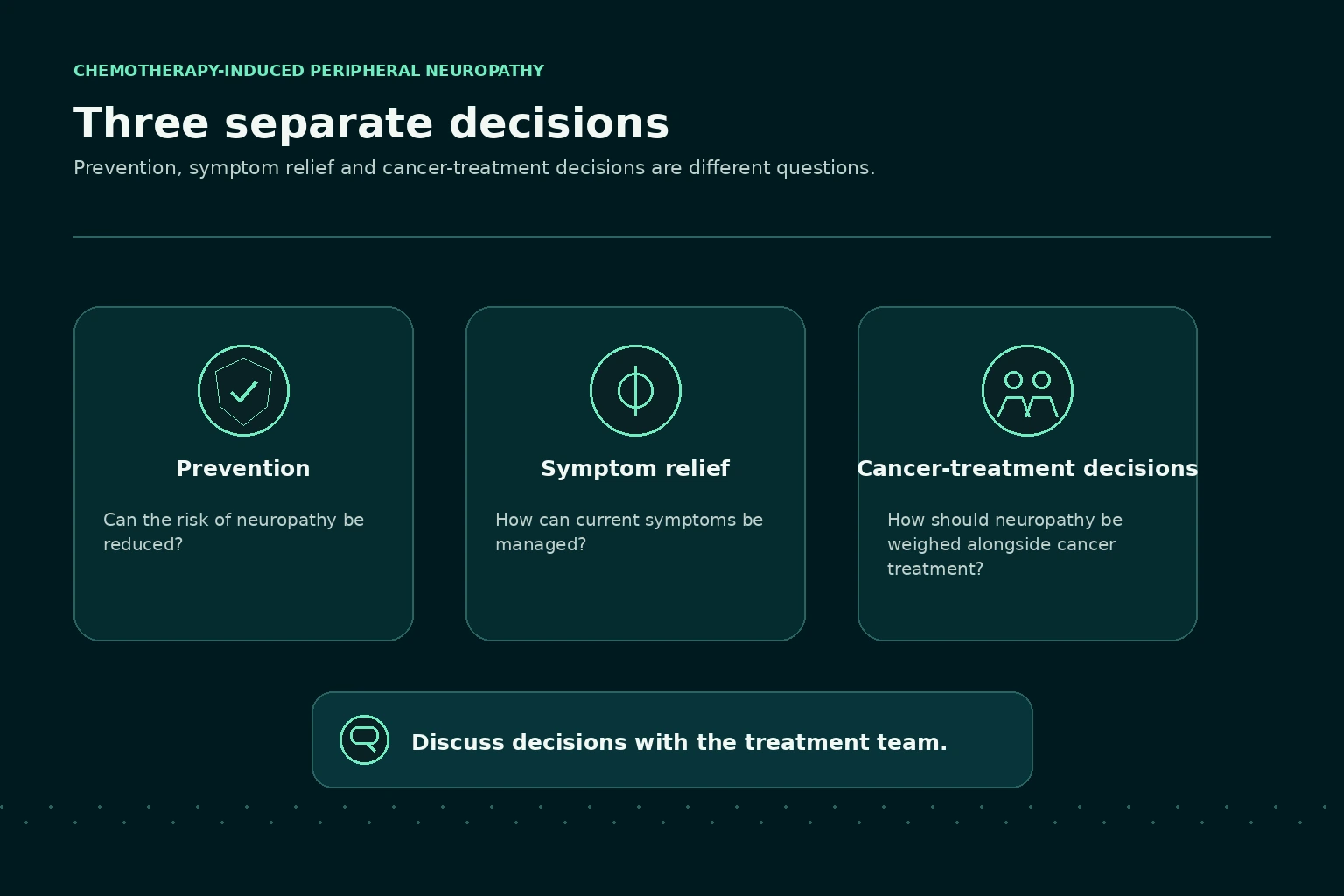
| Question | What the guidelines say, in short | Who decides |
|---|---|---|
| Can CIPN be prevented? | No medicine or supplement is recommended to prevent it. Cooling, compression and exercise are being studied; the two big guidelines judge them differently | You and your team, often as part of a clinic’s routine or a study |
| How can symptoms and pain be eased? | Duloxetine has the best evidence for painful CIPN, but the benefit is modest. Other options have weaker or mixed evidence | You and your oncologist, GP or pain team |
| Should the cancer treatment change? | If neuropathy becomes intolerable or affects function, delaying, lowering, stopping or switching the drug should be discussed | Your oncologist together with you, weighing nerve effects against the benefit of the cancer treatment |
Can chemotherapy-induced peripheral neuropathy be prevented?
This is where many people hope for a simple answer, and there isn’t one yet. The ASCO guideline, updated in 2020, recommends no medicine for preventing CIPN. It specifically says that acetyl-L-carnitine should not be offered and should be discouraged, because it may do harm. It also recommends against a long list of other agents for prevention, among them calcium and magnesium, vitamin B, vitamin E, omega-3 fatty acids and several drugs also used for nerve pain, such as gabapentin, pregabalin, amitriptyline and venlafaxine.1
As I read it, this is a good reason not to start supplements on your own to protect your nerves. Some supplements have not helped in trials, and it is worth asking your team before taking anything new during cancer treatment.
Cooling, compression and exercise
Cooling the hands and feet with frozen gloves or socks during the infusion, or squeezing them with tight surgical gloves, is meant, as I understand it, to reduce blood flow to the hands and feet so that less of the drug reaches the nerves there. Here the two main guidelines differ. ASCO makes no recommendation for or against cryotherapy, compression or exercise for prevention outside clinical trials, while noting that they look reasonably safe and that there is a risk of frostbite with cooling. The European guideline says cryotherapy can be considered, with most evidence for taxanes, and that compression can also be considered because it seems to do little harm. Both are given grade C, a low strength of recommendation in ESMO’s system.1, 8
Newer research leans in the same hopeful but uncertain direction. A 2025 meta-analysis of women with breast cancer treated with paclitaxel or nab-paclitaxel pooled 14 studies and found moderate or worse neuropathy in 25 percent with cryotherapy against 42 percent in the comparison groups. Cold intolerance was the most common side effect. It is one review in one group of patients, so it does not settle the question. A large US trial, SWOG S2205, is comparing cooling with compression and compression alone during taxane treatment, and it was listed as recruiting when I checked.10, 11
Cooling is not for everyone. With oxaliplatin, cold is exactly what triggers the short-lived symptoms described above. Macmillan’s general advice for people with neuropathy points the other way: keep hands and feet warm, and wear gloves and socks in cold weather. Macmillan also suggests asking your cancer team whether cooling is available where you are treated. As I see it, whether cooling or compression is offered depends on your drug and on the clinic, so it is a question to ask before treatment starts.1, 5
The European guideline says exercise to improve muscle strength and sensorimotor function can be offered to people at risk of CIPN. ASCO found the evidence too weak for a recommendation. As I understand it, exercise is unlikely to harm and has other benefits during cancer treatment, but it is not proven to prevent nerve damage.1, 8
What helps with pain and other symptoms?
One medicine has the best evidence so far. ASCO writes that duloxetine is the only agent with appropriate evidence for established painful CIPN, but that the amount of benefit is limited, and says clinicians may offer it. The European guideline recommends duloxetine for neuropathic pain from CIPN.1, 8
An important trial behind that recommendation was a randomised trial in JAMA with 231 people who had painful neuropathy after paclitaxel, other taxanes or oxaliplatin. After the first five weeks, 59 percent of those on duloxetine reported at least some decrease in pain, against 38 percent on placebo. The average difference was modest, less than one point on a 0–10 pain scale. Like all medicines, duloxetine can have side effects and interactions, so whether it suits you is something to go through with your doctor.12
For other medicines the picture is less clear. ASCO makes no recommendation for gabapentin, pregabalin or tricyclic antidepressants for CIPN outside trials. The European guideline is somewhat more open and says, for example, that venlafaxine can be considered and that a low-strength menthol cream on the skin should be considered because it is cheap and has had no reported side effects. As I read it, evidence from other kinds of nerve pain, such as diabetic neuropathy, cannot simply be transferred to CIPN.1, 8
Exercise, acupuncture and other treatments
ASCO writes that exercise, acupuncture and a nerve stimulation method called scrambler therapy show early signs of easing established symptoms and appear reasonably safe, but found too little evidence to recommend them. A 2024 meta-analysis of 15 randomised trials with 1,124 people found that exercise improved symptom scores, balance, pain and quality of life, but the certainty of the evidence was rated low to very low.1, 13
A 2024 network meta-analysis of 33 trials with 2,027 people found that acupuncture-related treatments did better than usual care, medicines or supplements on symptoms, pain and quality of life, but almost half of the trials were judged at high risk of bias, mainly because of problems with blinding. A 2025 overview of systematic reviews came to a similar bottom line: at least short-term relief from duloxetine-type medicines and acupuncture for people who have finished chemotherapy, some benefit from home-based balance and strength exercise during chemotherapy, while gabapentin seems unlikely to help and other medicines remain uncertain.14, 15
Your cancer treatment plan: why dose changes are a shared decision
Since no medicine prevents CIPN, the main lever, as I read the guidelines, is often the cancer treatment itself, and that is exactly why changes must not be made on your own. ASCO recommends that if neuropathy becomes intolerable or affects function, clinicians assess and discuss with the patient whether to delay the next dose, lower it, stop the drug or switch to one that does not affect the nerves.1
There is a real trade-off. The Oncology and Therapy review points out that dose reductions or stopping treatment early may affect how well the treatment works and survival. A framework written by CIPN researchers, including authors of the ASCO guideline, describes weighing the benefit of changing treatment to reduce neuropathy against the risk of making the cancer treatment less effective, taking into account the disease, the person and how much neuropathy that person feels they could live with. As I understand it, how much that trade-off matters differs a lot depending on the cancer and the aim of the treatment.9, 16
What you can do is report your symptoms honestly and in detail. The European guideline notes that health professionals tend to underestimate the symptoms patients experience. Neuropathy is often graded on a common scale, the CTCAE, where a moderate grade means the symptoms limit what the scale calls instrumental activities of daily living, such as preparing meals, shopping or using the telephone, and a severe grade means they limit self-care such as bathing, dressing and eating. Describing what you can and cannot do, rather than only saying “a bit numb”, gives your team much better information.8, 17
Everyday safety when your hands and feet feel less
Patient organisations give practical advice that makes sense whatever the cause of the numbness. The NCI suggests checking your arms, legs and feet every day for cuts or scratches. Macmillan suggests testing hot water with your elbow and not walking around barefoot. To lower the risk of falling, Macmillan suggests well-lit rooms and walkways free of clutter, and the NCI suggests sturdy shoes with soft soles and moving rugs out of your path.5, 7
The European guideline adds a caveat that permission to drive must be discussed with the treating oncologist. As I read it, that matters especially if numbness or weakness affects your feel for the pedals or your grip on the wheel.8
What remains uncertain about CIPN
- Whether cooling or compression prevents lasting nerve damage. The guidelines differ, and at least one large trial is still under way.1, 8, 11
- How many people have symptoms years later. Figures vary a lot between drugs and studies.2
- Which treatments help numbness itself. Most evidence is about pain, and no medicine has been shown to reverse the nerve damage.1, 5
- How much exercise and acupuncture help. Meta-analyses are positive, but the certainty is low and many trials have a high risk of bias.13, 14
- As far as I have found, neither ASCO nor ESMO has published a newer CIPN guideline since 2020, so parts of the advice may change.
Questions to take to your oncology appointment
Before treatment starts
- Can the drugs in my treatment affect the nerves, and how likely is that for me?
- I already have neuropathy, diabetes or nerve disease in the family. Does that change anything?
- Is cooling or compression used at this clinic for my drugs, or is there a study I could join?
- Is there anything I should avoid, for example cold drinks or cold air with oxaliplatin?
- Is it safe to take my usual supplements during treatment?
During treatment
- Which symptoms should I report before each treatment, and which should I report straight away?
- Who do I call, day and night, if symptoms get worse quickly?
- If my symptoms get worse, what are the options, and how would a change affect the aim of my cancer treatment?
- Could a physiotherapist help with balance and strength?
After treatment
- Could my symptoms still get worse for a while after the last dose?
- What can be done for pain, and what are the side effects?
- If new nerve symptoms start later on, who should I contact, and should other causes be checked?
I’m not a doctor. I’ve written this from published research and guidance, and to help you prepare questions for your own care.
Sources
- Loprinzi CL, Lacchetti C, Bleeker J, et al. Prevention and Management of Chemotherapy-Induced Peripheral Neuropathy in Survivors of Adult Cancers: ASCO Guideline Update. Journal of Clinical Oncology 2020;38(28):3325–3348. doi:10.1200/JCO.20.01399. https://doi.org/10.1200/JCO.20.01399
- Seretny M, Currie GL, Sena ES, et al. Incidence, prevalence, and predictors of chemotherapy-induced peripheral neuropathy: a systematic review and meta-analysis. Pain 2014;155(12):2461–2470. doi:10.1016/j.pain.2014.09.020. https://www.sciencedirect.com/science/article/pii/S0304395914004436
- American Cancer Society. Peripheral Neuropathy. Last revised 20 May 2025. https://www.cancer.org/cancer/side-effects/pain/peripheral-neuropathy.html
- Mirian A, Aljohani Z, Grushka D, Florendo-Cumbermack A. Diagnosis and management of patients with polyneuropathy. CMAJ 2023;195(6):E227–E233. doi:10.1503/cmaj.220936. https://www.cmaj.ca/content/195/6/E227
- Macmillan Cancer Support. Peripheral neuropathy and cancer: symptoms and support. https://www.macmillan.org.uk/cancer-information-and-support/impacts-of-cancer/peripheral-neuropathy
- Cancer Research UK. Nerve changes and cancer drugs. Last reviewed 14 June 2023. https://www.cancerresearchuk.org/about-cancer/treatment/cancer-drugs/side-effects/nerve-changes
- National Cancer Institute. Nerve Problems (Peripheral Neuropathy) and Cancer Treatment. Reviewed 15 January 2020. https://www.cancer.gov/about-cancer/treatment/side-effects/nerve-problems
- Jordan B, Margulies A, Cardoso F, et al. Systemic anticancer therapy-induced peripheral and central neurotoxicity: ESMO–EONS–EANO Clinical Practice Guidelines for diagnosis, prevention, treatment and follow-up. Annals of Oncology 2020;31(10):1306–1319. doi:10.1016/j.annonc.2020.07.003. https://www.sciencedirect.com/science/article/pii/S0923753420399385
- Burgess J, Ferdousi M, Gosal D, et al. Chemotherapy-Induced Peripheral Neuropathy: Epidemiology, Pathomechanisms and Treatment. Oncology and Therapy 2021;9(2):385–450. doi:10.1007/s40487-021-00168-y. https://link.springer.com/article/10.1007/s40487-021-00168-y
- Ashok Kumar P, Sampat P, Sandhu M, et al. A meta-analysis of the utility of cryotherapy for preventing peripheral neuropathy among breast cancer patients receiving paclitaxel and nab-paclitaxel. Breast Cancer Research and Treatment 2025;210:595–604. doi:10.1007/s10549-024-07597-z. https://link.springer.com/article/10.1007/s10549-024-07597-z
- SWOG Cancer Research Network. Cooling and Compression to Prevent Peripheral Neuropathy (Nerve Damage) During Chemotherapy (S2205, NCT05642611). https://www.swog.org/patients/trials-open-patients/cooling-and-compression-prevent-peripheral-neuropathy-nerve-damage
- Smith EML, Pang H, Cirrincione C, et al. Effect of duloxetine on pain, function, and quality of life among patients with chemotherapy-induced painful peripheral neuropathy: a randomized clinical trial. JAMA 2013;309(13):1359–1367. doi:10.1001/jama.2013.2813. https://pmc.ncbi.nlm.nih.gov/articles/PMC3912515/
- Huang Y, Tan T, Liu L, et al. Exercise for reducing chemotherapy-induced peripheral neuropathy: a systematic review and meta-analysis of randomized controlled trials. Frontiers in Neurology 2024;14:1252259. doi:10.3389/fneur.2023.1252259. https://www.frontiersin.org/journals/neurology/articles/10.3389/fneur.2023.1252259/full
- Yeh ML, Liao RW, Yeh PH, Lin CJ, Wang YJ. Acupuncture-related interventions improve chemotherapy-induced peripheral neuropathy: a systematic review and network meta-analysis. BMC Complementary Medicine and Therapies 2024;24:310. doi:10.1186/s12906-024-04603-1. https://link.springer.com/article/10.1186/s12906-024-04603-1
- Ye AL, Abdi S. Beyond p-values: a cross-sectional umbrella review of chemotherapy-induced peripheral neuropathy treatments. Frontiers in Pain Research 2025;6:1564662. doi:10.3389/fpain.2025.1564662. https://www.frontiersin.org/journals/pain-research/articles/10.3389/fpain.2025.1564662/full
- Hertz DL, Childs DS, Park SB, et al. Patient-centric decision framework for treatment alterations in patients with Chemotherapy-induced Peripheral Neuropathy (CIPN). Cancer Treatment Reviews 2021;99:102241. doi:10.1016/j.ctrv.2021.102241. https://www.sciencedirect.com/science/article/abs/pii/S030573722100089X
- National Cancer Institute, Cancer Therapy Evaluation Program. Common Terminology Criteria for Adverse Events (CTCAE) Version 6.0. Published 22 July 2025. https://dctd.cancer.gov/research/ctep-trials/for-sites/adverse-events/ctcae-v6.pdf
Sources checked on 26 September 2026.
Related reading
Restless legs or neuropathy? Similar symptoms, different assessments
Written by someone living with neuropathy: how restless legs syndrome differs from neuropathy, why the two are so often confused, how often they occur together, how each is assessed, and questions to take to your doctor.
Cold feet: nerve symptoms, circulation and when to seek help
Written by someone living with neuropathy: why feet can feel cold without being cold, when cold feet point to circulation instead, the warning signs that need urgent help, and a description aid for your appointment.
Numb hands and weak grip: neuropathy or another nerve problem?
Written by someone living with neuropathy: why numb hands and a weak grip can be a trapped nerve, a neck problem or polyneuropathy, the warning signs, and a description aid to take to your doctor.