
Blood tests for neuropathy are not a test for neuropathy itself. They are a search for its cause. Each tube answers a specific question: is blood sugar raised, is vitamin B12 low, is there an abnormal protein in the blood, are the kidneys, liver or thyroid involved? A Canadian review lists a short set of screening tests to start with, and further on this page I look at the extra tests that are added when something specific points that way.1, 2
I have neuropathy myself, and when I started reading about this I wanted to know what each of those tests was actually for. This page is my attempt to translate the common test groups into the questions behind them, and to be honest about what they cannot show. It is not a list to order for yourself, and it contains no cut-off values to judge your own results against. Your results only make sense next to your symptoms, your examination and the reference ranges of the lab that ran them.
What can blood tests for neuropathy actually show?
StatPearls, a medical reference used by clinicians, puts it plainly: there are no standard laboratory or imaging tests for peripheral neuropathy itself. The tests it lists, from blood counts to vitamin levels and infection tests, can help the diagnosis, largely by looking for a cause. For the common type that starts in both feet, the CMAJ review says that neuropathic symptoms and signs together with electrodiagnostic findings (nerve tests such as nerve conduction studies) give the most accurate diagnosis.1, 2
The same review gives a sense of scale. For the common pattern that starts in both feet, the history and examination point to a cause in nearly 60% of people. Screening blood tests find one in about 10% more, and around 30% remain without a known cause. A review in American Family Physician puts the share with no cause found at 25–46%.1, 4
So blood tests are a smaller part of the picture than many of us expect, but that 10% still matters to the people it applies to.
The first round: common screening tests
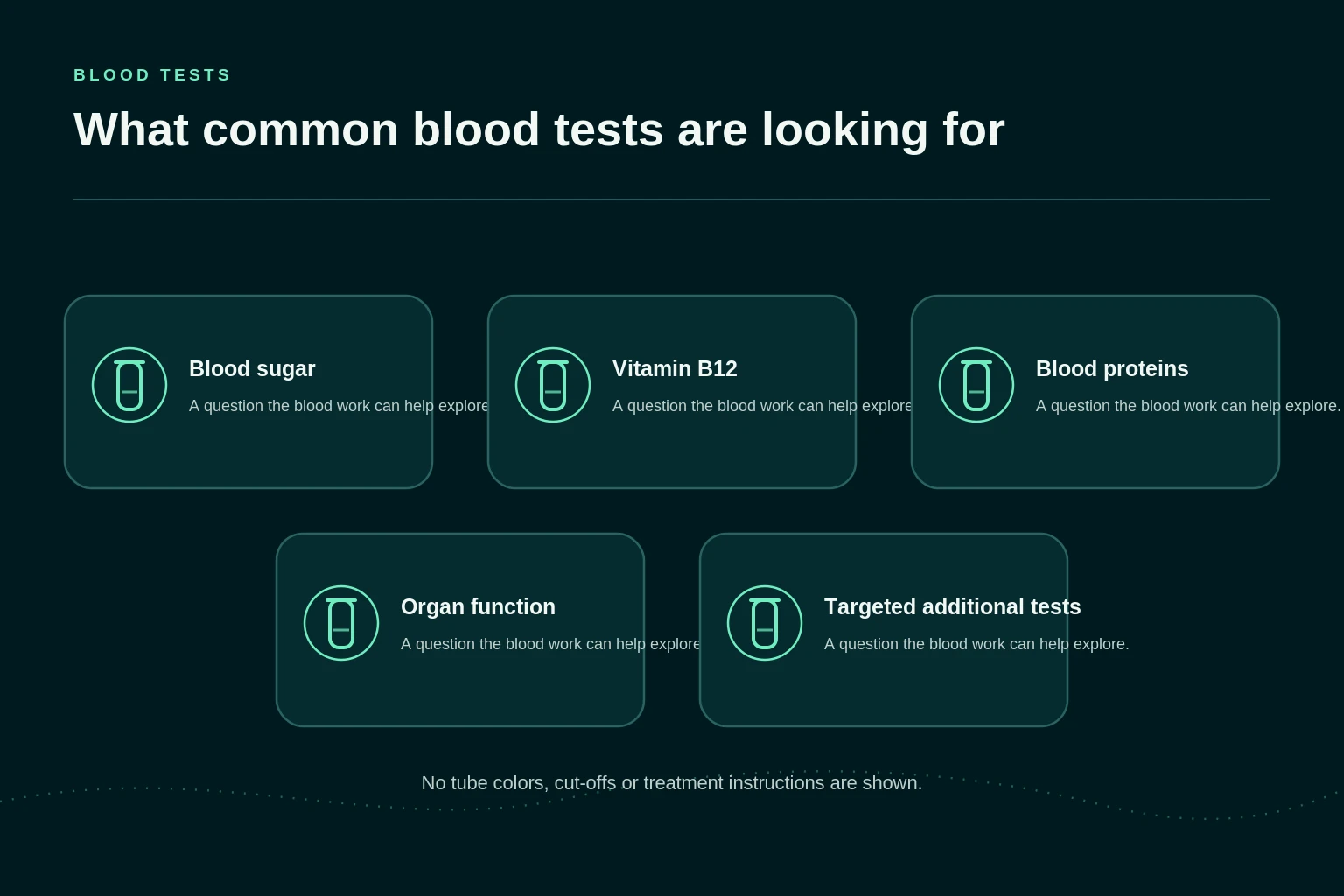
There is no single panel that every source agrees on. The CMAJ review lists a blood count, salts (sodium, potassium, chloride and bicarbonate), kidney tests, liver tests, fasting glucose and HbA1c, serum protein electrophoresis, and vitamin B12 with or without methylmalonic acid. The American Family Physician review adds thyroid-stimulating hormone (TSH) to its first round, and protein electrophoresis with immunofixation.1, 4
A guideline from the American Academy of Neurology (AAN) and two partner societies found that three tests turned up abnormal results most often: blood glucose, B12 with its breakdown products, and serum protein immunofixation electrophoresis. This recommendation is graded Level C, the lowest of the guideline’s A-to-C grades: the tests “may be considered”. The guideline dates from 2009, and the AAN reaffirmed it in February 2025. It also says there are no controlled studies on when to use other specific tests.5
The table is my own summary of what the sources describe. It is meant to help you understand a test you have been offered, not to decide which tests you should have.
| Test group | The question behind it | What can make it misleading |
|---|---|---|
| Fasting glucose and HbA1c, sometimes a glucose tolerance test | Could diabetes or raised blood sugar be the cause? | Routine tests may not show every blood sugar problem, so a tolerance test is sometimes added |
| Vitamin B12, sometimes methylmalonic acid or homocysteine | Is there a B12 deficiency, even when the B12 result itself is unclear? | Over-the-counter B12 products can raise the level without fully treating a deficiency; kidney problems and older age can raise methylmalonic acid |
| Serum protein electrophoresis with immunofixation | Is there an abnormal (monoclonal) protein in the blood? | Such proteins become more common with age and are often found by chance; a finding does not prove it caused the neuropathy |
| Blood count, salts, kidney and liver tests | Is another condition, such as kidney or liver disease, affecting the nerves? | Mostly general clues that need follow-up rather than answers on their own |
| Thyroid tests (TSH) | Could a thyroid problem play a part? | Included in some first-round lists but not in others |
| Targeted tests: inflammation and autoimmune markers, infections, copper and other vitamins, nerve antibodies, genetic tests | Does something specific in the history or examination point to a particular cause? | Chosen according to the history and examination rather than ordered for everyone; see the antibody example further down |
Blood sugar: why one number is not always enough
Diabetes is the cause most people think of first, and glucose and HbA1c are the usual starting point. The CMAJ review recommends a two-hour glucose tolerance test when HbA1c lies just below the diabetes range. The AAN guideline says a glucose tolerance test may be considered in sensory neuropathy when routine tests do not show diabetes, especially if there is pain.1, 5
In practice this test is not done very often. A 2025 study of US Medicare claims from 2019 found that glucose tolerance tests and protein electrophoresis were still likely underused, despite the recommendations. It also concluded that simple blood tests were the most cost-effective way to find causes that can be acted on.9
Vitamin B12: when a “normal” result is not the whole story
B12 deficiency is one of the causes where a blood test really can change what happens next. NICE, which writes guidance for the NHS in England, lists pins and needles, numbness, unsteady walking and balance problems among the signs. It also says a deficiency should not be ruled out just because there is no anaemia.6
NICE says the first test should be either total B12 or “active B12” (holotranscobalamin). If the result is indeterminate and there are symptoms, NICE says to consider measuring methylmalonic acid. The US Office of Dietary Supplements (ODS) calls methylmalonic acid the most sensitive marker of B12 status, but notes that it also rises with kidney problems and tends to be higher in older adults.6, 7
A few situations change how the results should be read. NICE says to be careful with results in people already taking an over-the-counter product containing B12, because it can raise the level without fully treating a deficiency. For suspected deficiency after recreational nitrous oxide use, NICE recommends starting with homocysteine or methylmalonic acid rather than B12 itself. NICE lists metformin, proton pump inhibitors and H2 blockers among the risk factors, and the ODS says metformin might significantly reduce B12 levels in the blood.6, 7
NICE also says that B12 replacement should not be delayed while waiting for results in people with suspected megaloblastic anaemia and neurological symptoms. That is a decision for the doctor, but it is worth knowing that the test is not always a reason to wait.6
The protein test: looking for an abnormal antibody
Serum protein electrophoresis looks at the proteins in your blood. Immunofixation is an extra step that confirms whether a protein spike comes from a single family of cells (monoclonal) and which type it is. A 2025 review in JAMA Internal Medicine says immunofixation is more sensitive than electrophoresis alone for small amounts of this protein.8
This is the test where the result most often needs careful explaining. Monoclonal gammopathy of undetermined significance (MGUS), a condition with an abnormal protein in the blood, is not cancer, and Mayo Clinic says it is most often found in blood tests done for other reasons. It becomes more common with age, affecting about 3% of people over 50. About 1% of people with MGUS a year go on to develop a plasma cell cancer or related condition, which is why it is followed up.10
The link to neuropathy is real but not automatic. A 2018 review says monoclonal proteins are about ten times more common in people with polyneuropathy than in people of the same age without it, and that about 10% of adults with acquired polyneuropathy have one. In people with neuropathy and an IgM-type protein, the antibodies react with a nerve protein called MAG, or with closely related molecules, in about half. The JAMA Internal Medicine review lists unexplained progressive neuropathy among the findings that should make doctors consider a rarer condition called AL amyloidosis. It also says there is no evidence to support screening the general population for MGUS.8, 11
As I read these sources, a positive protein test is a reason for follow-up, and not proof of what caused your neuropathy.
Tests that depend on your story
Beyond the first round, the sources describe targeted tests that doctors add when something specific points that way. The American Family Physician review gives examples: folate and thiamine with alcohol use disorder or after stomach surgery; HIV, Lyme disease and syphilis tests when one of these infections is suspected; autoimmune and vasculitis markers such as ANA and ANCA; heavy metals when poisoning is suspected; nerve antibodies such as anti-MAG and antiganglioside antibodies; and genetic tests when the picture looks inherited.4
A few examples show why the story matters. Copper deficiency can damage the spinal cord, and a review found that a neuropathy often occurs alongside it. The risk factors were mainly previous upper stomach surgery, too much zinc and poor absorption from the gut.12
Vitamin B6 is an example where too much can harm the nerves. The ODS says that taking 1–6 g of pyridoxine (a form of B6) a day for 12–40 months can cause severe and progressive sensory neuropathy, and that several reports describe sensory neuropathy at doses below 500 mg a day.13
For genetic tests, the AAN guideline says they may be considered when no cause is found and the neuropathy looks inherited, but finds too little evidence for routine genetic testing without such a pattern.5
Nerve antibody tests are the clearest example of why targeting matters. A 2024 study of ganglioside antibody testing found 4 positive results among 92 people tested, but only 1 was judged a true positive. The authors suggested limiting the test to people with typical features. The European guideline on CIDP, a rarer inflammatory neuropathy, likewise ties antibody testing to specific suspected conditions.14, 15
Why more tests are not always better
It is natural to want everything checked. But the sources point the other way. The antibody study above shows how a test ordered without a clear question can find little, and how most of its positive results may not be true positives. The JAMA Internal Medicine review notes that small rises in free light chains, another protein test, are common with age, kidney problems or inflammation, which makes them hard to interpret.8, 14
The 2025 Medicare study found the opposite imbalance too. Protein electrophoresis and glucose tolerance tests were likely underused, while MRI scans, done in about a quarter of people, were likely overused and rarely changed management.9 What I take from this is that the right question is not “have I had every test?” but “has each likely cause been looked at in a sensible way?”
Questions you can bring to your appointment
- Which blood tests have been done, and what question was each one meant to answer?
- Was my B12 result clear, or would methylmalonic acid help? Could my supplements or medicines affect it?
- Has a protein test with immunofixation been done? If something was found, what is the plan for follow-up?
- With my blood sugar results, would a glucose tolerance test add anything?
- Is there anything in my history, work, diet, surgery or family that calls for a targeted test?
- Do I need nerve conduction studies or a referral to a neurologist?
- If all the tests are normal, what happens next, and what changes should make me get in touch sooner?
I’m not a doctor. I’ve written this from published research and guidance, and to help you prepare questions for your own care.
Sources
- Mirian A, Aljohani Z, Grushka D, Florendo-Cumbermack A. Diagnosis and management of patients with polyneuropathy. CMAJ 2023;195(6):E227–E233. doi:10.1503/cmaj.220936. https://www.cmaj.ca/content/195/6/E227
- Hammi C, Yeung B. Neuropathy. StatPearls [Internet]. StatPearls Publishing; last update 15 October 2022. NBK542220. https://www.ncbi.nlm.nih.gov/books/NBK542220/
- National Institute of Neurological Disorders and Stroke (NINDS). Guillain-Barré Syndrome. Last reviewed 13 March 2026. https://www.ninds.nih.gov/health-information/disorders/guillain-barre-syndrome
- Castelli G, Desai KM, Cantone RE. Peripheral Neuropathy: Evaluation and Differential Diagnosis. Am Fam Physician 2020;102(12):732–739. https://www.aafp.org/pubs/afp/issues/2020/1215/p732.html
- England JD, Gronseth GS, Franklin G, et al. Practice Parameter: evaluation of distal symmetric polyneuropathy: role of laboratory and genetic testing (an evidence-based review). Report of the AAN, AANEM and AAPM&R. Neurology 2009;72(2):185–192. doi:10.1212/01.wnl.0000336370.51010.a1. Guideline page (reaffirmed 8 February 2025): https://www.aan.com/Guidelines/home/GuidelineDetail/315
- National Institute for Health and Care Excellence (NICE). Vitamin B12 deficiency in over 16s: diagnosis and management. NICE guideline NG239, 6 March 2024. https://www.nice.org.uk/guidance/ng239/chapter/recommendations
- NIH Office of Dietary Supplements. Vitamin B12: Fact Sheet for Health Professionals. Updated 2 July 2025. https://ods.od.nih.gov/factsheets/VitaminB12-HealthProfessional/
- Liu Y, Parks AL. Diagnosis and Management of Monoclonal Gammopathy of Undetermined Significance: A Review. JAMA Intern Med 2025;185(4):450–456. doi:10.1001/jamainternmed.2024.8124. https://pmc.ncbi.nlm.nih.gov/articles/PMC11975479/
- Callaghan BC, Reynolds EL, Muthukumar L, et al. Diagnostic Testing for Patients With Peripheral Neuropathy. JAMA Neurol 2025;82(4):420–421. doi:10.1001/jamaneurol.2025.0001. https://pmc.ncbi.nlm.nih.gov/articles/PMC11877403/
- Mayo Clinic Staff. Monoclonal gammopathy of undetermined significance (MGUS): Symptoms and causes. Mayo Clinic, 16 September 2026. https://www.mayoclinic.org/diseases-conditions/mgus/symptoms-causes/syc-20352362
- Dalakas MC. Advances in the diagnosis, immunopathogenesis and therapies of IgM-anti-MAG antibody-mediated neuropathies. Ther Adv Neurol Disord 2018;11:1756285617746640. doi:10.1177/1756285617746640. https://journals.sagepub.com/doi/10.1177/1756285617746640
- Jaiser SR, Winston GP. Copper deficiency myelopathy. J Neurol 2010;257(6):869–881. doi:10.1007/s00415-010-5511-x. https://link.springer.com/article/10.1007/s00415-010-5511-x
- NIH Office of Dietary Supplements. Vitamin B6: Fact Sheet for Health Professionals. Updated 16 June 2023. https://ods.od.nih.gov/factsheets/VitaminB6-HealthProfessional/
- Li CMF, Chang Y-C, Yang L, Budhram A. Evaluating yield and utilization of ganglioside antibody testing in clinical practice. J Neurol Sci 2024;457:122903. doi:10.1016/j.jns.2024.122903. https://www.sciencedirect.com/science/article/pii/S0022510X24000388
- Van den Bergh PYK, van Doorn PA, Hadden RDM, et al. European Academy of Neurology/Peripheral Nerve Society guideline on diagnosis and treatment of chronic inflammatory demyelinating polyradiculoneuropathy: Report of a joint Task Force – Second revision. J Peripher Nerv Syst 2021;26(3):242–268. doi:10.1111/jns.12455. https://doi.org/10.1111/jns.12455
Sources checked on 26 September 2026.
Related reading

Restless legs or neuropathy? Similar symptoms, different assessments
Written by someone living with neuropathy: how restless legs syndrome differs from neuropathy, why the two are so often confused, how often they occur together, how each is assessed, and questions to take to your doctor.

Cold feet: nerve symptoms, circulation and when to seek help
Written by someone living with neuropathy: why feet can feel cold without being cold, when cold feet point to circulation instead, the warning signs that need urgent help, and a description aid for your appointment.

Numb hands and weak grip: neuropathy or another nerve problem?
Written by someone living with neuropathy: why numb hands and a weak grip can be a trapped nerve, a neck problem or polyneuropathy, the warning signs, and a description aid to take to your doctor.