
If you are newly diagnosed with neuropathy, I think the first appointments are best spent on three questions: what is causing it, what can be done now, and which changes should make you get in touch sooner. Pain, foot care and balance come next. You don’t need to understand everything at once. A clear list of questions and a plan for follow-up will help more than a long read about every possible cause.
I have neuropathy myself, and I know how easy it is to leave an appointment with the word “polyneuropathy” and very little else. This page is not another overview of the condition. It is a way to prioritise the first conversations, with questions you can take with you and a checklist you can print.
When not to wait for your next appointment
- If weakness spreads over hours or days, or you have trouble breathing or swallowing, call your local emergency number. That pattern can be Guillain-Barré syndrome, where weakness can become severe enough to affect breathing and hospital care is needed.1
- If your symptoms change quickly over days or weeks, affect one side much more than the other, or weakness becomes more noticeable than numbness, contact your doctor promptly. A Canadian medical review lists features like these as reasons for urgent referral to a nerve specialist.2
- If a cut, blister or sore on your foot is not healing, or the skin turns red, warm or painful, contact your doctor or an urgent care service promptly. Numb feet can hide an injury.3
What does being newly diagnosed with neuropathy actually tell you?
“Polyneuropathy” describes a pattern: many peripheral nerves are affected, usually starting in the feet. On its own it does not say why. A review in the Canadian Medical Association Journal (CMAJ) says the cause is found in about 60% of people from the history and examination, in roughly another 10% from screening blood tests, and that around 30% remain without a known cause, which is called idiopathic.2
The diagnosis can also say something about which nerves are involved. The US National Institute of Neurological Disorders and Stroke (NINDS) describes three kinds: sensory nerves for feeling, motor nerves for movement and strength, and autonomic nerves for things we don’t control consciously, such as blood pressure, sweating and digestion. Nerve tests can also show whether the damage mainly affects the nerve fibre itself (axonal) or its insulating layer (demyelinating), which points the search for a cause in different directions.2, 4
So the first useful question is simply: what exactly has been found so far, and what is still open?
- What kind of neuropathy do I have: sensory, motor, autonomic, or a mix?
- Is it axonal, demyelinating, or not yet known?
- Is the diagnosis certain, or is it still a working diagnosis?
- Can I have a written summary, or where can I read the results?
Could the cause be something that can be treated?
For me this is the most important question in the first conversation, because some causes can be treated or removed. The NHS lists diabetes as the most common cause in the UK, and also names heavy drinking, vitamin B12 and other vitamin deficiencies, an underactive thyroid, liver and kidney disease, some autoimmune conditions, certain blood cancers and several medicines, including some chemotherapy and some antibiotics taken for months. NINDS adds that when the underlying cause is corrected, neuropathy can sometimes resolve as the nerves recover.4, 5
A smaller group matters because it needs a specialist quickly. In chronic inflammatory demyelinating polyneuropathy (CIDP), the immune system attacks the insulating layer of the nerves, causing weakness and reduced feeling in the arms and legs that gets worse over time. NINDS describes immune treatments, such as steroids, immunoglobulin and plasma exchange, for neuropathies caused by inflammation or the immune system. The CMAJ review says weakness near the body as well as in the hands and feet, especially if it is as marked as the numbness, may point to this kind of process, and that such features should lead to urgent referral.2, 4
Family history matters too. The CMAJ review notes that high arches, hammer toes and thin lower legs suggest a long-standing neuropathy, often an inherited one.2
- What do you think is the most likely cause, and what has been ruled out?
- Is there anything in my medicines, supplements or alcohol use that could play a part?
- Does my family history matter? Should relatives with foot problems or walking difficulties be mentioned?
- Is there any sign of an inflammatory or immune type that would need a specialist?
- If no cause is found, what does that mean for me?
Which tests have been done, and are more needed?
A guideline from the American Academy of Neurology and two partner societies found that the blood tests with the highest yield for this common type of neuropathy are blood sugar, vitamin B12 with related markers, and a test for abnormal proteins in the blood called serum protein immunofixation. The CMAJ review adds routine checks such as blood count, kidney and liver function, and HbA1c.2, 6
Nerve conduction studies and electromyography (EMG) can show which nerves are affected and how, and the CMAJ review suggests them for most people with polyneuropathy. It also points out that a pure small fibre neuropathy gives normal nerve conduction results, and that a skin biopsy is the reference test for it.2
More tests are not always better. In a Dutch study that followed 75 people with idiopathic axonal polyneuropathy for five years, repeating laboratory tests routinely added little, and the authors suggest repeating them only when something changes clinically.7
- Which tests have I had, and what did each one show?
- Have my blood sugar, B12 and blood proteins been checked?
- Do I need nerve conduction tests or EMG, or have I already had them?
- Should I see a neurologist, and if not, why not?
- When will I get the remaining results, and who will tell me?
How should pain and other symptoms be treated?
Not everyone with polyneuropathy has pain, but for those who do, it is worth saying clearly how it affects your sleep and daily life. The UK guideline from the National Institute for Health and Care Excellence (NICE) asks doctors to discuss exactly that, and to offer a choice of amitriptyline, duloxetine, gabapentin or pregabalin as a first medicine for nerve pain, switching to another if the first does not work or is not tolerated.8
Expectations matter. The CMAJ review says the goal is to reduce pain, not remove it, and that the effect of a medicine should be judged after 6 to 12 weeks at a working dose. A large 2025 analysis of nerve-pain treatments for the international neuropathic pain group NeuPSIG concluded that treatment results are modest. The NHS says the most common side effects are tiredness, dizziness or feeling “drunk”, and that you shouldn’t drive if a medicine makes you drowsy or blurs your vision. NICE also recommends reducing a medicine gradually, rather than stopping it abruptly, when it is stopped or switched.2, 8, 9, 10
- Is my pain likely to be nerve pain, and is treatment worth trying?
- What are the options, what can I realistically expect, and how long before we judge the effect?
- Which side effects should I look out for, and could any of them affect driving or balance?
- What should I do if the first medicine doesn’t help?
- Are there non-drug options, such as physiotherapy or psychological support for living with pain?
What should I do about my feet and balance?
These two questions are easy to forget, especially if pain is the main problem. When sensation in the feet is reduced, a small injury or a burn can go unnoticed. Mayo Clinic advises checking the feet daily for blisters, cuts and calluses. The US diabetes institute NIDDK, writing for people with diabetes, also advises testing bath water before stepping in and not using heating pads or hot water bottles on the feet.3, 11
Balance is the other part. In a Dutch population study of 1,445 adults with an average age of 71, people with polyneuropathy had more difficulty with daily activities and walked more slowly, and those with definite polyneuropathy had fallen more often, with falls that more often led to injury. A systematic review of exercise studies in peripheral neuropathy found that balance training seemed to be the most effective form of exercise, although there were only 18 studies and their quality varied.12, 13
- How should I look after my feet, and do I need to see a foot care specialist or podiatrist?
- Should my shoes or socks change?
- Would a physiotherapist be useful for balance or strength?
- Is it safe for me to keep driving, cycling or doing my usual exercise?
What happens next, and how will we know if it changes?
Many people’s first worry is where this is heading. The honest answer depends on the cause. The NHS says the outlook varies with the underlying cause and which nerves are affected: some people improve when the cause is treated, while for others the damage is permanent or slowly gets worse. For idiopathic axonal polyneuropathy, the Dutch five-year study found that progression was slow and that disability, if present, was not severe.7, 14
That is why a follow-up plan is worth asking for. NICE recommends regular reviews of pain treatment that look at pain control, side effects, daily activities including sleep, and physical and psychological well-being. Short, dated notes about your symptoms can make it easier to show a doctor what has actually changed.8
- Do I need a follow-up appointment, and when?
- Which changes should make me contact you before then?
- Who do I contact if things get worse, and how?
- Is there anything I can do myself that might help, such as exercise, alcohol or blood sugar?
Can I talk about mood, sleep and worry?
Yes, and I think it belongs in the first conversations, not the last. A systematic review of 66 studies found that painful peripheral neuropathy harms quality of life, and that pain and its effect on quality of life should be checked routinely. The CMAJ review says mood and sleep problems should be assessed and treated alongside the neuropathy. NINDS mentions talk therapy and meditation as ways that can help some people cope with long-term pain, as well as depression and anxiety.2, 4, 15
Patient organisations can help as well. The Foundation for Peripheral Neuropathy, a US patient organisation, is connected to more than 100 support groups in the US and Canada, and many countries have their own organisations for people with nerve conditions.16
How can I get the most out of a short appointment?
Much of what is said in a medical appointment is forgotten quickly. A review in the Journal of the Royal Society of Medicine cites studies suggesting that 40% to 80% of medical information is forgotten almost immediately, and that written or visual information, and taking notes, can help people remember more.17
Preparing questions helps, though only a little. A Cochrane review of 33 trials found that tools such as question checklists slightly increased how many questions people asked and how satisfied they were, without making appointments noticeably longer. I still find that reassuring: it means a written list is unlikely to be a burden for the doctor.18
Three short questions have been tested in an Australian trial where trained actors, posing as patients, saw family doctors: What are my options? What are the possible benefits and harms of those options? How likely are each of those benefits and harms to happen to me? When the questions were asked, the doctors gave better information about the options. The NHS “Ask 3 Questions” leaflet uses an adapted version.19, 20
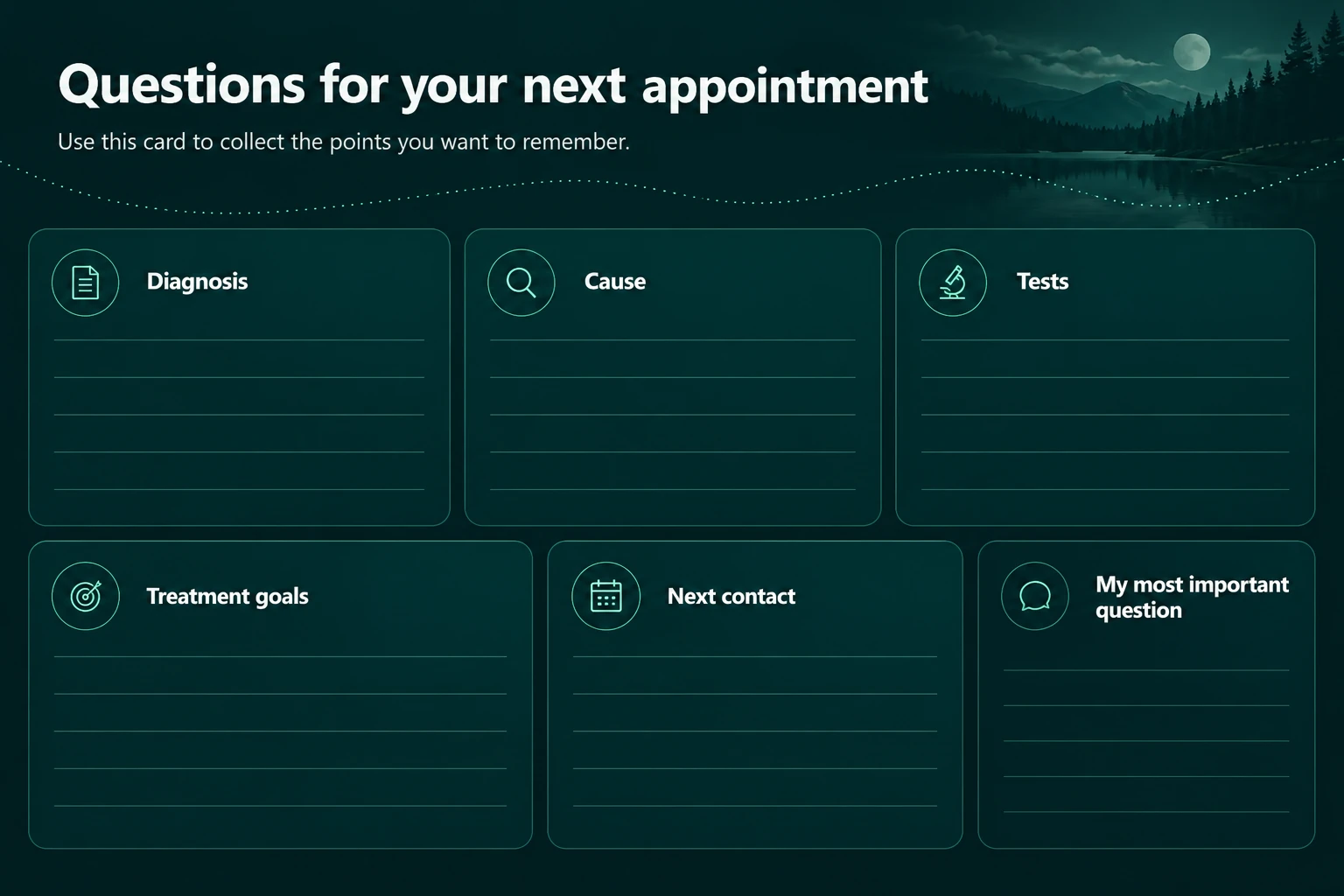
A few other things are worth doing:
- Bring all the medicines you take, including non-prescription medicines, vitamins and supplements.21
- Bring someone with you if you can. A review of studies of routine medical visits, mostly by older adults, found that doctors gave more medical information when a family companion was present.22
- Before you leave, say back in your own words what you understood. Health professionals use the same idea, called “teach-back”, to check understanding and catch misunderstandings.23
- Ask for written information, and ask how you will get test results.21
A printable checklist for your next appointment
This is a conversation aid I would use to prepare. It is not a way to diagnose yourself, and you won’t get through all of it in one visit. Put a mark by the three questions that matter most to you right now.

Bring with you
- A list of all medicines and supplements, with the amount you actually take
- When your symptoms started, where they are, and how they have changed
- Any family history of neuropathy, foot deformities or walking problems
- Your usual alcohol intake, stated honestly
- Previous test results or letters, if you have them
- A pen and paper, or someone who can take notes
Ask about
- Cause: what is likely, what has been ruled out, and whether anything is treatable
- Tests: what has been done, what is still missing, and when results come
- Specialist: whether a neurologist or other specialist should be involved
- Symptoms: options for pain, sleep and other troublesome symptoms, and what to expect
- Safety: foot care, balance, falls and driving
- Follow-up: when, with whom, and which changes mean you should get in touch sooner
Before you leave
- Say back what you understood the plan to be
- Check who to contact, and how, if things get worse
- Ask for a written summary or where to find it
I’m not a doctor. I’ve written this from published research and guidance, and to help you prepare questions for your own care.
Sources
- National Institute of Neurological Disorders and Stroke (NINDS). Guillain-Barré Syndrome. Last reviewed 13 March 2026. https://www.ninds.nih.gov/health-information/disorders/guillain-barre-syndrome
- Mirian A, Aljohani Z, Grushka D, Florendo-Cumbermack A. Diagnosis and management of patients with polyneuropathy. CMAJ 2023;195(6):E227–E233. doi:10.1503/cmaj.220936. https://www.cmaj.ca/content/195/6/E227
- National Institute of Diabetes and Digestive and Kidney Diseases (NIDDK). Diabetes & Foot Problems. Last reviewed January 2017. https://www.niddk.nih.gov/health-information/diabetes/overview/preventing-problems/foot-problems
- National Institute of Neurological Disorders and Stroke (NINDS). Peripheral Neuropathy. Last reviewed 13 March 2026. https://www.ninds.nih.gov/health-information/disorders/peripheral-neuropathy
- NHS. Peripheral neuropathy – Causes. Page last reviewed 10 October 2022. https://www.nhs.uk/conditions/peripheral-neuropathy/causes/
- England JD, Gronseth GS, Franklin G, et al. Practice Parameter: evaluation of distal symmetric polyneuropathy: role of laboratory and genetic testing (an evidence-based review). Report of the AAN, AANEM and AAPM&R. Neurology 2009;72(2):185–192. doi:10.1212/01.wnl.0000336370.51010.a1. https://www.neurology.org/doi/10.1212/01.wnl.0000336370.51010.a1
- Notermans NC, Wokke JH, van der Graaf Y, Franssen H, van Dijk GW, Jennekens FG. Chronic idiopathic axonal polyneuropathy: a five year follow up. Journal of Neurology, Neurosurgery and Psychiatry 1994;57(12):1525–1527. doi:10.1136/jnnp.57.12.1525. https://jnnp.bmj.com/content/57/12/1525
- National Institute for Health and Care Excellence (NICE). Neuropathic pain in adults: pharmacological management in non-specialist settings. Clinical guideline CG173. Published November 2013, last updated April 2025. https://www.nice.org.uk/guidance/cg173/chapter/Recommendations
- Soliman N, Moisset X, Ferraro MC, et al. Pharmacotherapy and non-invasive neuromodulation for neuropathic pain: a systematic review and meta-analysis. Lancet Neurology 2025;24(5):413–428. doi:10.1016/S1474-4422(25)00068-7. https://www.thelancet.com/journals/laneur/article/PIIS1474-4422(25)00068-7/fulltext
- NHS. Peripheral neuropathy – Treatment. Page last reviewed 10 October 2022. https://www.nhs.uk/conditions/peripheral-neuropathy/treatment/
- Mayo Clinic Staff. Peripheral neuropathy – Diagnosis and treatment. Mayo Foundation for Medical Education and Research. https://www.mayoclinic.org/diseases-conditions/peripheral-neuropathy/diagnosis-treatment/drc-20352067
- Hanewinckel R, Drenthen J, Verlinden VJA, et al. Polyneuropathy relates to impairment in daily activities, worse gait, and fall-related injuries. Neurology 2017;89(1):76–83. doi:10.1212/WNL.0000000000004067. https://www.neurology.org/doi/10.1212/WNL.0000000000004067
- Streckmann F, Zopf EM, Lehmann HC, et al. Exercise intervention studies in patients with peripheral neuropathy: a systematic review. Sports Medicine 2014;44(9):1289–1304. doi:10.1007/s40279-014-0207-5. https://link.springer.com/article/10.1007/s40279-014-0207-5
- NHS. Peripheral neuropathy (overview). Page last reviewed 10 October 2022. https://www.nhs.uk/conditions/peripheral-neuropathy/
- Girach A, Julian TH, Varrassi G, Paladini A, Vadalouka A, Zis P. Quality of life in painful peripheral neuropathies: a systematic review. Pain Research and Management 2019;2019:2091960. doi:10.1155/2019/2091960. https://onlinelibrary.wiley.com/doi/10.1155/2019/2091960
- The Foundation for Peripheral Neuropathy. Newly Diagnosed. Updated 23 January 2025. https://www.foundationforpn.org/newly-diagnosed/
- Kessels RPC. Patients’ memory for medical information. Journal of the Royal Society of Medicine 2003;96(5):219–222. doi:10.1177/014107680309600504. https://journals.sagepub.com/doi/10.1177/014107680309600504
- Kinnersley P, Edwards A, Hood K, et al. Interventions before consultations for helping patients address their information needs. Cochrane Database of Systematic Reviews 2007;(3):CD004565. doi:10.1002/14651858.CD004565.pub2. https://www.cochranelibrary.com/cdsr/doi/10.1002/14651858.CD004565.pub2/full
- Shepherd HL, Barratt A, Trevena LJ, et al. Three questions that patients can ask to improve the quality of information physicians give about treatment options: a cross-over trial. Patient Education and Counseling 2011;84(3):379–385. doi:10.1016/j.pec.2011.07.022. https://www.sciencedirect.com/science/article/abs/pii/S0738399111003892
- Advancing Quality Alliance (AQuA) NHS. Ask 3 Questions (patient leaflet, undated; hosted by NHS Sussex). https://www.sussex.ics.nhs.uk/wp-content/uploads/sites/9/2022/06/Ask-3-questions-leaflet.pdf
- Agency for Healthcare Research and Quality (AHRQ). Be More Engaged in Your Healthcare. Last reviewed November 2024. https://www.ahrq.gov/questions/be-engaged/index.html
- Wolff JL, Roter DL. Family presence in routine medical visits: a meta-analytical review. Social Science & Medicine 2011;72(6):823–831. doi:10.1016/j.socscimed.2011.01.015. https://www.sciencedirect.com/science/article/abs/pii/S027795361100058X
- Agency for Healthcare Research and Quality (AHRQ). Health Literacy Universal Precautions Toolkit, Tool 5: Use the Teach-Back Method. Last reviewed April 2024. https://www.ahrq.gov/health-literacy/improve/precautions/tool5.html
Sources checked on 25 September 2026.
Related reading

Restless legs or neuropathy? Similar symptoms, different assessments
Written by someone living with neuropathy: how restless legs syndrome differs from neuropathy, why the two are so often confused, how often they occur together, how each is assessed, and questions to take to your doctor.

Cold feet: nerve symptoms, circulation and when to seek help
Written by someone living with neuropathy: why feet can feel cold without being cold, when cold feet point to circulation instead, the warning signs that need urgent help, and a description aid for your appointment.

Numb hands and weak grip: neuropathy or another nerve problem?
Written by someone living with neuropathy: why numb hands and a weak grip can be a trapped nerve, a neck problem or polyneuropathy, the warning signs, and a description aid to take to your doctor.