
Yes, a lack of vitamin B12 can damage nerves. B12 deficiency neuropathy usually starts as numbness, tingling or pins and needles in the feet, often with poorer balance, and it can happen even when your blood count looks normal. It is a cause of neuropathy that can be tested for and treated, and finding and treating it early matters for avoiding lasting nerve damage.1, 4
I have neuropathy myself, and B12 comes up in almost every conversation about nerve symptoms. So I wanted to separate two things that often get mixed up: a confirmed deficiency, which needs proper testing and treatment, and the general idea that extra B12 is good for everyone’s nerves. The research treats those as two very different questions.
When not to wait
- If you have numbness or tingling together with unsteady walking, worsening balance or weakness, contact your doctor promptly. NICE, the UK guideline body, says B12 replacement should not be delayed while waiting for test results in people with suspected megaloblastic anaemia (a type of anaemia caused by B12 or folate deficiency) and neurological symptoms, especially symptoms suggesting the spinal cord is involved.1
- If weakness spreads over hours or days, or you have trouble breathing or swallowing, call your local emergency number. That pattern can point to other conditions, such as Guillain-Barré syndrome, which a Canadian medical review says needs emergency assessment.2
- If you use nitrous oxide (“laughing gas”) recreationally and notice numbness, tingling or difficulty walking, tell a doctor promptly and be open about it. It can cause serious B12-related nerve and spinal cord damage.1, 10
How can B12 deficiency cause neuropathy?
Vitamin B12 is needed for healthy nerves and blood. The US National Institutes of Health (NIH) fact sheet on B12 describes numbness and tingling in the hands and feet as a sign of deficiency, and stresses that these nerve symptoms can occur without anaemia, so early diagnosis matters to avoid irreversible damage.4
The deficiency can affect the peripheral nerves, giving a neuropathy that usually starts in the feet. It can also affect the spinal cord, in a condition called subacute combined degeneration. StatPearls, a medical reference on the US National Library of Medicine’s bookshelf, explains that this damages the pathways that carry position sense, which can lead to unsteadiness, loss of proprioception and peripheral neuropathy. In practice, balance problems and a feeling of not knowing where your feet are can be as important as the tingling itself.5, 6
The NICE guideline on B12 deficiency lists pins and needles or numbness, balance problems and falls, walking difficulties, and memory or thinking problems among the possible symptoms. It also says a deficiency should not be ruled out just because there is no anaemia or no enlarged red blood cells.1
Who is most at risk of B12 deficiency?
The NICE guideline and the NIH fact sheet point to several groups:1, 4
- Autoimmune gastritis (often called pernicious anaemia), where the stomach can no longer help absorb B12. NIH calls pernicious anaemia the most common cause of clinically evident deficiency.4
- Older age. NIH notes that estimates of deficiency among older adults living at home vary widely, from 3% to 43%.4
- A vegan diet, or a diet low in animal foods, without a reliable B12 source.1
- Stomach or bowel surgery, including many weight-loss operations, and conditions such as coeliac disease or Crohn’s disease.1, 5
- Some long-term medicines, including metformin and acid-reducing medicines (proton pump inhibitors and H2 blockers).1
- Recreational nitrous oxide use.1
Metformin is worth a closer look, because many people with diabetes take it, and diabetes is itself a common cause of neuropathy. The UK medicines regulator (MHRA) says B12 deficiency is a common side effect of metformin that may affect up to 1 in 10 users, that the risk rises with higher doses and longer use, and that people with new neuropathy symptoms should have their B12 checked. It also says people can carry on taking metformin. For acid-reducing medicines, a large study in JAMA found that two or more years of use was linked to a higher chance of B12 deficiency, though a link like this does not prove cause.8, 9
Nitrous oxide is a particular concern in younger people. It inactivates B12, so a person can develop nerve and spinal cord damage even if their blood level of B12 does not look very low. In a small Thai case series of young adults, all seven patients had both spinal cord and peripheral nerve involvement, and their B12 levels ranged from low to borderline.6, 10
How is B12 deficiency neuropathy diagnosed?
B12 is part of the standard blood work when someone has symmetrical nerve symptoms. A review in the Canadian Medical Association Journal (CMAJ) lists vitamin B12, with or without methylmalonic acid, among the high-yield screening tests for polyneuropathy, and a practice parameter from the American Academy of Neurology (AAN) and partner societies, reaffirmed in 2025, lists serum B12 with its metabolites (methylmalonic acid, with or without homocysteine) among the tests with the highest yield.2, 3
The tricky part is that one B12 number does not always settle it. NICE recommends starting with either total B12 or “active B12” (holotranscobalamin). For total B12, it describes three bands: below 180 ng/L as a confirmed deficiency, 180 to 350 ng/L as indeterminate, and above 350 ng/L as unlikely. For people with symptoms and an indeterminate result, it suggests considering a methylmalonic acid (MMA) test. These are NICE’s UK thresholds; laboratories use different units and cut-offs, so your own result has to be read against your lab’s range.1
A few details can change how results are read. NICE advises caution if you already take an over-the-counter B12 product or the combined contraceptive pill, and it suggests homocysteine or MMA as the first test when nitrous oxide use is suspected. An antibody test for intrinsic factor can help show autoimmune gastritis, but a negative result does not rule it out. The British Society for Haematology adds that treatment should not be delayed when strong clinical signs don’t match the test result.1, 7
Three questions, not one
What helped me understand this topic was seeing that “B12 and my nerves” is really three separate questions, each with its own tests and conversations:
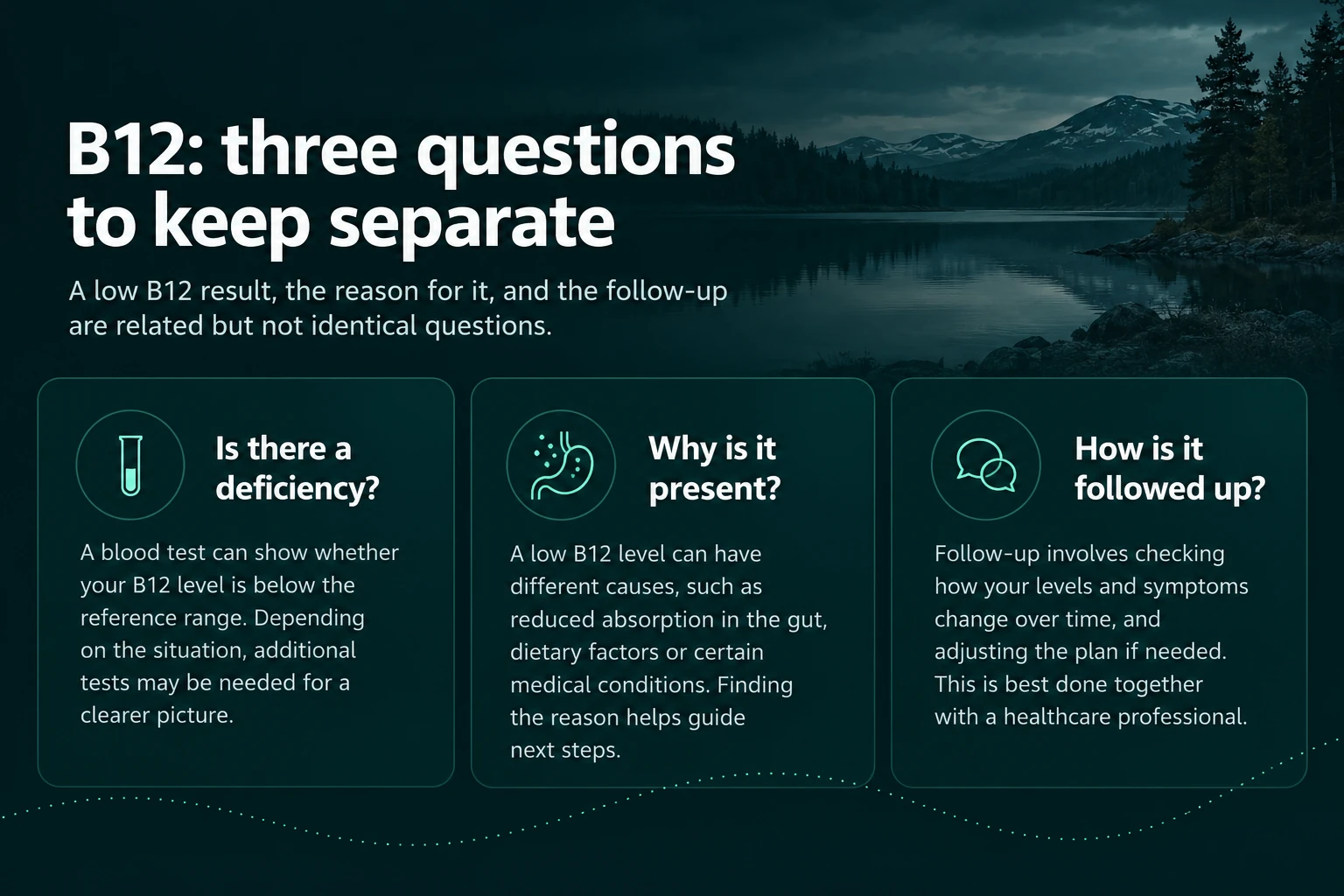
| The question | What usually helps answer it | What you could ask |
|---|---|---|
| Do I have a B12 deficiency? | A total or active B12 test, and MMA or homocysteine if the result is borderline or nitrous oxide may be involved | “Was my result clearly low, borderline or normal, and do I need a second test?” |
| Why is it low? | Diet, medicines, stomach or bowel history, nitrous oxide, and sometimes an intrinsic factor antibody test | “What do you think is causing it, and will I need treatment long term?” |
| Is treatment working, and is B12 the whole story? | Follow-up of symptoms and, where needed, repeat tests; a look at other causes if symptoms persist | “When do we check how I’m doing, and what happens if my nerve symptoms don’t improve?” |
Deficiency, cause and follow-up as three separate questions (based on sources 1–3 and 7). This is a conversation aid, not a diagnostic tool.
What does treatment of a confirmed deficiency aim to do?
Treatment has two aims: to replace the B12 and to deal with the reason it ran low. NICE notes that the response to treatment varies and depends on the cause. When the cause is permanent, for example autoimmune gastritis or complete removal of the stomach, NICE recommends lifelong treatment.1
B12 can be given as high-dose tablets or as injections. A review in Nature Reviews Disease Primers describes both as ways of managing deficiency. Which one, how often and for how long depends on the cause and on how severe the symptoms are. The NHS says B12 deficiency anaemia is usually treated with injections, and that people who have had nerve symptoms are referred to a blood specialist (haematologist). The choice is a decision for your doctor, and I’m not going to give doses or schedules here.1, 13, 22
One safety point is worth knowing. Folic acid can correct the anaemia of B12 deficiency without correcting the nerve damage. The NIH folate fact sheet explains this, and the NHS warns that folic acid alone can mask an underlying B12 deficiency. A review in American Family Physician advises that when both are low, B12 is replaced first. If you are offered folic acid, it is reasonable to ask whether your B12 has been checked.11, 12, 13
If nitrous oxide is the cause, stopping it is part of the treatment. NICE advises people to stop using it recreationally.1
Can nerves recover after B12 deficiency?
Often they improve, but not always completely, and it takes time. NICE advises that people starting treatment are told their symptoms could start to improve within two weeks but may take up to three months, and that it can take much longer for them to go away completely. The American Family Physician review expects nerve symptoms to improve over roughly six weeks to three months. StatPearls says clinical improvement may take months or even years.1, 5, 11
How long the deficiency went untreated seems to matter most. MedlinePlus, from the US National Library of Medicine, says complete recovery may be expected if spinal cord involvement is treated within a few weeks, but full recovery may not be possible if treatment is delayed longer than one or two months. A pooled review of 57 published cases of spinal cord involvement found that 86% improved with B12 but only 14% recovered completely. Full recovery was linked to milder disease at diagnosis and to being under 50. Those numbers come from published case reports, so they are not precise, but the direction is consistent.14, 15
An older neurology review adds a realistic note: treatment may not always improve nerve symptoms that are already established, but it can help stop them getting worse. That matters too. Keeping what you have is a real result.16
Recovery can also differ because B12 is not always the only cause. Diabetes, alcohol and other conditions can sit alongside a deficiency, and nitrous oxide damage can be severe. In the Thai case series, most people had moderate to complete recovery after six months or more, but some still had mild weakness.10
Is B12 a treatment for all neuropathy?
No, and this is where I think a lot of advertising goes too far. Treating a confirmed deficiency is one thing. Taking B12 for neuropathy with another cause, when your levels are fine, is something else.
A Cochrane review of 13 trials, mostly in alcohol-related and diabetic neuropathy, concluded that the evidence was insufficient to say whether vitamin B treatment helps or harms. A 2026 meta-analysis of B-vitamin trials in diabetic neuropathy found improvements on some neuropathy scores that were small or below what counts as clinically important, and inconsistent effects on pain. Only two of its 13 trials reported baseline B12 levels. A systematic review in people taking metformin also called the effect on neuropathy unclear.17, 18, 19
There is also a reason to read labels on combined “nerve” supplements. Many contain vitamin B6, and NIH notes that long-term high-dose B6 can itself cause a sensory neuropathy. So “more B vitamins” is not automatically safer.20
The US National Institute of Neurological Disorders and Stroke (NINDS) names B12 deficiency, together with excess vitamin B6, as the best-known vitamin-related causes of neuropathy. That is exactly why it is tested for. It is not a reason to assume B12 is the answer for everyone.21
What should follow-up look like?
NICE recommends a first follow-up about three months after treatment starts, or earlier if symptoms are severe. At each check, the question is whether symptoms have improved, got worse or changed. If they have not improved enough, the treatment may be adjusted. If there are new or worsening symptoms, NICE says to think about another diagnosis. And if tests show the deficiency has been corrected but symptoms remain, it recommends looking for other causes.1
For those of us living with nerve symptoms, I think that last point is the most useful one. If your B12 is now fine and your feet still tingle, that doesn’t mean treatment failed or that nothing more can be done. It is a reason to ask what else might be going on. Questions I would bring:
- Was my deficiency confirmed, and by which test?
- What is the likely cause, and does it need its own treatment?
- How long will I need treatment, and how will we know it’s working?
- If my nerve symptoms stay the same, what else should we look at?
- Should I tell you about any supplements I take, including B-complex or “nerve” products?
I’m not a doctor. I’ve written this from published research and guidance, and to help you prepare questions for your own care.
Sources
- National Institute for Health and Care Excellence (NICE). Vitamin B12 deficiency in over 16s: diagnosis and management. NICE guideline NG239, published 6 March 2024. https://www.ncbi.nlm.nih.gov/books/NBK603366/
- Mirian A, Aljohani Z, Grushka D, Florendo-Cumbermack A. Diagnosis and management of patients with polyneuropathy. CMAJ 2023;195(6):E227–E233, 13 February 2023. doi:10.1503/cmaj.220936. https://www.cmaj.ca/content/195/6/E227
- England JD, Gronseth GS, Franklin G, et al. Practice Parameter: Evaluation of distal symmetric polyneuropathy: role of laboratory and genetic testing (an evidence-based review). American Academy of Neurology, AANEM and AAPM&R. Neurology 2009;72(2):185–192; reaffirmed 8 February 2025. https://www.aan.com/Guidelines/home/GuidelineDetail/315
- NIH Office of Dietary Supplements. Vitamin B12 – Fact Sheet for Health Professionals. Updated 2 July 2025. https://ods.od.nih.gov/factsheets/VitaminB12-HealthProfessional/
- Ankar A, Kumar A. Vitamin B12 Deficiency. StatPearls, NCBI Bookshelf. Last updated 10 September 2024. https://www.ncbi.nlm.nih.gov/books/NBK441923/
- Saji AM, Lui F, De Jesus O. Spinal Cord Subacute Combined Degeneration. StatPearls, NCBI Bookshelf. Last updated 21 April 2024. https://www.ncbi.nlm.nih.gov/books/NBK560728/
- Devalia V, Hamilton MS, Molloy AM, on behalf of the British Committee for Standards in Haematology. Guidelines for the diagnosis and treatment of cobalamin and folate disorders. British Journal of Haematology 2014;166(4):496–513. doi:10.1111/bjh.12959. https://onlinelibrary.wiley.com/doi/10.1111/bjh.12959
- Medicines and Healthcare products Regulatory Agency (MHRA). Metformin and reduced vitamin B12 levels: new advice for monitoring patients at risk. Drug Safety Update, 20 June 2022. https://www.gov.uk/drug-safety-update/metformin-and-reduced-vitamin-b12-levels-new-advice-for-monitoring-patients-at-risk
- Lam JR, Schneider JL, Zhao W, Corley DA. Proton pump inhibitor and histamine 2 receptor antagonist use and vitamin B12 deficiency. JAMA 2013;310(22):2435–2442. doi:10.1001/jama.2013.280490. https://jamanetwork.com/journals/jama/fullarticle/1788456
- Kulkantrakorn K, Chunhachatrachai P, Kulkantrakorn W. Nitrous oxide abuse and associated neurological diseases. BMC Neurology 2024;24:461, 26 November 2024. doi:10.1186/s12883-024-03966-9. https://link.springer.com/article/10.1186/s12883-024-03966-9
- Langan RC, Goodbred AJ. Vitamin B12 Deficiency: Recognition and Management. American Family Physician 2017;96(6):384–389. https://www.aafp.org/pubs/afp/issues/2017/0915/p384.html
- NIH Office of Dietary Supplements. Folate – Fact Sheet for Health Professionals. https://ods.od.nih.gov/factsheets/Folate-HealthProfessional/
- NHS. Vitamin B12 or folate deficiency anaemia – Treatment. Page last reviewed 20 February 2023 (next review was due 20 February 2026). https://www.nhs.uk/conditions/vitamin-b12-or-folate-deficiency-anaemia/treatment/
- Vasconcelos OM, Poehm EH, McCarter RJ, Campbell WW, Quezado ZMN. Potential outcome factors in subacute combined degeneration: review of observational studies. Journal of General Internal Medicine 2006;21(10):1063–1068. doi:10.1111/j.1525-1497.2006.00525.x. https://link.springer.com/article/10.1111/j.1525-1497.2006.00525.x
- MedlinePlus Medical Encyclopedia (US National Library of Medicine). Subacute combined degeneration. Reviewed 16 April 2025. https://medlineplus.gov/ency/article/000723.htm
- Saperstein DS, Barohn RJ. Peripheral neuropathy due to cobalamin deficiency. Current Treatment Options in Neurology 2002;4:197–201. doi:10.1007/s11940-002-0036-y. https://link.springer.com/article/10.1007/s11940-002-0036-y
- Ang CD, Alviar MJM, Dans AL, et al. Vitamin B for treating peripheral neuropathy. Cochrane Database of Systematic Reviews 2008, Issue 3 (published 16 July 2008). doi:10.1002/14651858.CD004573.pub3. https://www.cochrane.org/evidence/CD004573_vitamin-b-treating-disorders-peripheral-nerves
- Mandra EV, Parfenov VA, Stupin VA, Silina EV. Vitamin B Supplementation for Diabetic Peripheral Neuropathy: A Review and Meta-Analysis. Journal of Clinical Medicine 2026;15(13):5156, 2 July 2026. doi:10.3390/jcm15135156. https://www.mdpi.com/2077-0383/15/13/5156
- Pratama S, Lauren BC, Wisnu W. The efficacy of vitamin B12 supplementation for treating vitamin B12 deficiency and peripheral neuropathy in metformin-treated type 2 diabetes mellitus patients: a systematic review. Diabetes & Metabolic Syndrome: Clinical Research & Reviews 2022;16(10):102634. doi:10.1016/j.dsx.2022.102634. https://www.sciencedirect.com/science/article/pii/S187140212200248X
- NIH Office of Dietary Supplements. Vitamin B6 – Fact Sheet for Health Professionals. Updated 16 June 2023. https://ods.od.nih.gov/factsheets/VitaminB6-HealthProfessional/
- National Institute of Neurological Disorders and Stroke (NINDS). Peripheral Neuropathy. Last reviewed 13 March 2026. https://www.ninds.nih.gov/health-information/disorders/peripheral-neuropathy
- Green R, Allen LH, Bjørke-Monsen A-L, et al. Vitamin B12 deficiency. Nature Reviews Disease Primers 2017;3:17040, 29 June 2017. doi:10.1038/nrdp.2017.40. https://www.nature.com/articles/nrdp201740
Sources checked on 25 September 2026.
Related reading

Restless legs or neuropathy? Similar symptoms, different assessments
Written by someone living with neuropathy: how restless legs syndrome differs from neuropathy, why the two are so often confused, how often they occur together, how each is assessed, and questions to take to your doctor.

Cold feet: nerve symptoms, circulation and when to seek help
Written by someone living with neuropathy: why feet can feel cold without being cold, when cold feet point to circulation instead, the warning signs that need urgent help, and a description aid for your appointment.

Numb hands and weak grip: neuropathy or another nerve problem?
Written by someone living with neuropathy: why numb hands and a weak grip can be a trapped nerve, a neck problem or polyneuropathy, the warning signs, and a description aid to take to your doctor.