
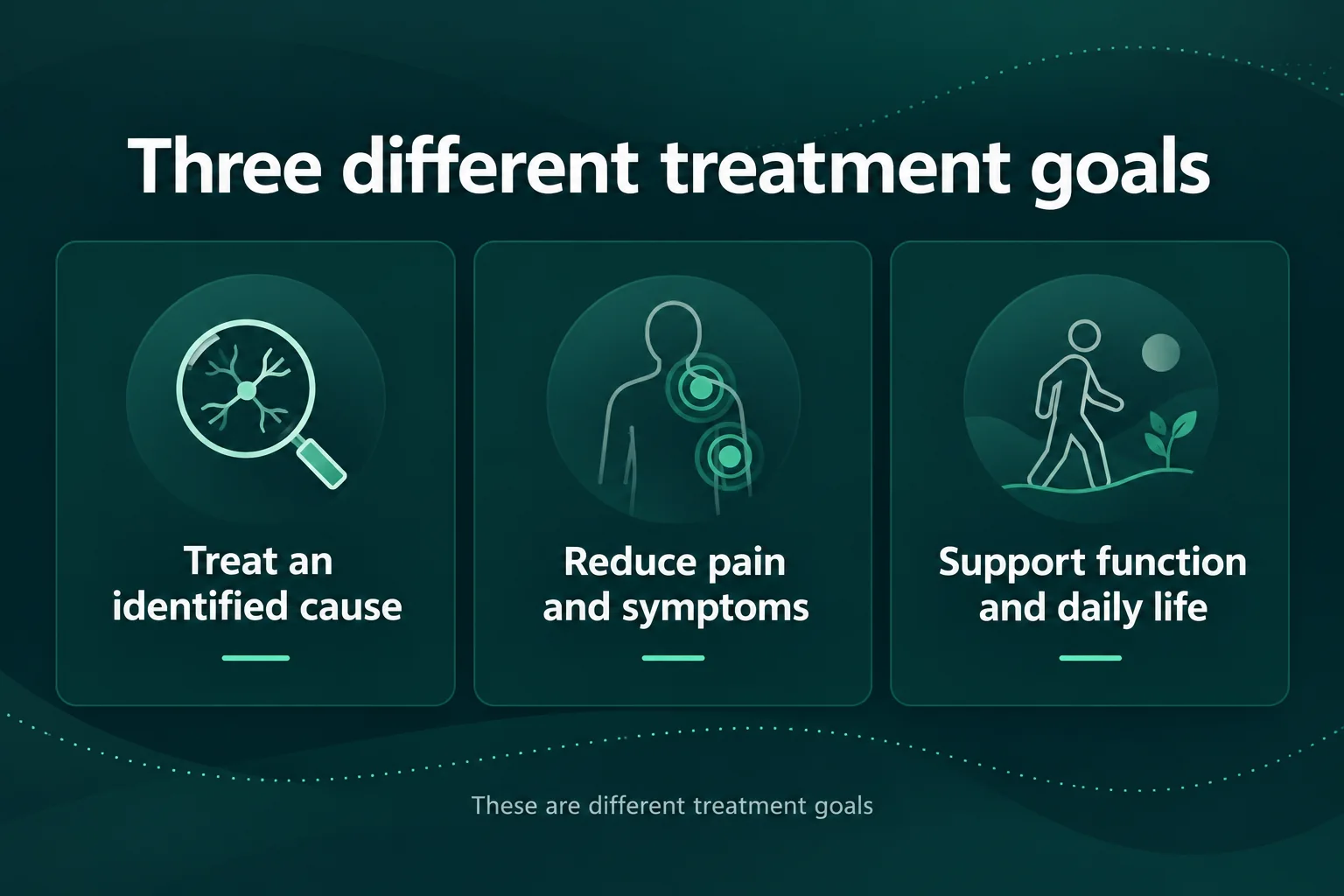
Can peripheral neuropathy be reversed? Sometimes, partly. If the cause is found and treated early, some nerves can recover and regrow, and symptoms may ease. But much of the time the realistic goal is different: stopping it from getting worse, easing the pain, and keeping you steady and active. Those are four different kinds of improvement, and it helps to know which one you’re hoping for.2, 3, 5
I have neuropathy myself, and “will it go away?” is probably the question I care about most. The honest answer depends on the cause, the type of nerve damage and how long it has been there. Here is what the research and guidelines actually say, without percentages or promises that nobody can keep.
Don’t wait with these.
- Call your local emergency number if weakness or numbness spreads quickly over hours or days, or if you have difficulty breathing or swallowing. This can be Guillain-Barré syndrome, which needs hospital care straight away.15
- Contact your doctor or an urgent care service promptly if your symptoms get clearly worse over days or weeks, if one side is much worse than the other, or if weakness rather than numbness becomes the main problem.1
- See your doctor soon about a cut, blister or sore on your foot that isn’t healing, especially if you have diabetes.6
What do we mean when we ask if peripheral neuropathy can be reversed?
When I ask whether neuropathy can be reversed, I usually mean “will my feet feel normal again?” But doctors and studies often talk about improvement in quite different ways. I find it useful to keep four meanings apart.
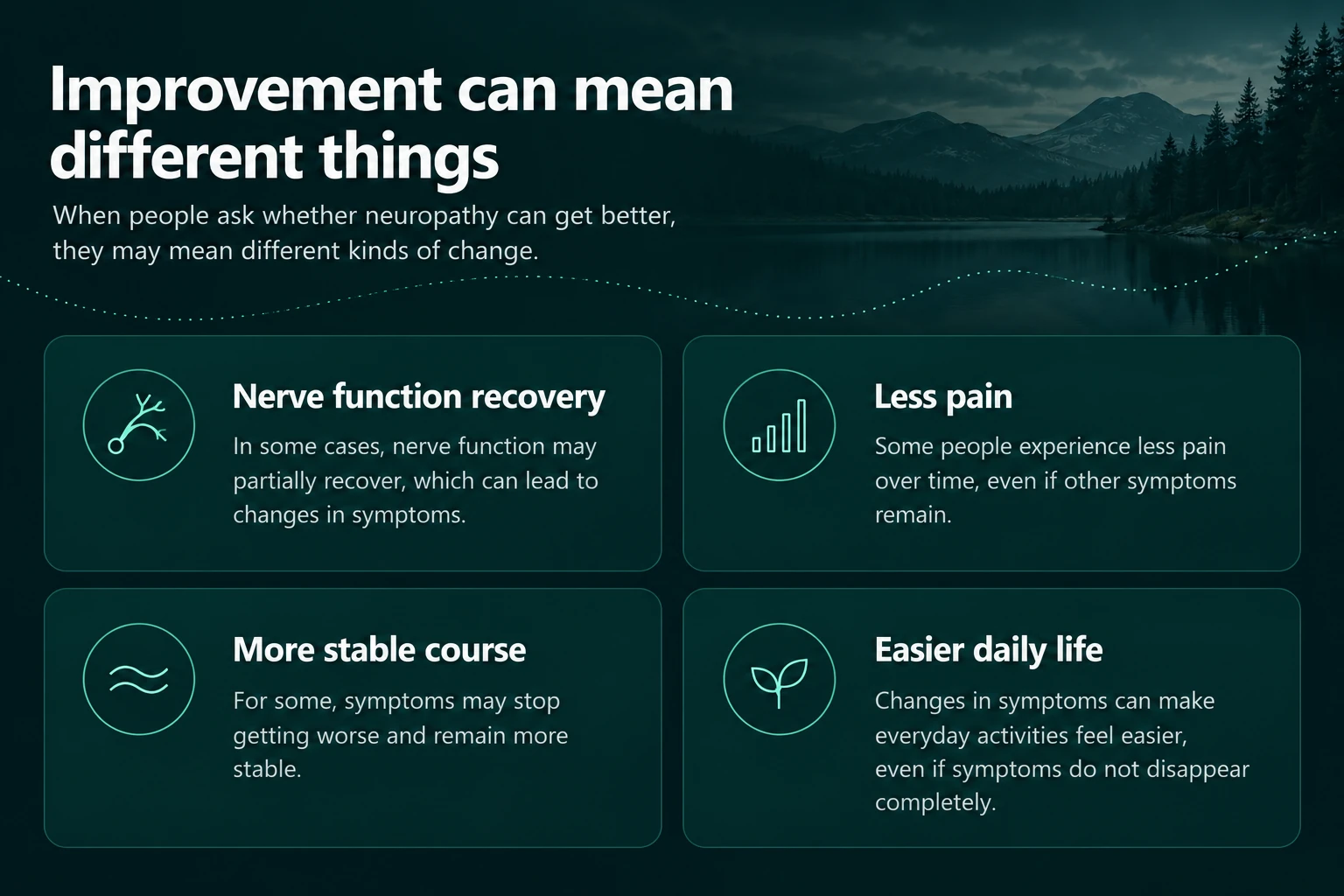
| Kind of improvement | What it means | When it is most realistic | What it doesn’t mean |
|---|---|---|---|
| Nerve recovery | Nerves repair or regrow and feeling or strength returns | A treatable cause found early; damage mainly to the myelin coating; milder damage | A guarantee: long-standing damage to the nerve fibre itself often leaves something behind |
| Less pain | Burning, stabbing or tingling eases | Painful neuropathy, with medicines and other approaches | The nerves are healed; numbness can stay the same |
| Stabilising | The neuropathy stops getting worse or slows down | When the cause is managed, for example blood sugar or alcohol | That lost feeling comes back |
| Better function | Steadier balance, safer walking, healthier feet, more confidence | Balance and strength training, aids, footwear and foot care | A change on a nerve test |
Four meanings of improvement (based on sources 2, 5, 6, 17, 20 and 21). They can happen separately: you can have one without the others.
This matters because you can be doing well on one line and not on another. Pain can fade while numbness stays. Balance can improve without any change in the nerves. Knowing which kind of improvement you’re looking for makes it easier to notice progress and to ask your doctor the right questions.
Treating the cause versus repairing the damage
The US National Institute of Neurological Disorders and Stroke (NINDS) puts the hopeful side clearly: sometimes, when the underlying cause is corrected, neuropathy can resolve as the nerves recover and regrow. The NHS adds the other side: some cases improve with time if the cause is treated, while in some people the damage may be permanent or slowly get worse.2, 3
Treating a cause mainly stops new damage. Whether the existing damage repairs itself is a separate question. The American Diabetes Association (ADA) says this very directly in its 2026 Standards of Care: good blood sugar management, started early, can delay or prevent diabetic neuropathy in type 1 diabetes and may modestly slow it in type 2 diabetes, but it does not reverse the nerve loss. The ADA also states that no treatment to reverse the underlying nerve damage in diabetes is currently available.6
A Cochrane review points the same way for prevention: tighter glucose control clearly reduced the risk of developing neuropathy in type 1 diabetes, but the effect in type 2 diabetes was smaller and not statistically certain. It also raised the risk of severe low blood sugar, so targets are something to set with your diabetes team.7
Some causes have a better outlook than others
- Vitamin B12 deficiency. StatPearls, describing the nerve damage B12 deficiency can cause in the spinal cord, says prompt treatment can partly resolve the symptoms and stop them getting worse, but improvement can take months or even years, and people without severe deficits respond best. The NICE guideline says the response varies and it can take a long time for symptoms to disappear altogether.10, 11
- Too much vitamin B6. The US Office of Dietary Supplements says symptoms usually stop if the supplement is stopped as soon as nerve symptoms appear.14
- Alcohol. StatPearls describes improvement after months to years without alcohol, but also says some neuropathy often remains even in people who stop. A CMAJ review is more pessimistic and calls alcohol-related neuropathy irreversible. I read that as: stopping gives the nerves their best chance, but it’s not a guarantee.1, 12
- Chemotherapy. The American Society of Clinical Oncology (ASCO) guideline notes that neuropathy from some drugs, such as paclitaxel, tends to improve over the months after treatment ends. With oxaliplatin it can get worse for a couple of months after the last dose before settling, and in some people it lasts for years.13
- Some medicines. Neuropathy caused by a medicine may improve if that medicine is stopped, the NHS says. Please don’t stop a prescribed medicine on your own; talk to the doctor who prescribed it first.4
- Immune neuropathies. Guillain-Barré syndrome is sudden, and NINDS says most people eventually recover, even from severe cases, though recovery can take weeks to years and some are left with lasting weakness, numbness, fatigue or pain. In CIDP, a chronic immune neuropathy, the European guideline recommends immune treatment and maintenance, but also recognises deficits that cannot improve because of severe long-standing damage to the nerve fibres.15, 16
When no cause is found (idiopathic neuropathy), there is no specific cause to treat, and the focus moves to the other three kinds of improvement. More generally, Johns Hopkins puts it bluntly: peripheral neuropathy usually can’t be cured, but a lot can be done to stop it getting worse.19
Less pain doesn’t automatically mean the nerves have healed
This is the part I think gets mixed up most often. Medicines for nerve pain work on how pain signals are handled. They don’t repair nerves. A review in the Canadian Medical Association Journal (CMAJ) says the goal of pain treatment is to reduce, not eliminate, pain, so that expectations match what treatments can do.1
The international NeuPSIG review from 2025, which covered over 300 trials on nerve pain from many different causes, recommends some antidepressants and gabapentin or pregabalin as first-line options, but describes the results as modest. So if your pain eases, that’s a real gain. It just doesn’t tell you that numbness or balance will follow.17
It can go the other way too. NINDS notes that as nerves heal, many people can reduce or stop their pain medicine, but always in discussion with a doctor. If your pain changes, in either direction, I think that’s worth taking to your own doctor rather than guessing what it means.2
Why recovery takes so long, and why it differs
Several things explain why one person improves over months and another stays much the same.
Which part of the nerve is damaged
StatPearls explains that when the insulating coating (myelin) is damaged, the outlook is more favourable, because the coating can be rebuilt fairly quickly. When the nerve fibre itself (the axon) is damaged, the fibre has to regrow all the way to the muscle or skin it serves, and recovery is harder.5
The feet are a long way away
Most neuropathies are length-dependent: the nerve endings furthest from the brain, in the feet, are where symptoms usually start or are worst. Regrowing nerve fibres are slow. A StatPearls chapter on nerve injury gives a rough rate of about one millimetre a day, and the American Academy of Physical Medicine and Rehabilitation describes it as about an inch a month. Those figures come from injuries to single nerves, not polyneuropathy, so they’re not a timetable. But they show why recovery in the feet, if it happens, is counted in months rather than weeks.2, 8, 9
Severity, timing and age
The same chapter says that the more severe the injury, the poorer the expected recovery, and that age and the distance to the target matter. The rehabilitation resource adds that, after a nerve injury, a regrowing fibre has a limited window, around two years, to reach its target before the path closes. For B12 deficiency, StatPearls notes that younger people and those without severe deficits do better.8, 9, 10
This is why I’m wary of anyone who promises a fixed recovery time. The honest answer is that it varies, and your own doctor is better placed than any website to say what’s realistic for you.
What meaningful improvement can look like
Even when the nerves don’t recover, everyday life often can. Two systematic reviews of people with diabetic neuropathy found that exercise such as balance, gait and strength training improved balance. One also found a small reduction in fear of falling but no clear effect on the risk of falling; in the other, most trials didn’t measure falls at all. Both rated the evidence as low or very low certainty. Still, it’s something you can work on.20, 21
Mayo Clinic describes physical therapy for weakness or balance problems, braces or walking aids where needed, daily foot checks, suitable footwear and regular exercise such as walking. The ADA recommends that everyone with diabetes learns how to check their feet for early problems.6, 18
To me, meaningful improvement can be small and concrete: walking to the shop without feeling unsure, sleeping better because the burning is calmer, catching a blister early. None of that shows up on a nerve test, but it counts.
How to talk about your own prognosis
Nobody can give you a general answer, but you can ask for a personal one. These are the questions I would bring:
- Has a cause been found, and is it one that can be treated or removed?
- Is the damage mainly to the nerve fibres, the myelin coating, or both?
- Has it been getting worse, staying the same or improving over the last year?
- Which kind of improvement is realistic for me: nerve recovery, less pain, stabilising or better function?
- What would be a sign that it’s getting worse, and when should I come back?
- Would physiotherapy, balance training or foot care help me?
It can help to note how your symptoms change over a few months, how far you walk and how you sleep. That gives you and your doctor something concrete to compare.
I’m not a doctor. I’ve written this from published research and guidance, and to help you prepare questions for your own care.
Sources
- Mirian A, Aljohani Z, Grushka D, Florendo-Cumbermack A. Diagnosis and management of patients with polyneuropathy. CMAJ 2023;195(6):E227–E233, 13 February 2023. https://www.cmaj.ca/content/195/6/E227
- National Institute of Neurological Disorders and Stroke (NINDS). Peripheral Neuropathy. Last reviewed 13 March 2026. https://www.ninds.nih.gov/health-information/disorders/peripheral-neuropathy
- NHS. Peripheral neuropathy. Page last reviewed 10 October 2022. https://www.nhs.uk/conditions/peripheral-neuropathy/
- NHS. Peripheral neuropathy – Treatment. Page last reviewed 10 October 2022. https://www.nhs.uk/conditions/peripheral-neuropathy/treatment/
- Hammi C, Yeung B. Neuropathy. StatPearls, NCBI Bookshelf. Last updated 15 October 2022. https://www.ncbi.nlm.nih.gov/books/NBK542220/
- American Diabetes Association Professional Practice Committee for Diabetes. 12. Retinopathy, Neuropathy, and Foot Care: Standards of Care in Diabetes—2026. Diabetes Care 2026;49(Suppl 1):S261–S276. https://doi.org/10.2337/dc26-S012
- Callaghan BC, Little AA, Feldman EL, Hughes RAC. Enhanced glucose control for preventing and treating diabetic neuropathy. Cochrane Database of Systematic Reviews 2012, Issue 6, CD007543. https://www.cochrane.org/evidence/CD007543_enhanced-glucose-control-preventing-and-treating-diabetic-neuropathy
- Nadi M, Dabbas W, Das JM. Peripheral Nerve Injury. StatPearls, NCBI Bookshelf. Last updated 15 February 2026. https://www.ncbi.nlm.nih.gov/books/NBK549848/
- Lam L, Reeh C, Copeland R, et al. Peripheral Neurological Recovery and Regeneration. PM&R KnowledgeNow, American Academy of Physical Medicine and Rehabilitation. Last updated 24 August 2023. https://now.aapmr.org/peripheral-neurological-recovery-and-regeneration/
- Ankar A, Kumar A. Vitamin B12 Deficiency. StatPearls, NCBI Bookshelf. Last updated 10 September 2024. https://www.ncbi.nlm.nih.gov/books/NBK441923/
- National Institute for Health and Care Excellence (NICE). Vitamin B12 deficiency in over 16s: diagnosis and management (NG239). 6 March 2024. https://www.ncbi.nlm.nih.gov/books/NBK603366/
- Sadowski A, Houck RC. Alcoholic Neuropathy. StatPearls, NCBI Bookshelf. Last updated 30 December 2022. https://www.ncbi.nlm.nih.gov/books/NBK499856/
- Loprinzi CL, Lacchetti C, Bleeker J, et al. Prevention and Management of Chemotherapy-Induced Peripheral Neuropathy in Survivors of Adult Cancers: ASCO Guideline Update. Journal of Clinical Oncology 2020;38(28):3325–3348. https://ascopubs.org/doi/10.1200/JCO.20.01399
- NIH Office of Dietary Supplements. Vitamin B6 – Fact Sheet for Health Professionals. Last updated 16 June 2023. https://ods.od.nih.gov/factsheets/VitaminB6-HealthProfessional/
- National Institute of Neurological Disorders and Stroke (NINDS). Guillain-Barré Syndrome. Last reviewed 13 March 2026. https://www.ninds.nih.gov/health-information/disorders/guillain-barre-syndrome
- Van den Bergh PYK, van Doorn PA, Hadden RDM, et al. European Academy of Neurology/Peripheral Nerve Society guideline on diagnosis and treatment of chronic inflammatory demyelinating polyradiculoneuropathy: Report of a joint Task Force – Second revision. Journal of the Peripheral Nervous System 2021;26(3):242–268. https://doi.org/10.1111/jns.12455
- Soliman N, Moisset X, Ferraro MC, et al. Pharmacotherapy and non-invasive neuromodulation for neuropathic pain: a systematic review and meta-analysis. Lancet Neurology 2025;24(5):413–428. doi:10.1016/S1474-4422(25)00068-7. https://vbn.aau.dk/en/publications/pharmacotherapy-and-non-invasive-neuromodulation-for-neuropathic-
- Mayo Clinic. Peripheral neuropathy – Diagnosis and treatment. https://www.mayoclinic.org/diseases-conditions/peripheral-neuropathy/diagnosis-treatment/drc-20352067
- Johns Hopkins Medicine. Peripheral Neuropathy. Health library. https://www.hopkinsmedicine.org/health/conditions-and-diseases/peripheral-neuropathy
- Lima RAO, Piemonte GA, Nogueira CR, Nunes-Nogueira VS. Efficacy of exercise on balance, fear of falling, and risk of falls in patients with diabetic peripheral neuropathy: a systematic review and meta-analysis. Archives of Endocrinology and Metabolism 2021;65(2). doi:10.20945/2359-3997000000337. https://www.scielo.br/j/aem/a/bNMqwKs5nh4WWkwp3wpVqXP/?lang=en
- Ma R, Xu S, Kang J, Liu X, Liu M. Exercise training and balance function in middle-aged and older adults with diabetic peripheral neuropathy: a GRADE-based systematic review and meta-analysis. Frontiers in Public Health 2026;14:1756867, 23 February 2026. https://www.frontiersin.org/journals/public-health/articles/10.3389/fpubh.2026.1756867/full
Sources checked on 25 September 2026.
Related reading

Restless legs or neuropathy? Similar symptoms, different assessments
Written by someone living with neuropathy: how restless legs syndrome differs from neuropathy, why the two are so often confused, how often they occur together, how each is assessed, and questions to take to your doctor.

Cold feet: nerve symptoms, circulation and when to seek help
Written by someone living with neuropathy: why feet can feel cold without being cold, when cold feet point to circulation instead, the warning signs that need urgent help, and a description aid for your appointment.

Numb hands and weak grip: neuropathy or another nerve problem?
Written by someone living with neuropathy: why numb hands and a weak grip can be a trapped nerve, a neck problem or polyneuropathy, the warning signs, and a description aid to take to your doctor.