
Idiopathic peripheral neuropathy means that you have a real, confirmed nerve disorder, but no cause has been found after an appropriate evaluation. It is common: reviews suggest that roughly one in five to one in three people with polyneuropathy end up with this label, and more in some settings. It usually changes slowly, and it doesn’t mean nothing is wrong or nothing can be done.1, 2, 3, 5
I have neuropathy myself, and “we couldn’t find a cause” can feel like relief or frustration, sometimes both in one week. Here is what that answer does and doesn’t tell you.
Don’t wait with these.
- Call your local emergency number if weakness or numbness is spreading quickly over hours or days, or if you have any difficulty breathing or swallowing. Rapidly spreading weakness can signal a condition such as Guillain-Barré syndrome, which can affect breathing.18
- Contact your doctor or an urgent care service promptly if symptoms suddenly get much worse over days or weeks, if one side is clearly worse than the other, if you develop a sudden foot drop or wrist drop, or if weakness in your hips, thighs or shoulders becomes the main problem.1
- See your doctor soon if you have a cut or sore on your foot that isn’t healing.19
A slowly changing idiopathic neuropathy doesn’t usually behave like this, so don’t wait for the next routine visit.
What does idiopathic peripheral neuropathy mean?
“Idiopathic” means “of unknown cause”: as Mayo Clinic puts it, sometimes no cause can be identified. In research you will also see the word “cryptogenic”, used in much the same way.4, 21
Specialists often use a narrower term, chronic idiopathic axonal polyneuropathy (CIAP). A 2016 systematic review defines it as a neuropathy affecting sensory and motor nerves, starting in the longest nerves (so the feet first), with damage to the nerve fibres themselves (axonal damage) on nerve tests, a gradual onset, slow or no progression over at least six months, and no cause found despite appropriate investigations. It is usually diagnosed in people in their fifties and is somewhat more common in men. A Canadian primary care review describes it as a slowly progressive polyneuropathy in people who can still walk, typically starting after the age of 60.1, 3
When symptoms are mainly sensory, without real weakness, the term chronic cryptogenic sensory polyneuropathy is sometimes used. In a US study from two university neuromuscular clinics, this was the diagnosis in 93 of 402 people with polyneuropathy (23 %), and symptoms almost always started in the feet.4
How common is it that no cause is found?
The Canadian review estimates that history and examination identify a cause in nearly 60 % of people with the common, length-dependent type of polyneuropathy, screening blood tests add about another 10 %, and around 30 % remain idiopathic.1
A Dutch epidemiology review found that 20 to 30 % stayed idiopathic across studies, varying with the clinical setting, and a US family-medicine review gives 25 to 46 %. The share depends on who is studied and how thoroughly, so I’d treat any single figure with caution.2, 5
Polyneuropathy as a whole affects roughly 1 to 3 % of the general population, rising to about 7 % among people over 65.1
What has a completed evaluation usually checked?
“No cause found” only means something once the right things have been looked for. For the common, symmetrical type of polyneuropathy, a guideline from the American Academy of Neurology (AAN) and partner societies, published in 2009 and reaffirmed in 2025, names three blood tests with the highest yield: blood glucose, vitamin B12 with its metabolites, and serum protein immunofixation electrophoresis (a test for abnormal proteins). If routine glucose tests don’t show diabetes, testing for impaired glucose tolerance may be considered. These recommendations are graded level C, which means they rest on limited evidence.6
A US family-medicine review reports that glucose was raised in about 11 % of people, the protein test was abnormal in about 9 %, and B12 was low in about 3.6 %. Both primary care reviews add a blood count and kidney and liver tests; the US one adds thyroid function and the Canadian one HbA1c.1, 5
An AAN quality document describes the combination of symptoms, examination findings and abnormal nerve tests as the most accurate basis for diagnosing this type of polyneuropathy; nerve tests also show whether the damage looks axonal or demyelinating, which points in different directions.1, 7
What usually isn’t needed: brain or spine MRI. For a typical neuropathy without signs of brain or spinal cord involvement, the US neuromuscular society (AANEM) says, through the Choosing Wisely campaign, that there is essentially no justification for it.8
| Part of the evaluation | What it looks for | Worth asking |
|---|---|---|
| History and examination | The pattern of symptoms, medicines, alcohol, family history, strength, reflexes and sensation | Does my pattern fit a typical length-dependent neuropathy? |
| Blood glucose (and possibly a glucose tolerance test) | Diabetes or earlier stages of raised blood sugar | Has my blood sugar been checked in more than one way? |
| Vitamin B12 with metabolites | B12 deficiency, which can be treated | Were metabolites checked if B12 was borderline? |
| Serum protein electrophoresis with immunofixation | Abnormal proteins in the blood linked to some neuropathies | Was this test included? |
| Nerve conduction studies and EMG | Whether the damage is axonal or demyelinating, and which nerves are involved | What type of neuropathy did the test show? |
Core parts of the evaluation for a typical symmetrical polyneuropathy (sources 1, 5, 6 and 7). Your doctor decides which tests fit you; this is not a checklist to order yourself.
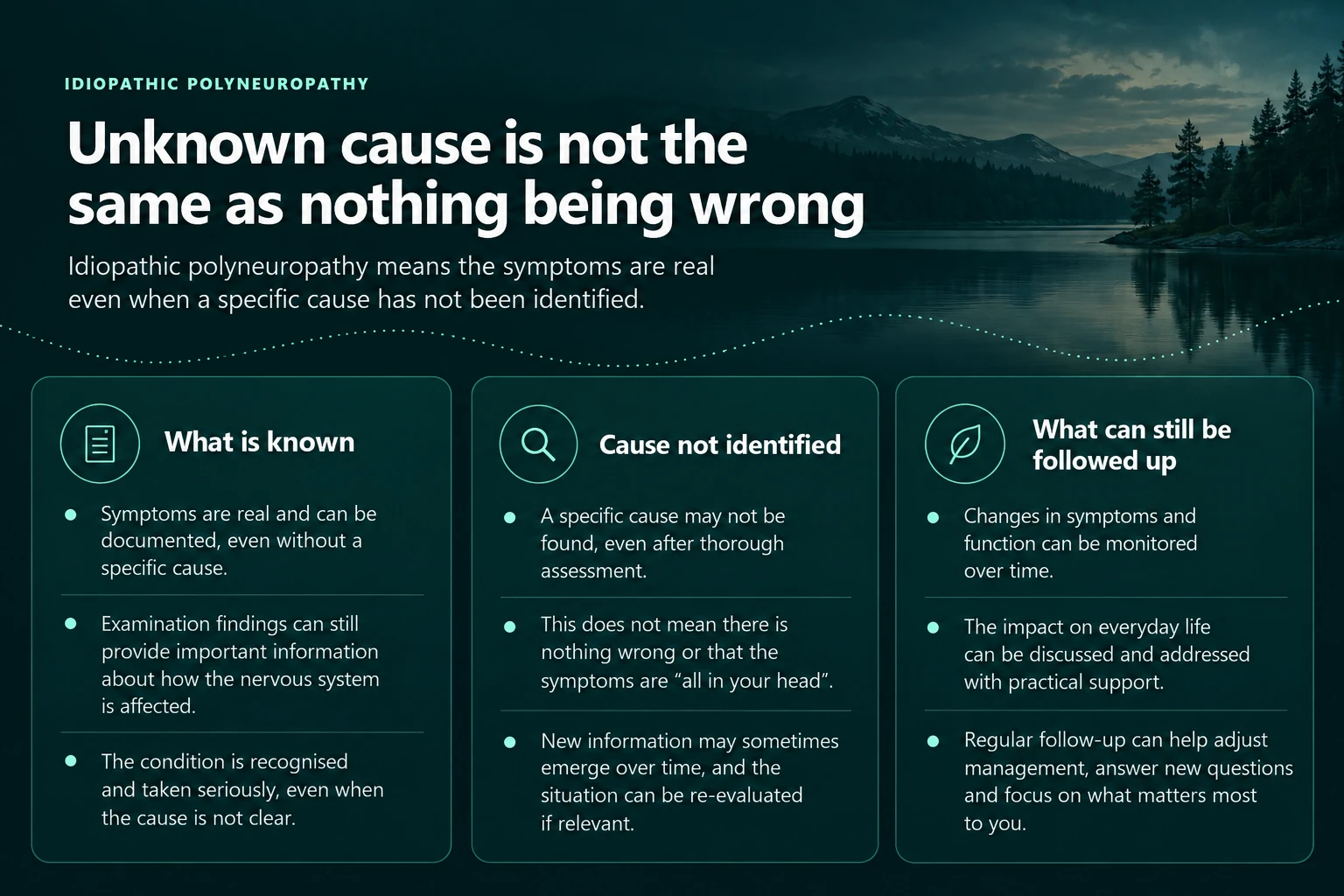
An unknown cause is not the same as nothing being wrong
“Idiopathic” describes the limits of what testing can currently explain. It doesn’t mean your symptoms are imagined, exaggerated or unimportant.
A Dutch study of 56 people with CIAP found fatigue and reduced walking ability in most of them, to very different degrees; age, muscle strength and fatigue explained much of the difference in walking.11
“Unknown” also isn’t always the whole story. In a Dutch case-control study, 55 % of 249 people with CIAP met the criteria for metabolic syndrome, compared with 34 % of 709 people without neuropathy, with high blood pressure and abdominal obesity standing out most. A later review links metabolic syndrome, prediabetes, obesity and blood lipids to cryptogenic sensory neuropathy. These are associations, not proof of cause, but worth discussing with your doctor.12, 13
A population study from Rotterdam points the same way: among people found to have chronic axonal polyneuropathy, more than half had not been diagnosed through regular care, and about one in five had a combination of risk factors. The authors argue for a full diagnostic workup even when one risk factor is already known.20
What usually happens over time?
In a Dutch study that followed 75 people with CIAP for five years, progression was slow, and where disability occurred it was not severe. In the US clinic study of cryptogenic sensory neuropathy, all 66 people who had follow-up visits, over about a year on average, could still walk.4, 9
Those are results from specialist clinics, some with short follow-up, and they don’t promise anything about one person’s future. I found no reliable figures on how many people eventually need walking aids.
A diagnosis you can revisit. When a Dutch team re-examined 53 people who had been diagnosed with CIAP, only 27 (51 %) kept the diagnosis. In 19, the original diagnosis was judged wrong, mainly because the diagnostic guideline hadn’t been followed or a hereditary neuropathy hadn’t been recognised.10 That was one centre, in 1993–2000, but it shows why a fresh look can make sense if something doesn’t add up.
What can treatment aim for when no cause is found?
There is no medicine proven to slow or reverse CIAP itself. A Cochrane review from 2017 found no adequate randomised trials and concluded that, in their absence, there is no proven effective drug treatment. The aims shift to easing symptoms, protecting your feet and balance, and looking after your general health.14
Nerve pain
Pain is treated like nerve pain from other causes. The UK guideline from NICE offers a choice of amitriptyline, duloxetine, gabapentin or pregabalin as initial treatment, and a 2025 international review from the neuropathic pain group NeuPSIG places the same drug groups first, with capsaicin or lidocaine patches as second-line options.15, 16 Which, if any, suits you is for you and your doctor to decide.
Balance, strength and walking
A 2022 meta-analysis of randomised trials found that exercise, especially balance and sensorimotor training, improved balance in people with neuropathy. Most trials were in diabetic or chemotherapy-related neuropathy rather than idiopathic neuropathy, so applying this to CIAP is a reasonable extrapolation, not proof. The NHS lists physiotherapy for strength, and walking aids or splints where needed, and the AAN quality document counts asking about falls as part of good care.7, 17, 19

Feet and everyday health
Reduced feeling makes it easy to miss a blister or cut, so check your feet and get a sore that won’t heal looked at. For neuropathy linked to diabetes, the NHS suggests stopping smoking, cutting down on alcohol, keeping a healthy weight and exercising regularly. Given the links to metabolic syndrome, asking about blood pressure, weight and blood sugar seems sensible to me, though it isn’t proven that treating them changes the course of idiopathic neuropathy.12, 13, 19
When is it worth taking a fresh look?
Routinely repeating the same tests doesn’t seem to help much. In the five-year Dutch follow-up, a cause was found in only four of 75 people (two hereditary neuropathies, one inflammatory neuropathy and one related to alcohol), and the authors concluded that routine repeat laboratory tests were not informative and should be done only on clinical grounds.9
A change in the pattern does justify a new look. The Canadian review describes features that don’t fit a typical, slow neuropathy and may call for referral:1
- onset over days or weeks, or a sudden foot or wrist drop
- a rapidly worsening, painful neuropathy
- clear differences between the two sides, or problems in several separate nerves
- weakness near the trunk (hips, thighs, shoulders) as well as in the hands and feet
- loss of reflexes everywhere without other findings
- signs of illness elsewhere in the body, such as weight loss, fever, skin changes or joint inflammation
The US review adds mainly motor or autonomic symptoms, such as weakness rather than numbness, or problems with blood pressure, bowel or bladder. Relatives with a similar condition are worth mentioning too, since missed hereditary neuropathies explained some wrong diagnoses in the Dutch re-evaluation.5, 10
Questions to take to your next appointment
No guideline I found sets a fixed follow-up schedule, so agree on one with your doctor. Questions worth asking:
- Do my tests cover glucose (including a glucose tolerance test or HbA1c), B12 with metabolites, and protein electrophoresis with immunofixation?
- Did my nerve tests show an axonal or a demyelinating pattern?
- Could anything in my history, medicines, alcohol use or family still be relevant, and should my blood pressure, weight, lipids or blood sugar be looked at more closely?
- What changes should make me contact you early, or justify a referral or fresh evaluation?
- Would physiotherapy, balance training or regular foot checks help me, and if I have nerve pain, how will we judge whether a treatment is working?
I’m not a doctor. I’ve written this from published research and guidance, and to help you prepare questions for your own care.
Sources
- Mirian A, Aljohani Z, Grushka D, Florendo-Cumbermack A. Diagnosis and management of patients with polyneuropathy. CMAJ 2023;195(6):E227–E233, 13 February 2023 (correction: CMAJ 2023;195(11):E415). https://www.cmaj.ca/content/195/6/E227
- Hanewinckel R, van Oijen M, Ikram MA, van Doorn PA. The epidemiology and risk factors of chronic polyneuropathy. European Journal of Epidemiology 2016;31:5–20. doi:10.1007/s10654-015-0094-6. https://link.springer.com/article/10.1007/s10654-015-0094-6
- Zis P, Sarrigiannis PG, Rao DG, Hewamadduma C, Hadjivassiliou M. Chronic idiopathic axonal polyneuropathy: a systematic review. Journal of Neurology 2016;263(10):1903–1910. https://link.springer.com/article/10.1007/s00415-016-8082-7
- Wolfe GI, Baker NS, Amato AA, et al. Chronic cryptogenic sensory polyneuropathy: clinical and laboratory characteristics. Archives of Neurology 1999;56(5):540–547 (abstract). https://scholars.uthscsa.edu/en/publications/chronic-cryptogenic-sensory-polyneuropathy-clinical-and-laborator/
- Castelli G, Desai KM, Cantone RE. Peripheral neuropathy: evaluation and differential diagnosis. American Family Physician 2020;102(12):732–739. https://www.aafp.org/pubs/afp/issues/2020/1215/p732.html
- American Academy of Neurology. Evaluation of distal symmetric polyneuropathy: role of laboratory and genetic testing (England JD et al., Neurology 2009;72(2):185–192). Guideline page, reaffirmed 8 February 2025. https://www.aan.com/Guidelines/home/GuidelineDetail/315
- American Academy of Neurology / AANEM. Distal Symmetric Polyneuropathy Performance Measurement Set. Approved 2012 (AAN) and 2013 (AANEM). https://www.aanem.org/docs/default-source/documents/aanem/practice/guidelines/distal-symmetric-polyneuropathy.pdf?sfvrsn=7ad81a5a_0
- American Family Physician / Choosing Wisely. Don’t do an MRI scan of the spine or brain for patients with only peripheral neuropathy (without signs or symptoms suggesting a brain or spine disorder) (AANEM recommendation). https://www.aafp.org/pubs/afp/collections/choosing-wisely/239.html
- Notermans NC, Wokke JH, van der Graaf Y, Franssen H, van Dijk GW, Jennekens FG. Chronic idiopathic axonal polyneuropathy: a five year follow up. Journal of Neurology, Neurosurgery and Psychiatry 1994;57(12):1525–1527. https://jnnp.bmj.com/content/57/12/1525
- Rosenberg NR, Vermeulen M. Chronic idiopathic axonal polyneuropathy revisited. Journal of Neurology 2004;251(9):1128–1132. https://link.springer.com/article/10.1007/s00415-004-0499-8
- Erdmann PG, Teunissen LL, van Genderen FR, et al. Functioning of patients with chronic idiopathic axonal polyneuropathy (CIAP). Journal of Neurology 2007;254(9):1204–1211. https://link.springer.com/article/10.1007/s00415-006-0501-8
- Visser NA, Vrancken AFJE, van der Schouw YT, van den Berg LH, Notermans NC. Chronic idiopathic axonal polyneuropathy is associated with the metabolic syndrome. Diabetes Care 2013;36(4):817–822. https://diabetesjournals.org/care/article/36/4/817/37920/Chronic-Idiopathic-Axonal-Polyneuropathy-Is
- Kazamel M, Stino AM, Smith AG. Metabolic syndrome and peripheral neuropathy. Muscle & Nerve 2021;63(3):285–293. doi:10.1002/mus.27086. https://ohiostate.elsevierpure.com/en/publications/metabolic-syndrome-and-peripheral-neuropathy
- Warendorf J, Vrancken AFJE, van Schaik IN, Hughes RAC, Notermans NC. Drug therapy for chronic idiopathic axonal polyneuropathy. Cochrane Database of Systematic Reviews 2017, CD003456, 20 June 2017. https://www.cochrane.org/evidence/CD003456_drug-therapy-chronic-idiopathic-axonal-polyneuropathy
- NICE. Neuropathic pain in adults: pharmacological management in non-specialist settings (CG173). Published 20 November 2013, last updated 22 September 2020. https://www.nice.org.uk/guidance/cg173/chapter/Recommendations
- Soliman N, Moisset X, Ferraro MC, et al.; NeuPSIG Review Update Study Group. Pharmacotherapy and non-invasive neuromodulation for neuropathic pain: a systematic review and meta-analysis. Lancet Neurology 2025;24(5):413–428 (abstract). https://vbn.aau.dk/en/publications/pharmacotherapy-and-non-invasive-neuromodulation-for-neuropathic-
- Streckmann F, Balke M, Cavaletti G, et al. Exercise and neuropathy: systematic review with meta-analysis. Sports Medicine 2022;52:1043–1065. https://link.springer.com/article/10.1007/s40279-021-01596-6
- National Institute of Neurological Disorders and Stroke (NINDS). Guillain-Barré Syndrome. Last reviewed 13 March 2026. https://www.ninds.nih.gov/health-information/disorders/guillain-barre-syndrome
- NHS. Peripheral neuropathy and Peripheral neuropathy – treatment. Last reviewed 10 October 2022. https://www.nhs.uk/conditions/peripheral-neuropathy/
- Taams NE, Drenthen J, Hanewinckel R, Ikram MA, van Doorn PA. Prevalence and risk factor profiles for chronic axonal polyneuropathy in the general population. Neurology 2022;99(20):e2234–e2240 (abstract). https://pure.eur.nl/en/publications/prevalence-and-risk-factor-profiles-for-chronic-axonal-polyneurop/
- Mayo Clinic. Peripheral neuropathy – Symptoms and causes. 19 May 2026. https://www.mayoclinic.org/diseases-conditions/peripheral-neuropathy/symptoms-causes/syc-20352061
Sources checked on 25 September 2026.
Related reading

Restless legs or neuropathy? Similar symptoms, different assessments
Written by someone living with neuropathy: how restless legs syndrome differs from neuropathy, why the two are so often confused, how often they occur together, how each is assessed, and questions to take to your doctor.

Cold feet: nerve symptoms, circulation and when to seek help
Written by someone living with neuropathy: why feet can feel cold without being cold, when cold feet point to circulation instead, the warning signs that need urgent help, and a description aid for your appointment.

Numb hands and weak grip: neuropathy or another nerve problem?
Written by someone living with neuropathy: why numb hands and a weak grip can be a trapped nerve, a neck problem or polyneuropathy, the warning signs, and a description aid to take to your doctor.