
Numb hands and a weak grip can come from several different nerve problems. The main ones are a nerve pinched at the wrist (carpal tunnel syndrome) or at the elbow, a nerve root pressed in the neck, and polyneuropathy, which usually starts in the feet and reaches the hands later. Rarer causes exist too. Which fingers are affected, on one side or both, and whether your feet are numb too all help a doctor tell them apart, and nerve tests often help.1, 2, 3
I have neuropathy myself, and I write these pages to make the research easier to read. This one explains why neuropathy in the hands with a weak grip needs sorting out, and how to describe your symptoms to a doctor. It is not a way to diagnose yourself.
Neuropathy, hands and weak grip: why the cause matters
Neuropathy in the hands with a weak grip is not one condition. A review in American Family Physician names carpal tunnel syndrome as the most common nerve entrapment in the arm and calls pressure on the ulnar nerve at the elbow also relatively common. Both involve one nerve in one place. In polyneuropathy many nerves are affected, and the search is for a cause in the whole body; the CMAJ review names diabetes as the most common cause.1, 3
The next steps differ too, and pressure on the spinal cord in the neck calls for quick referral to a specialist. StatPearls, a clinical reference, links having spinal cord symptoms for more than 18 months with a poorer outlook.8
You can also have both. In a 2002 study of 478 people, carpal tunnel syndrome was found on clinical assessment in 2% of a reference group without diabetes or neuropathy, 14% of people with diabetes but no polyneuropathy and 30% of people with diabetic polyneuropathy. As I read it, a new change in your hands deserves a look even if you already know you have neuropathy.9
What the typical patterns look like
Real symptoms are often less tidy than these descriptions, which is one reason an examination matters.
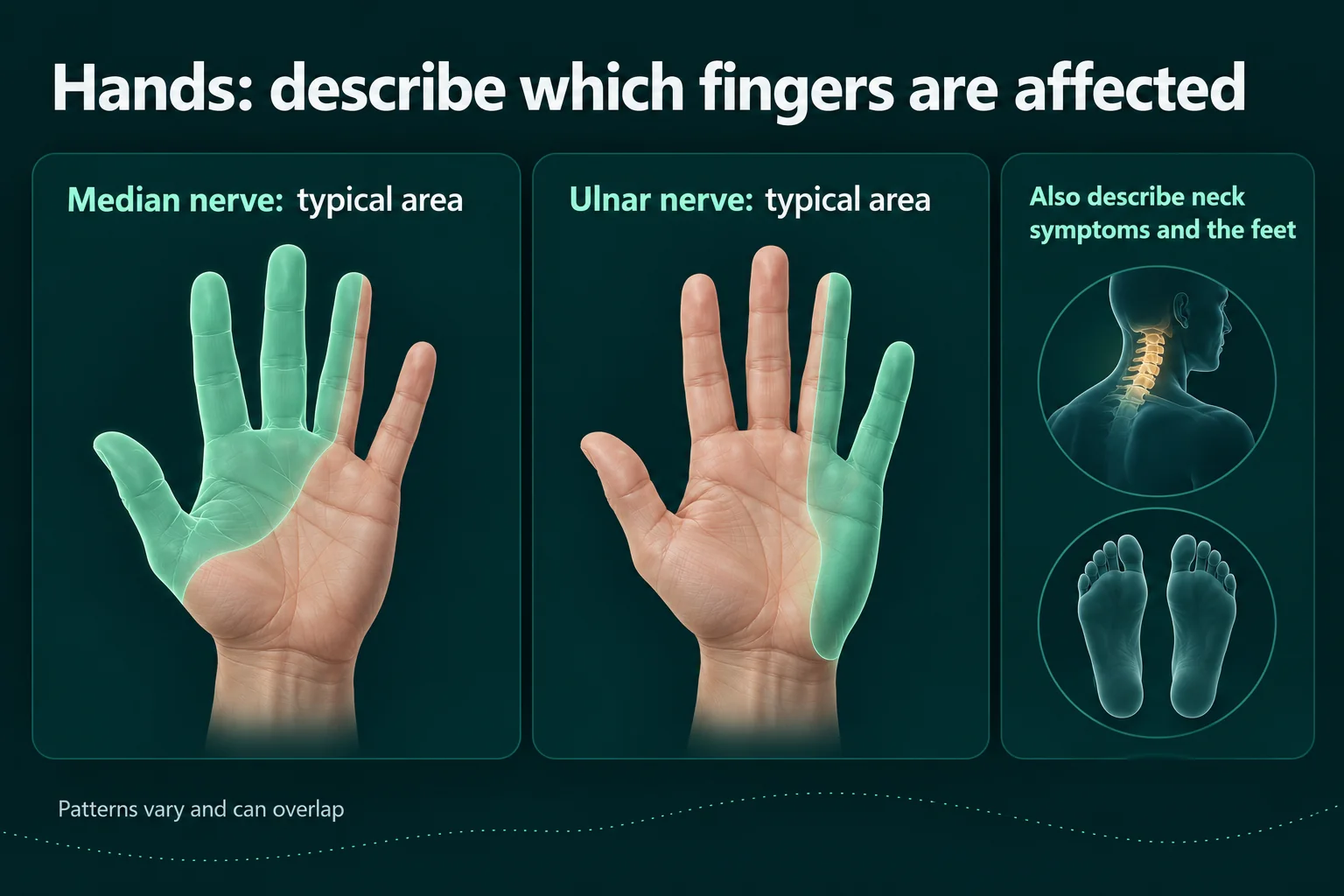
Carpal tunnel syndrome (median nerve at the wrist)
StatPearls describes pain, numbness and pins and needles in the thumb, index and middle fingers and the thumb side of the ring finger. Mayo Clinic adds that the little finger is not affected. Symptoms often start at night, and shaking the hand can bring relief. They may come on while holding a steering wheel, phone or book.10, 11
The NHS lists a weak thumb or difficulty gripping, and Mayo Clinic says people may drop things. In more advanced cases, StatPearls describes weakness and wasting of the muscles at the base of the thumb. Diabetes, pregnancy, an underactive thyroid, obesity and rheumatoid arthritis are among the risk factors it lists.10, 11, 12
Ulnar nerve at the elbow (cubital tunnel syndrome)
StatPearls describes numbness and pins and needles in the little finger, the little-finger side of the ring finger and the edge of the palm below them, followed by weakness, clumsiness and a weaker pinch. The American Academy of Orthopaedic Surgeons (AAOS) patient site says symptoms are more common with the elbow bent, can wake people at night, and in more severe cases can include a weaker grip and poorer finger coordination, such as when typing. It advises seeing a doctor for severe symptoms, or milder ones lasting over six weeks, because muscle wasting cannot be reversed.13, 14
A nerve root in the neck (cervical radiculopathy)
Here the pain starts in the neck and runs down the arm along the path of one nerve root, with numbness, pins and needles or weakness. StatPearls says symptoms tend to be on one side and often get worse when you bend the neck back, turn it towards the painful side or use the arm overhead. The C7 root is affected most often, followed by C6. The British Journal of General Practice review describes the numbness or tingling as one-sided and following the skin area of the affected nerve root.6, 15
StatPearls lists cervical radiculopathy among the conditions to consider before calling something carpal tunnel syndrome.10
The spinal cord in the neck (cervical myelopathy)
StatPearls describes clumsy hands, difficulty with fine tasks such as buttons or handwriting, numbness in the hands, and problems with walking and balance; some people also have bladder or bowel problems. It usually comes on gradually and gets worse in steps. The CMAJ review names cervical myelopathy as a condition that can mimic polyneuropathy.1, 8
Polyneuropathy
In the common length-dependent pattern, the longest nerves are affected first. The CMAJ review explains that numbness begins in the feet, and the fingertips become affected once it reaches the upper calf, because those nerve lengths are roughly the same. This is the “glove and stocking” pattern. Weakness comes after the sensory changes, starting with the toes. NINDS describes the same feet-first pattern.1, 2
So numb hands with normal feet do not fit the usual picture. An American Family Physician review lists symptoms that are uneven between the two sides, that come on suddenly, that progress quickly or that are mainly motor as reasons for referral for nerve tests, and says an uneven pattern can point to less common causes such as vasculitis. CMAJ adds patterns such as several single nerves affected at once, or weakness close to the body as well as far out, which can point to an inflammatory neuropathy.1, 16
Describing your hand symptoms to your doctor
This table is my own description aid, built from the sources. It is not a self-test and gives no answer; it only helps you put into words the details doctors use. An American Family Physician summary notes that hand diagrams, where you mark where it tingles, may be useful in assessing carpal tunnel syndrome, so a simple drawing can be worth bringing.17

| What to describe | Things to note down | Why a doctor may ask |
|---|---|---|
| Where exactly | Which fingers, and which side of the ring finger; one hand or both; the palm or the back of the hand; your feet as well; neck or arm pain | A single nerve, a nerve root and polyneuropathy each tend to cover a different area |
| When it happens | At night or on waking; when holding a phone, book or steering wheel; with the elbow bent; when you move your neck; whether shaking the hand helps | Position and time of day can point to the wrist, the elbow or the neck |
| What your hands can’t do | Opening jars, gripping, pinching small things, buttons, handwriting, typing, dropping things | Loss of strength or fine control can show which nerves or which part of the nervous system is involved |
| How it has changed | When it started; whether it is spreading and how fast (days, weeks, months or years) | Speed of change affects how urgently things need to happen |
| Anything else | Unsteady walking or balance problems; bladder or bowel changes; diabetes, thyroid problems, pregnancy or arthritis; work with vibrating tools or repeated wrist movements | These can point to the spinal cord, or to known risk factors |
How doctors tell them apart
The American Family Physician review on nerve entrapment in the arm says the history should cover the time course, what makes it worse and where the symptoms are, and the examination maps skin areas and muscle groups to find where the problem sits. The CMAJ review adds that reflexes help: an isolated reflex change on one side, such as losing only one ankle reflex, can suggest a single nerve or nerve root.1, 3
Nerve conduction studies and electromyography (often shortened to NCS/EMG) measure how well nerves and muscles carry signals. The CMAJ review says these tests make the diagnosis more specific, and the AAOS patient site says they can help show where a nerve is being pressed. I explain the tests in my article on EMG and nerve conduction studies.1, 14
For carpal tunnel syndrome, the AAOS guideline from 2024 says a structured clinical score called CTS-6 can be used to diagnose it instead of routine ultrasound or nerve tests, which remain useful when the picture is less clear. It also says MRI should not be used to diagnose carpal tunnel syndrome. MRI is, however, the preferred scan when a doctor suspects a nerve root or the spinal cord in the neck, according to StatPearls.8, 15, 18
Diabetes makes this harder. In the 2002 study, nerve test results did not reliably show which people with diabetes had carpal tunnel syndrome, and the authors recommended that treatment decisions for it be made independently of the nerve test findings.9
A word on treatment
Treatment depends on the cause, so here are only pointers. For carpal tunnel syndrome, the NHS describes a wrist splint at night first, then possibly a steroid injection, and surgery when other treatments have not helped. The AAOS guideline says a steroid injection may help in the short term but gives no long-term improvement. StatPearls says more than 85% of acute cervical radiculopathy settles within 8 to 12 weeks without specific treatment. For polyneuropathy, the focus is on finding and treating the cause, which my article on polyneuropathy covers.12, 15, 18
Questions to take to your appointment
- Does the pattern in my hands fit one trapped nerve, a nerve root in my neck, or polyneuropathy?
- Could I have more than one of these at the same time?
- Should my feet, reflexes and walking be checked as well?
- Do I need nerve conduction studies or EMG, and what would they add?
- Is a scan of my neck needed, and why or why not?
- Which changes, such as weakness, muscle wasting or balance problems, mean I should come back sooner?
What is still uncertain
In the parts of the AAOS guideline I could read, I found no specific advice for people who also have polyneuropathy, where the diagnosis is harder. The 2002 study is old and looked at one group of people with diabetes, so its figures may not apply to everyone. And hand diagrams “may be useful”, not more.9, 17, 18
Much of this comes from reference texts and reviews rather than trials comparing ways to tell these conditions apart. As I read it, the patterns are a guide for the conversation with your doctor, not rules.
I’m not a doctor. I’ve written this from published research and guidance, and to help you prepare questions for your own care.
Sources
- Mirian A, Aljohani Z, Grushka D, Florendo-Cumbermack A. Diagnosis and management of patients with polyneuropathy. CMAJ 2023;195(6):E227–E233. Published 13 February 2023. doi:10.1503/cmaj.220936. https://www.cmaj.ca/content/195/6/E227
- National Institute of Neurological Disorders and Stroke (NINDS). Peripheral Neuropathy. Last reviewed 13 March 2026. https://www.ninds.nih.gov/health-information/disorders/peripheral-neuropathy
- Silver S, Ledford CC, Vogel KJ, Arnold JJ. Peripheral Nerve Entrapment and Injury in the Upper Extremity. Am Fam Physician 2021;103(5):275–285. Published 1 March 2021. https://www.aafp.org/pubs/afp/issues/2021/0301/p275.html
- NHS. Symptoms of a stroke. Page last reviewed 12 September 2024. https://www.nhs.uk/conditions/stroke/symptoms/
- NHS. Guillain-Barré syndrome. Page last reviewed 12 August 2024. https://www.nhs.uk/conditions/guillain-barre-syndrome/
- McCartney S, Baskerville R, Blagg S, McCartney D. Cervical radiculopathy and cervical myelopathy: diagnosis and management in primary care. Br J Gen Pract 2018;68(666):44–46. doi:10.3399/bjgp17X694361. https://pmc.ncbi.nlm.nih.gov/articles/PMC5737310/
- NHS. Pins and needles. Page last reviewed 4 January 2024. https://www.nhs.uk/symptoms/pins-and-needles/
- Margetis K, Donnally CJ III. Cervical Myelopathy. StatPearls [Internet]. StatPearls Publishing; last update 2 August 2025. NBK482312. https://www.ncbi.nlm.nih.gov/books/NBK482312/
- Perkins BA, Olaleye D, Bril V. Carpal tunnel syndrome in patients with diabetic polyneuropathy. Diabetes Care 2002;25(3):565–569. doi:10.2337/diacare.25.3.565. https://pubmed.ncbi.nlm.nih.gov/11874948/
- Sevy JO, Sina RE, Varacallo MA. Carpal Tunnel Syndrome. StatPearls [Internet]. StatPearls Publishing; last update 29 October 2023. NBK448179. https://www.ncbi.nlm.nih.gov/books/NBK448179/
- Mayo Clinic Staff. Carpal tunnel syndrome – Symptoms and causes. Mayo Clinic, 30 June 2026. https://www.mayoclinic.org/diseases-conditions/carpal-tunnel-syndrome/symptoms-causes/syc-20355603
- NHS. Carpal tunnel syndrome. Page last reviewed 17 April 2024. https://www.nhs.uk/conditions/carpal-tunnel-syndrome/
- Davis DD, Kane SM. Ulnar Nerve Entrapment. StatPearls [Internet]. StatPearls Publishing; last update 7 August 2023. NBK555929. https://www.ncbi.nlm.nih.gov/books/NBK555929/
- American Academy of Orthopaedic Surgeons (AAOS). Cubital Tunnel Syndrome (Ulnar Nerve Entrapment at the Elbow). OrthoInfo. Undated page (contributor updates listed up to 2023; © 1995–2026). https://www.orthoinfo.org/diseases–conditions/ulnar-nerve-entrapment-at-the-elbow
- Margetis K, Magnus W, Mesfin FB. Cervical Radiculopathy. StatPearls [Internet]. StatPearls Publishing; last update 6 August 2025. NBK441828. https://www.ncbi.nlm.nih.gov/books/NBK441828/
- Castelli G, Desai KM, Cantone RE. Peripheral Neuropathy: Evaluation and Differential Diagnosis. Am Fam Physician 2020;102(12):732–739. Published 15 December 2020. https://www.aafp.org/afp/2020/1215/p732
- Alvarez CA, Brown SR. Carpal Tunnel Syndrome (Point-of-Care Guides). Am Fam Physician 2024;109(6):571–572. Published June 2024. https://www.aafp.org/pubs/afp/issues/2024/0600/pocg-carpal-tunnel-syndrome.html
- American Academy of Orthopaedic Surgeons. Management of Carpal Tunnel Syndrome: Evidence-Based Clinical Practice Guideline. AAOS, 18 May 2024. https://www.aaos.org/globalassets/quality-and-practice-resources/carpal-tunnel/carpal-tunnel-2024/cts-cpg.pdf
Sources checked on 26 September 2026.
Related reading

Restless legs or neuropathy? Similar symptoms, different assessments
Written by someone living with neuropathy: how restless legs syndrome differs from neuropathy, why the two are so often confused, how often they occur together, how each is assessed, and questions to take to your doctor.

Cold feet: nerve symptoms, circulation and when to seek help
Written by someone living with neuropathy: why feet can feel cold without being cold, when cold feet point to circulation instead, the warning signs that need urgent help, and a description aid for your appointment.

Autonomic neuropathy: dizziness, digestion, bladder and other symptoms
Written by someone living with neuropathy: the symptoms autonomic neuropathy can cause in blood pressure, digestion, bladder, sex life, sweating and eyes, the other common causes to rule out for each, and questions to take to your doctor.