
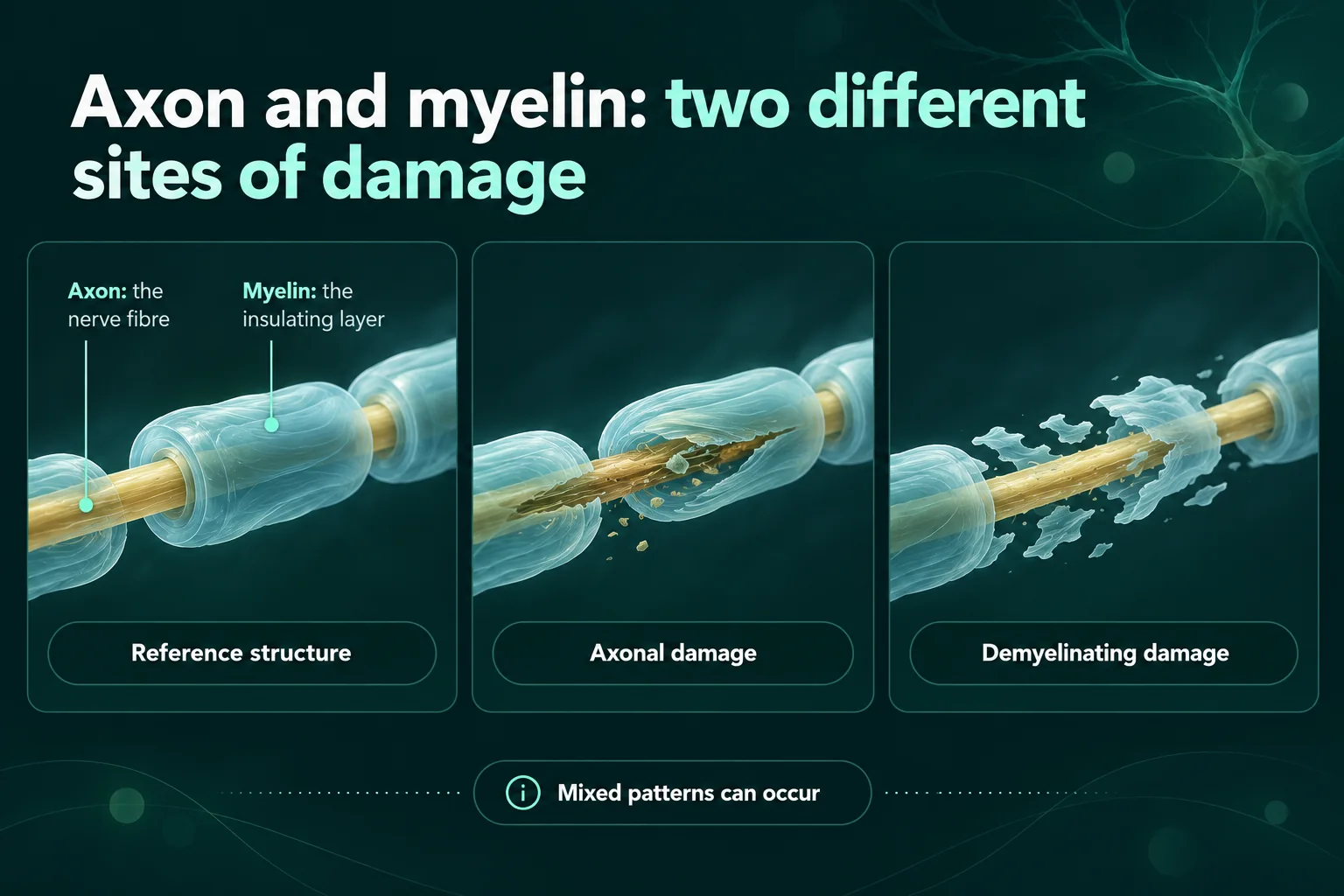
CIDP neuropathy, short for chronic inflammatory demyelinating polyneuropathy, is a rare nerve disease in which the immune system damages the insulating layer around the nerves. It is diagnosed differently from ordinary neuropathy: typically by a particular pattern of weakness and numbness that builds up over at least eight weeks, confirmed by specific nerve conduction findings. That is why immune treatment is meant for CIDP, not for neuropathy in general.1
I have neuropathy myself, and I write these pages to make the research easier to read and to help you ask good questions. This page explains how CIDP is told apart from other neuropathies and how treatment is judged. It cannot tell you whether you have CIDP. Weakness, or the word “demyelinating” on a report, is not enough on its own.
What is CIDP neuropathy?
The Merck Manual describes CIDP as an immune-mediated polyneuropathy with weakness on both sides, in muscles both close to the body and further out, that keeps progressing for more than two months.4
The GBS|CIDP Foundation International, a patient organisation, describes damage to the nerves’ covering, called myelin, and notes that CIDP can relapse or go into remission and often needs ongoing treatment.5
CIDP is rare. StatPearls, a medical reference, gives prevalence figures from 0.8 to 8.9 per 100,000 people, and says it affects men about twice as often as women. It can also occur in children.6
How is it different from Guillain–Barré syndrome?
Mainly in time. Guillain–Barré syndrome comes on over hours or days, and most people reach their weakest point within about two weeks.2
CIDP keeps developing beyond eight weeks. The European guideline adds that some people start like Guillain–Barré, but keep getting worse more than eight weeks after onset, or relapse at least three times after first improving. That is then called acute-onset CIDP.1
According to Merck, 2 to 5 percent of people first diagnosed with Guillain–Barré syndrome are later reclassified as having CIDP. Guillain–Barré syndrome itself has its own article on this site.4
How CIDP, ordinary neuropathy and Guillain–Barré differ
This comparison shows the diagnostic principle, not a self-test. Real cases overlap, CIDP has variants that look different, and only a specialist examination with nerve tests can sort them out.
| Feature | Typical CIDP | Typical length-dependent polyneuropathy (for example from diabetes) | Guillain–Barré syndrome |
|---|---|---|---|
| Time course | Progressive or relapsing, developing over at least 8 weeks | Slowly progressive; onset over days to weeks is a warning sign | Comes on over hours to days; weakest point usually within about 2 weeks |
| Where it starts | Both sides, in muscles close to the body as well as further out, in arms and legs | Both sides, starting furthest out, in the feet | Often starting in the feet and moving upward |
| Weakness or numbness? | Weakness and sensory loss; reflexes reduced or absent in all limbs | Sensory loss and weakness far out in the limbs; weakness that dominates is a warning sign | Mainly weakness, with tingling or pain; can affect swallowing and breathing |
| Nerve conduction studies | Required; both motor and sensory nerves tested, looking for set demyelinating features | Suggested for most people; help sort axonal from demyelinating and point to a cause | Signals slowed along damaged nerves |
| Supportive tests | Spinal fluid protein, MRI or ultrasound of nerve roots and nerves, objective treatment response | Tests to find the cause; diabetes is the most common one | Spinal fluid with raised protein and few immune cells |
| Treatment approach | Immune treatment, often long term, adjusted over time | Find the cause; treat symptoms such as nerve pain | Urgent hospital care; immunoglobulin or plasma exchange |
How is CIDP diagnosed under the current guideline?
The current criteria come from the 2021 guideline of the European Academy of Neurology and the Peripheral Nerve Society (EAN/PNS). As I read it, the diagnosis is built in steps.1
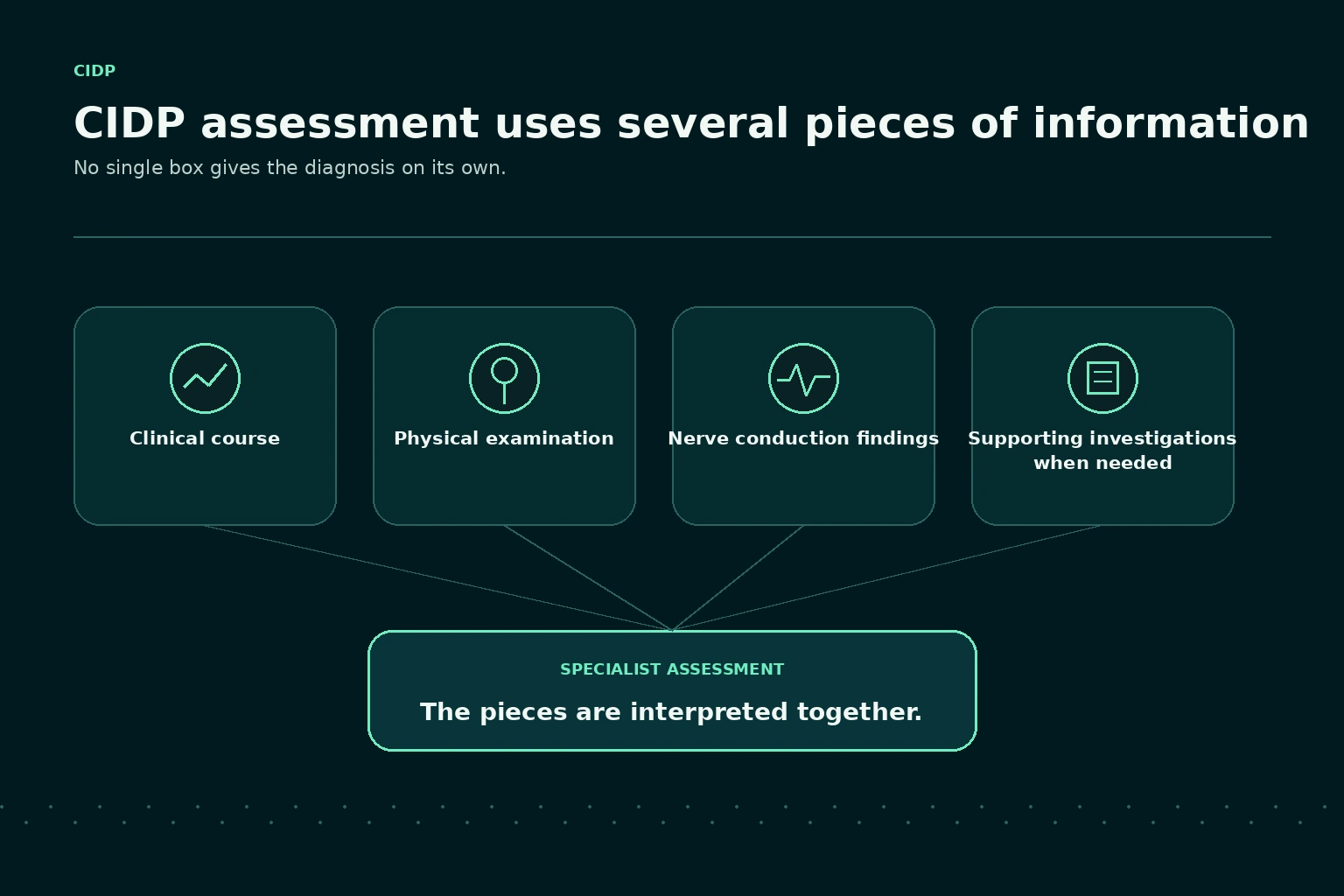
- The clinical pattern comes first. Typical CIDP means progressive or relapsing, symmetric weakness in the upper and lower limbs, both close to the body and further out, with sensory involvement, developing over at least eight weeks, and reduced or absent reflexes in all limbs.1
- Nerve conduction studies are required. The guideline now asks for both motor and sensory nerve tests, and sorts the result into two levels: CIDP or possible CIDP. The earlier version had three levels.1
- Supportive criteria are used when the result is only “possible CIDP”. These are raised protein in the spinal fluid, enlarged or bright nerve roots on MRI, enlarged nerves on ultrasound, an objective response to immune treatment and, in specific situations only, a nerve biopsy. In typical CIDP, at least two supportive criteria can move “possible CIDP” up to CIDP.1
Typical CIDP and the variants
The guideline replaced the old term “atypical CIDP” with “CIDP variants”. It names five: distal (mainly far out in the limbs, especially the legs), multifocal (patchy and often uneven, mostly in the arms), focal (only one limb), motor (weakness without sensory loss) and sensory (sensory loss without weakness). It adds that sensory CIDP is often a passing stage, and that weakness later appears in about 70 percent.1
Why a single finding is not enough
Raised protein in the spinal fluid is a good example. The guideline says it is often found in CIDP, but its specificity is unknown. Normal values are higher after the age of 50, and a raised level should be interpreted cautiously in people with diabetes. The guideline also warns of misdiagnosis when the nerve tests do not confirm CIDP and only the spinal fluid protein is raised.1
The same goes for the word “demyelinating” on a report: it describes a finding, not a diagnosis. My article on axonal and demyelinating neuropathy covers such reports.
What are autoimmune nodopathies?
Some people who seemed to have CIDP turn out to have antibodies against proteins at the nodes of Ranvier, the small gaps in the nerve’s insulation. The antibodies are called anti-NF155, anti-CNTN1, anti-Caspr1 and anti-NF140/186. The guideline now calls these conditions autoimmune nodopathies and no longer counts them as CIDP, because they have distinct features, no clear inflammation and a poor response to immunoglobulin.1
The guideline advises antibody testing in situations such as when CIDP does not respond to immunoglobulin and corticosteroids, began acutely or aggressively, or comes with a slow tremor or poor coordination.1
A 2025 review in Frontiers in Immunology notes that these antibodies are mainly of a type called IgG4.7
Why is CIDP so often misdiagnosed?
A study in Neurology looked at 59 people in a row who had been referred with a diagnosis of CIDP. Almost half, 47 percent, did not meet the minimal diagnostic requirements of the criteria in use at the time. Half of those without CIDP had the spinal fluid finding often linked to it, usually only mildly raised protein, and many reported feeling better on immune treatment even though the diagnosis was wrong.8
The authors named three common errors: relying on a person’s own sense of benefit, reading “demyelination” too liberally into nerve tests, and overrating mildly raised spinal fluid protein.8
The guideline agrees that misdiagnosis is common, especially in the variants, and that some people who formally meet the criteria still do not have CIDP.1
What treatments are used for CIDP?
The EAN/PNS guideline strongly recommends immunoglobulin or corticosteroids as the first treatment, and plasma exchange if those do not work. In motor CIDP it suggests immunoglobulin first, because some people with that variant get worse on corticosteroids.1
Immunoglobulin, into a vein or under the skin
A 2024 Cochrane review found that intravenous immunoglobulin (IVIG) increases the chance of a clear improvement in disability within six weeks, with about four people treated for one extra to improve. It found probably little or no difference compared with corticosteroids, and serious side effects about as often as with placebo.9
In a placebo-controlled trial called ICE, 54 percent on immunoglobulin and 21 percent on placebo improved on a disability scale and stayed improved through week 24.10
Immunoglobulin can also be given under the skin (SCIG) as maintenance. The PATH trial included people who had responded to and depended on immunoglobulin into a vein: 63 percent on placebo relapsed or withdrew, compared with 39 and 33 percent on the two SCIG doses.11
The guideline gives no preference between the two routes for maintenance.1
Corticosteroids
A 2017 Cochrane review found only small trials. In one, 12 of 19 people on prednisone improved compared with 5 of 16 without treatment, but the certainty of that evidence was very low. Daily prednisolone and monthly high-dose dexamethasone showed little or no difference after a year, and the review points to the risk of serious side effects with long-term use.12
Plasma exchange
In plasma exchange, the liquid part of the blood is removed and replaced. A 2015 Cochrane review of two small trials found clear short-term improvement, but 8 of 12 people who improved deteriorated quickly afterwards. Side effects occurred in 3 to 17 percent of procedures and were sometimes serious.13
Efgartigimod, a newer option
Efgartigimod blocks a receptor called FcRn, which normally recycles antibodies of the IgG type, so their level in the blood falls.7
In the ADHERE trial, 66 percent of 322 people improved in the open first stage. In the second stage, 28 percent of those who stayed on efgartigimod relapsed, compared with 54 percent switched to placebo.14
The US Food and Drug Administration (FDA) approved it as Vyvgart Hytrulo for adults with CIDP in June 2024.15
In the European Union it is authorised for adults with active CIDP after earlier treatment with corticosteroids or immunoglobulins.16
For people who do not respond to the standard treatments, the guideline says rituximab may be considered, although the evidence is of very low certainty. Other new medicines are still being studied.1, 7
How do doctors judge whether treatment is working?
The guideline asks for an objective response: improvement on at least one disability scale and one impairment scale. Examples are the I-RODS scale of everyday activities, the INCAT disability score and measured grip strength.1
For corticosteroids, the guideline says improvement usually starts after several weeks or months. For immunoglobulin, several repeated courses may be needed before it is clear whether it works. The guideline also says that a lack of improvement does not rule out CIDP.1
Because feeling better can mislead, as the misdiagnosis study showed, I think it helps to note concrete things between visits, such as how far you can walk or whether you manage stairs. Those notes support the measurements; they do not replace them.8
Can treatment be reduced over time?
Sometimes. The guideline recommends that, when someone is stable, the team checks periodically whether the immunoglobulin dose can be lowered, the interval lengthened, or the treatment stopped.1
A 2025 study from a UK specialist centre notes that in earlier trials where immunoglobulin was withdrawn, 16 to 55 percent did not get worse. In the centre’s own planned withdrawals, 8 of 12 people stayed stable for at least a year, and everyone who got worse returned to their earlier level when treatment was restarted. The authors stress that this needs a dedicated setup with a specialist nurse and prompt access to a senior neurologist.17
So a reduction is a step planned with your specialist team, with a clear plan for what to watch and whom to call, never something to try on your own.
What is the outlook?
StatPearls says about 40 percent reach cure or remission, but 54 percent have severe disability at some point, and 10 to 15 percent do not respond to the standard treatments.6
The GBS|CIDP Foundation says that most people respond well if treated early.5
Pain is common too: the guideline cites an estimate that 46 percent have pain at some point.1
Why doesn’t immune treatment help ordinary neuropathy?
Most people with neuropathy have the common, length-dependent type. The CMAJ review describes it as slowly progressive and length-dependent, affecting the longest nerves first, with diabetes as the most common cause. It says most causes can be found from the medical history and screening tests, and it describes medicines that ease nerve pain.3
Immune treatments are aimed at an immune attack on the nerves. The trials above were done in people with CIDP, and I found no evidence in these sources that they help ordinary length-dependent neuropathy without signs of an immune process. That is my reading, and worth asking your neurologist about.
Wrong treatment is not harmless either. The 2025 review points out that immunoglobulin is expensive, limited in supply and time-consuming to give.7 Immunoglobulin for small fibre neuropathy is a separate question, covered in its own article.
What remains uncertain
- How common CIDP is. Estimates vary widely between studies and regions.6
- Where CIDP ends at the edges. Much diagnostic guidance rests on expert consensus, and misdiagnosis still happens.1
- How well corticosteroids work. The trial evidence is small and of very low certainty, even though they are widely used.12
- How efgartigimod compares with immunoglobulin, and how it works over many years. ADHERE compared it with placebo, not with immunoglobulin, and in a small real-world series of nine people none improved and four had a severe relapse.7
- Who can reduce or stop treatment. The share who stayed stable after withdrawal ranged from 16 to 55 percent in earlier trials.17
- How many people do not respond to standard treatments. StatPearls says 10 to 15 percent, the 2025 review 10 to 25 percent.6, 7
Questions to take to your appointment
- Which pattern do my symptoms fit, and has the pattern been checked against the current EAN/PNS criteria?
- Do my nerve conduction results show demyelination that fits CIDP, or could something else explain them?
- Would antibody tests for autoimmune nodopathy be useful for me?
- Which treatment do you suggest first, how will we measure whether it works, and when will we decide?
- If I am stable, will we try reducing treatment, and how will that be followed up?
- Which changes in my strength mean I should contact you straight away?
I’m not a doctor. I’ve written this from published research and guidance, and to help you prepare questions for your own care.
Sources
- Van den Bergh PYK, van Doorn PA, Hadden RDM, et al. European Academy of Neurology/Peripheral Nerve Society guideline on diagnosis and treatment of chronic inflammatory demyelinating polyradiculoneuropathy: Report of a joint Task Force – Second revision. Journal of the Peripheral Nervous System 2021;26(3):242–268. doi:10.1111/jns.12455. Also published in European Journal of Neurology 2021. https://www.aan.com/Guidelines/home/GetGuidelineContent/1108
- National Institute of Neurological Disorders and Stroke (NINDS). Guillain-Barré Syndrome. Last reviewed 13 March 2026. https://www.ninds.nih.gov/health-information/disorders/guillain-barre-syndrome
- Mirian A, Aljohani Z, Grushka D, Florendo-Cumbermack A. Diagnosis and management of patients with polyneuropathy. CMAJ 2023;195(6):E227–E233. doi:10.1503/cmaj.220936. https://www.cmaj.ca/content/195/6/E227
- Feldman AM. Chronic Inflammatory Demyelinating Polyneuropathy (CIDP). Merck Manual Professional Edition. Reviewed/revised May 2026. https://www.merckmanuals.com/professional/neurologic-disorders/peripheral-nervous-system-and-motor-unit-disorders/chronic-inflammatory-demyelinating-polyneuropathy-cidp
- GBS|CIDP Foundation International. Intro to Chronic Inflammatory Demyelinating Polyneuropathy (CIDP). Last updated 20 August 2026. https://www.gbs-cidp.org/cidp/
- Gogia B, Rocha Cabrero F, Khan Suheb MZ, Lui F, Rai PK. Chronic Inflammatory Demyelinating Polyradiculoneuropathy. StatPearls. StatPearls Publishing; last updated 4 March 2024. https://www.ncbi.nlm.nih.gov/books/NBK563249/
- Caballero-Ávila M, Martin-Aguilar L, Collet-Vidiella R, Querol L, Pascual-Goñi E. A pathophysiological and mechanistic review of chronic inflammatory demyelinating polyradiculoneuropathy therapy. Frontiers in Immunology 2025;16. doi:10.3389/fimmu.2025.1575464. https://www.frontiersin.org/journals/immunology/articles/10.3389/fimmu.2025.1575464/full
- Allen JA, Lewis RA. CIDP diagnostic pitfalls and perception of treatment benefit. Neurology 2015;85(6):498–504. doi:10.1212/WNL.0000000000001833. https://www.neurology.org/doi/10.1212/WNL.0000000000001833
- Bus SRM, de Haan RJ, Vermeulen M, van Schaik IN, Eftimov F. Intravenous immunoglobulin for chronic inflammatory demyelinating polyradiculoneuropathy. Cochrane Database of Systematic Reviews, 14 February 2024 (Cochrane summary). https://www.cochrane.org/CD001797/NEUROMUSC_intravenous-immunoglobulin-chronic-inflammatory-demyelinating-polyradiculoneuropathy
- Hughes RAC, Donofrio P, Bril V, et al. Intravenous immune globulin (10% caprylate-chromatography purified) for the treatment of chronic inflammatory demyelinating polyradiculoneuropathy (ICE study): a randomised placebo-controlled trial. Lancet Neurology 2008;7(2):136–144. doi:10.1016/S1474-4422(07)70329-0. https://www.thelancet.com/journals/laneur/article/PIIS1474442207703290/abstract
- van Schaik IN, Bril V, van Geloven N, et al. Subcutaneous immunoglobulin for maintenance treatment in chronic inflammatory demyelinating polyradiculoneuropathy (PATH): a randomised, double-blind, placebo-controlled, phase 3 trial. Lancet Neurology 2018;17(1):35–46. doi:10.1016/S1474-4422(17)30378-2. https://www.thelancet.com/journals/laneur/article/PIIS1474442207703782/abstract
- Hughes RAC, Mehndiratta MM, Rajabally YA. Corticosteroids for chronic inflammatory demyelinating polyradiculoneuropathy. Cochrane Database of Systematic Reviews 2017, CD002062.pub4 (published 29 November 2017). https://www.cochrane.org/evidence/CD002062_corticosteroids-chronic-inflammatory-demyelinating-polyradiculoneuropathy
- Mehndiratta MM, Hughes RAC, Pritchard J. Plasma exchange for chronic inflammatory demyelinating polyradiculoneuropathy. Cochrane Database of Systematic Reviews, 25 August 2015 (Cochrane summary). https://www.cochrane.org/CD003906/NEUROMUSC_plasma-exchange-chronic-inflammatory-demyelinating-polyradiculoneuropathy
- Allen JA, Lin J, Basta I, et al.; ADHERE Study Group. Safety, tolerability, and efficacy of subcutaneous efgartigimod in patients with chronic inflammatory demyelinating polyradiculoneuropathy (ADHERE): a multicentre, randomised-withdrawal, double-blind, placebo-controlled, phase 2 trial. Lancet Neurology 2024;23(10):1013–1024. doi:10.1016/S1474-4422(24)00309-0. https://www.thelancet.com/journals/laneur/article/PIIS1474442202403090/abstract
- US Food and Drug Administration (FDA). FDA Roundup: June 25, 2024. https://www.fda.gov/news-events/press-announcements/fda-roundup-june-25-2024
- European Medicines Agency (EMA). Vyvgart (efgartigimod alfa): EPAR – medicine overview. Page last updated 23 January 2026. https://www.ema.europa.eu/en/medicines/human/EPAR/vyvgart
- Koay S, Chen YC, Ransley G, Compton L, Lunn MP, Carr AS. Safety and Cost Analysis of Immunoglobulin Cessation Trials in Chronic Inflammatory Demyelinating Polyneuropathy. Journal of the Peripheral Nervous System 2025;30:e70007. doi:10.1111/jns.70007. https://discovery.ucl.ac.uk/id/eprint/10212893/1/Safety%20and%20Cost%20Analysis%20of%20Immunoglobulin%20Cessation%20Trials%20in%20Chronic%20Inflammatory%20Demyelinating%20Polyradiculoneuropathy.pdf
Sources checked on 26 September 2026.
Related reading

Restless legs or neuropathy? Similar symptoms, different assessments
Written by someone living with neuropathy: how restless legs syndrome differs from neuropathy, why the two are so often confused, how often they occur together, how each is assessed, and questions to take to your doctor.

Cold feet: nerve symptoms, circulation and when to seek help
Written by someone living with neuropathy: why feet can feel cold without being cold, when cold feet point to circulation instead, the warning signs that need urgent help, and a description aid for your appointment.

Numb hands and weak grip: neuropathy or another nerve problem?
Written by someone living with neuropathy: why numb hands and a weak grip can be a trapped nerve, a neck problem or polyneuropathy, the warning signs, and a description aid to take to your doctor.