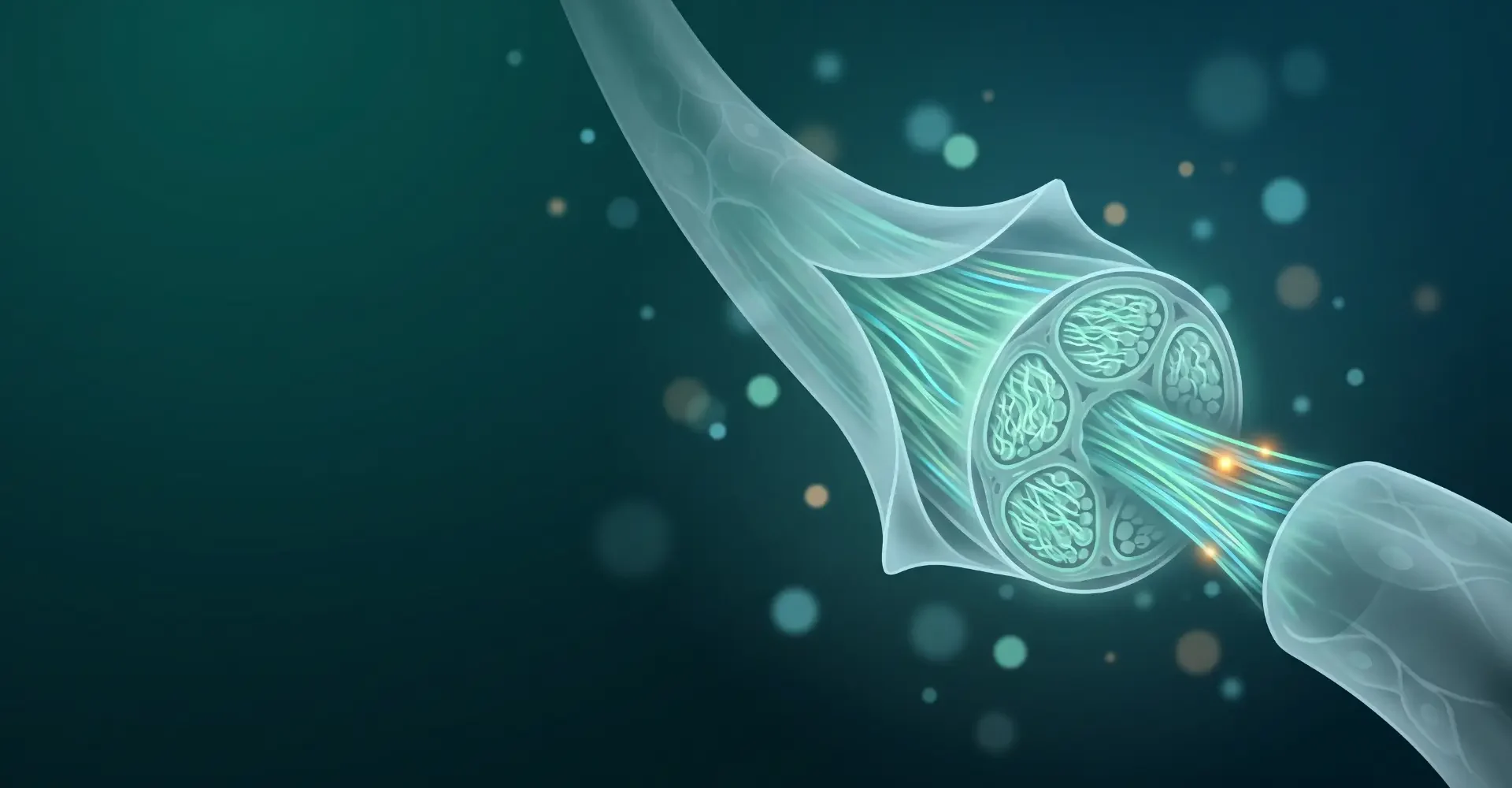
Most people with polyneuropathy never need a nerve biopsy; the NHS says they are rarely needed. Doctors consider one when they suspect a cause that shows up in the nerve tissue itself and would change treatment, above all inflammation of the blood vessels in the nerves (vasculitis), but also conditions such as sarcoidosis or amyloidosis. It is meant to come after less invasive tests, and it often leaves a lasting numb patch on the outer foot.1, 2, 3, 4
I have neuropathy myself, and “biopsy” is one of those words that makes people nervous. This page is about when a nerve biopsy is worth it, what it involves, what it can leave behind and what else might answer the same question. How neuropathy is investigated in general, and the skin biopsy for small nerve fibres, have their own pages on this site.
What is a nerve biopsy?
A nerve biopsy means removing a small piece of a nerve so it can be looked at under a microscope. MedlinePlus, from the US National Library of Medicine, says it is most often done on the sural nerve at the ankle. The skin is numbed, a small cut is made, a piece of nerve is removed, and the cut is closed and covered.9
University College London Hospitals (UCLH) describes a cut of two to four centimetres and a nerve section of about the same length. StatPearls, a reference for clinicians, places the cut about 5 to 7 centimetres above the outer ankle bone, between the Achilles tendon and the fibula.6, 4
Baylor College of Medicine explains that the nerve chosen should be a purely sensory nerve, and that the superficial peroneal nerve at the front of the shin may be used instead. A review of nerve biopsy in Muscle & Nerve from 2021 describes taking a small piece of the peroneus brevis muscle through the same cut when vasculitis is suspected. The European guideline on CIDP adds that a nerve that is clearly affected is more likely to give useful information.10, 3, 11
The sample then goes to a specialised laboratory. Michigan Medicine’s lab, as one example, uses light microscopy with special stains, plastic embedding and electron microscopy, and teases apart single fibres when needed. NeuropathyCommons, a patient resource from Mass General Brigham, calls nerve biopsy an older technique performed only at special centres.12, 13
When is a nerve biopsy needed for neuropathy?
The CMAJ review says nerve biopsy is useful when vasculitis, sarcoidosis or infiltrative disorders, such as cancer or amyloidosis, are suspected. The 2021 review in Muscle & Nerve says only a minority of people with neuropathy go on to a nerve biopsy, and that many biopsies do not give a definite answer, while the procedure has real cost and side effects.1, 3
StatPearls sums up three conditions that should be met: there are signs that the neuropathy might be something other than diabetic neuropathy; the suspected disease causes changes that can be seen in the nerve; and the result would change the treatment plan. It adds that less invasive methods, such as a thorough clinical assessment, laboratory tests and nerve conduction studies, should be used first.4
The Muscle & Nerve review ranks the reasons. It puts vasculitic neuropathy (especially the form limited to the nerves), lymphoma cells in the nerves, nerve and nerve-sheath tumours and a pure nerve form of leprosy at the top. Amyloidosis, sarcoidosis and IgG4-related disease come in the middle. Atypical CIDP, neuropathy linked to abnormal blood proteins, hereditary neuropathy and neuropathy without a known cause come lower.3
The pattern of symptoms matters too. The Peripheral Nerve Society guideline says vasculitis limited to the nerves should be considered when an axonal neuropathy keeps progressing, especially if it is asymmetric or affects nerves in patches. A small Oxford study of 64 people, summarised by the European Academy of Neurology, found that biopsies were more often diagnostic when the neuropathy had worsened in steps, affected several single nerves, was asymmetric or had lasted a shorter time.14, 15
Suspected vasculitis: the clearest reason
According to the Peripheral Nerve Society guideline, a definite diagnosis on biopsy needs inflammation of the vessel walls together with damage to the vessels. The same guideline also has a “clinically probable” category for people without biopsy proof, so a biopsy strengthens the diagnosis but is not the only way to reach it.14
Adding a small muscle sample seems to help a little. A 2011 review found that combined nerve and muscle biopsy found definite vasculitis in about 5 percent more people with suspected vasculitic neuropathy than nerve biopsy alone. The review’s own authors pointed out methodological flaws in the studies they pooled and said the finding should be checked in a prospective study.16
Amyloidosis, CIDP and hereditary neuropathy
For hereditary transthyretin amyloidosis, GeneReviews lists several tissues that can be sampled, among them the fat under the skin of the belly and the sural nerve. It says a sural nerve biopsy is less sensitive because amyloid is often deposited in patches, and that the diagnosis is confirmed with a genetic test.17
For CIDP, the 2021 guideline from the European Academy of Neurology and the Peripheral Nerve Society suggests not doing a nerve biopsy routinely. It should be considered only when CIDP cannot be confirmed in other ways, or when treatment gives little or no response, and only if symptoms are severe enough to justify the possible harm. In people who only partly meet the diagnostic criteria, the guideline suggests that nerve ultrasound or MRI may help support the diagnosis.11
For hereditary neuropathies, the Muscle & Nerve review says nerve biopsy is not needed for most people, especially now that broad genetic testing is available.3
When is it usually not needed?
The NHS says nerve biopsies are rarely needed, and lists tests such as blood tests and nerve conduction studies as the usual ways to look into neuropathy. An older practice parameter from the American Academy of Neurology found the evidence insufficient to say when a nerve biopsy helps in the common symmetric form that starts in the feet. That parameter has since been retired, but I haven’t found anything that says the opposite.2, 18
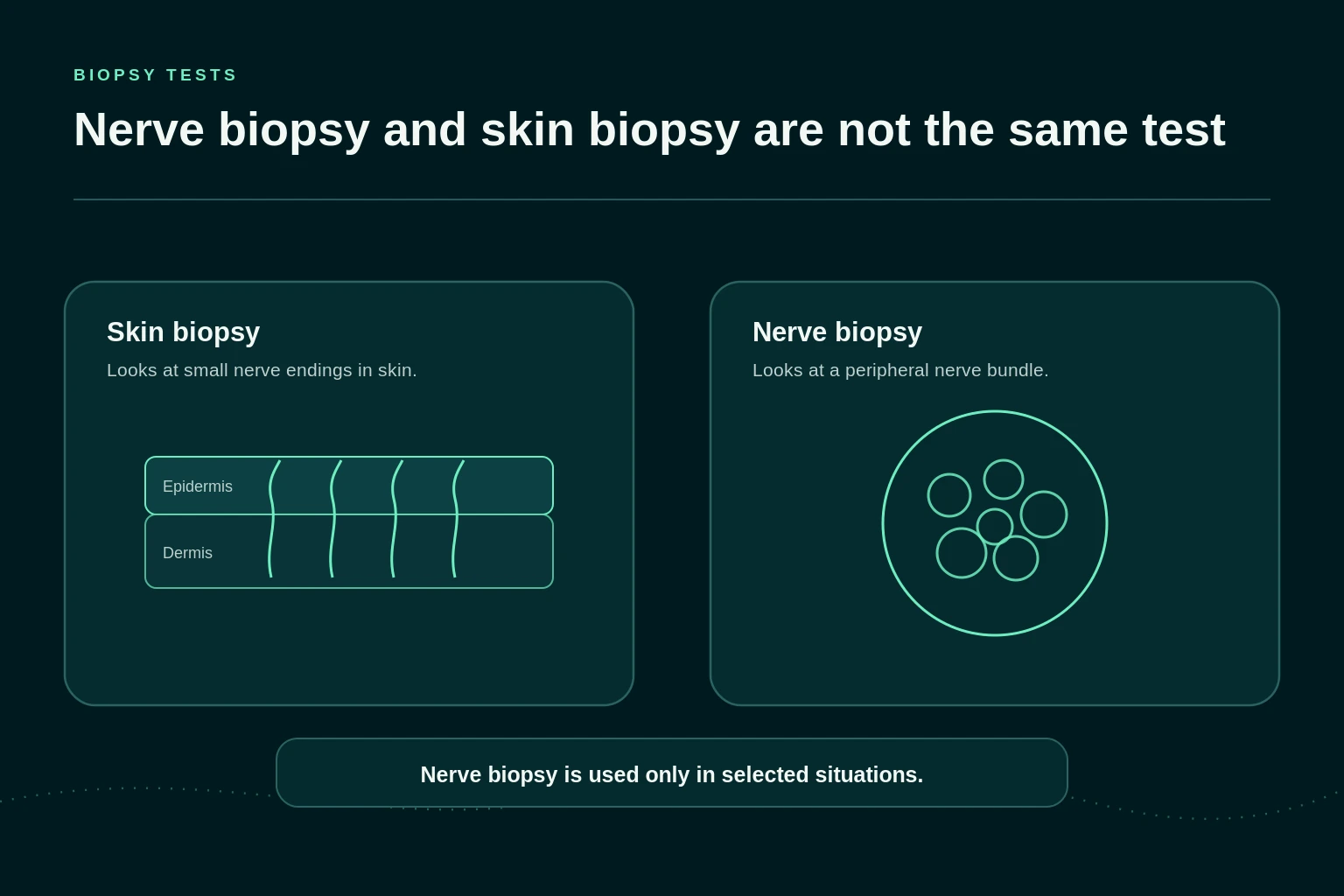
For small fibre neuropathy, NeuropathyCommons says that for many but not all people a skin biopsy can replace a nerve biopsy. StatPearls lists an active infection, poor blood flow in the leg and a neuropathy better explained by more likely causes as reasons not to do the procedure at all.13, 4
What can the results show, and how often do they help?
The honest answer is: sometimes a lot, often less than hoped. In a prospective study of 50 people published in 2000, the biopsy changed the diagnosis in 14 percent, confirmed the suspected diagnosis in most others, and changed or helped guide treatment in 60 percent. In eight people it added nothing to the diagnosis.19
Other studies look back at older cases. An Italian series of 1,179 sural nerve biopsies from 1981 to 2017 gave one clear diagnosis in 53 percent, several possible diagnoses in 14 percent and no firm answer in 34 percent. Another Italian study of 82 people found a definite answer in the tissue in about 35 percent, and a changed diagnosis in about 21 percent. A Mayo Clinic team writing about targeted biopsies notes that ordinary biopsies of a small sensory nerve rarely give a diagnosis in more than half of cases.20, 21, 22
As I read these numbers, they depend heavily on who was biopsied and what counted as a diagnosis. All of them come from specialist centres with carefully selected people, so they don’t tell you your own chances.
Waiting times differ between clinics. UCLH says preliminary results can come in about a week and the full report usually after about four weeks. UTHealth Houston says up to three to four weeks, and HonorHealth usually within two weeks.6, 7, 23
The risks: what a nerve biopsy can leave behind
A nerve biopsy takes away a piece of a working nerve, so some loss of feeling is expected. UCLH says all patients get numbness in the area the nerve supplies, and that for some the outer side of the foot stays numb for the rest of their lives. In a German follow-up of 54 people, 93 percent reported long-lasting loss of feeling.6, 24
Pain at the biopsy site is where the figures differ most. UCLH says about 30 in 100 people get pain there, mostly settling within days or weeks, and it lists pain that persists indefinitely among the rare but serious problems. In the 2000 study, a third reported more pain at the site after six months. The German study found mild persistent pain in a third, which had gone away completely by the end of follow-up. Baylor gives chronic pain in 3 to 5 percent.6, 19, 24, 10
The Muscle & Nerve review collects the ranges across studies: persistent numbness in 72 to 100 percent, persistent pain in 0 to 58 percent, wound infection in 5 to 20 percent, delayed wound healing in 1 to 12 percent and unpleasant altered sensation in 11 to 60 percent. UCLH says infection is more likely if you have diabetes, take steroids or have poor circulation in your feet. MedlinePlus also mentions an allergic reaction to the numbing medicine.3, 6, 9
So nobody can promise a nerve biopsy will be free of lasting effects. That is exactly why it is kept for situations where the answer could matter.
Nerve biopsy and the alternatives at a glance
This is my own simplified summary of what the sources describe. Your doctors weigh your whole situation.
| Situation | Role of nerve biopsy | Other routes the sources mention |
|---|---|---|
| Suspected vasculitis in the nerves | The clearest reason; can confirm the diagnosis | A muscle sample in the same cut; a “clinically probable” diagnosis without biopsy |
| Suspected amyloidosis | Can help, but may miss patchy deposits | Biopsy of other tissue such as belly fat; genetic testing for the hereditary form |
| Suspected CIDP | Only in specific cases | Nerve conduction studies, nerve ultrasound or MRI, response to treatment |
| Suspected hereditary neuropathy | Rarely needed | Genetic testing |
| Suspected small fibre neuropathy | Usually not the first choice | Skin biopsy |
| Typical slowly progressing neuropathy in both feet | Rarely needed | History, examination, blood tests, nerve conduction studies |
Recovery: what clinics tell people
The biopsy is done under local anaesthetic, and MedlinePlus says the site may be sore for a few days. Aftercare advice differs between clinics. UCLH asks people to rest with the leg raised for 24 hours, keep the dressing on and dry for ten days, and avoid heavy exercise or a lot of walking for two weeks. UTHealth Houston advises not putting weight on the leg for two to three days and having someone drive you home.9, 6, 7
Some clinics use stitches that dissolve by themselves, and others remove them at a follow-up visit about 10 to 14 days later. UTHealth also asks people to tell their doctor beforehand if they take blood thinners or aspirin. Please don’t stop or change any medicine on your own; ask the team doing the biopsy what applies to you.7, 8
Questions about benefit, risk and alternatives
Benefit
- What do you suspect, and what could the biopsy show that other tests can’t?
- Would the result change my treatment? What would you do if the biopsy is normal or unclear?
- Which nerve would you take, and why that one?
Risk
- Which area of my foot or leg will be numb afterwards, and is that likely to be permanent?
- How often do your patients get lasting pain or wound problems?
- Does diabetes, steroid treatment or poor circulation raise my risk?
Alternatives
- Could a skin biopsy, fat biopsy, muscle biopsy, genetic test or nerve imaging answer the same question?
- What happens if I wait, or decide not to have it?
Practical
- Which lab will look at the sample, and when will I get the full report?
- What should I do about my medicines, and when can I walk, work and exercise normally?
I’m not a doctor. I’ve written this from published research and guidance, and to help you prepare questions for your own care.
Sources
- Mirian A, Aljohani Z, Grushka D, Florendo-Cumbermack A. Diagnosis and management of patients with polyneuropathy. CMAJ 2023;195(6):E227–E233. doi:10.1503/cmaj.220936. https://www.cmaj.ca/content/195/6/E227
- NHS. Peripheral neuropathy – Diagnosis. Page last reviewed 10 October 2022. https://www.nhs.uk/conditions/peripheral-neuropathy/diagnosis/
- Nathani D, Spies J, Barnett MH, Pollard J, Wang M-X, Sommer C, Kiernan MC. Nerve biopsy: Current indications and decision tools. Muscle Nerve 2021;64(2):125–139. doi:10.1002/mus.27201. https://onlinelibrary.wiley.com/doi/10.1002/mus.27201
- Chambers AR, Song K. Sural Nerve Biopsy. StatPearls [Internet]. StatPearls Publishing; last update 25 July 2023. NBK551645. https://www.ncbi.nlm.nih.gov/books/NBK551645/
- National Institute of Neurological Disorders and Stroke (NINDS). Guillain-Barré Syndrome. Last reviewed 13 March 2026. https://www.ninds.nih.gov/health-information/disorders/guillain-barre-syndrome
- University College London Hospitals NHS Foundation Trust. Nerve biopsy (patient information). Last updated 24 May 2024. https://www.uclh.nhs.uk/patients-and-visitors/patient-information-pages/nerve-biopsy
- McGovern Medical School, UTHealth Houston, Department of Neurology. Nerve biopsy. Page modified 24 August 2026. https://med.uth.edu/neurology/specialty-programs/neuromuscular-program/biopsy-services/nerve-biopsy/
- UMass Memorial Health. Discharge Instructions for Nerve/Muscle Biopsy (health library). Undated. https://www.ummhealth.org/health-library/discharge-instructions-for-nervemuscle-biopsy
- MedlinePlus Medical Encyclopedia, US National Library of Medicine. Nerve biopsy. Reviewed 16 April 2025. https://medlineplus.gov/ency/article/003928.htm
- Baylor College of Medicine. Nerve Biopsy. Undated. https://www.bcm.edu/healthcare/specialties/neurology/neuromuscular-diseases/diagnostics-and-procedures/nerve-biopsy
- Van den Bergh PYK, van Doorn PA, Hadden RDM, et al. European Academy of Neurology/Peripheral Nerve Society guideline on diagnosis and treatment of chronic inflammatory demyelinating polyradiculoneuropathy: Report of a joint Task Force – Second revision. Eur J Neurol 2021;28(11):3556–3583. doi:10.1111/ene.14959. https://onlinelibrary.wiley.com/doi/10.1111/ene.14959
- Michigan Medicine Laboratories (MLabs). Nerve Biopsy (test overview). Undated. https://mlabs.umich.edu/tests/nerve-biopsy
- NeuropathyCommons, Mass General Brigham. Diagnosing Peripheral Neuropathy. Undated (page copyright 2022). https://neuropathycommons.org/neuropathy/tests-diagnosing-small-fiber-polyneuropathy
- Collins MP, Dyck PJB, Gronseth GS, et al. Peripheral Nerve Society Guideline on the classification, diagnosis, investigation, and immunosuppressive therapy of non-systemic vasculitic neuropathy: executive summary. J Peripher Nerv Syst 2010;15(3):176–184. doi:10.1111/j.1529-8027.2010.00281.x. https://mayoclinic.elsevierpure.com/en/publications/peripheral-nerve-society-guideline-on-the-classification-diagnosi/
- Rusin G. Selection of nerve biopsy candidates: what matters? European Academy of Neurology, Neurology Updates, 19 March 2025 (summary of Kopanidis P, et al. Intern Med J 2023;53(12):2224–2230, doi:10.1111/imj.16099). https://www.ean.org/research/resources/neurology-updates/detail/selection-of-nerve-biopsy-candidates-what-matters
- Centre for Reviews and Dissemination. Structured abstract (DARE) of: Vrancken AF, Gathier CS, Cats EA, Notermans NC, Collins MP. The additional yield of combined nerve/muscle biopsy in vasculitic neuropathy. Eur J Neurol 2011;18(1):49–58. NBK81569. https://www.ncbi.nlm.nih.gov/books/NBK81569/
- Sekijima Y, Nakamura K. Hereditary Transthyretin Amyloidosis. GeneReviews [Internet]. University of Washington, Seattle; last update 30 May 2024. NBK1194. https://www.ncbi.nlm.nih.gov/books/NBK1194/
- England JD, Gronseth GS, Franklin G, et al. Practice Parameter: Evaluation of distal symmetric polyneuropathy: Role of autonomic testing, nerve biopsy, and skin biopsy (an evidence-based review). Neurology 2009;72(2):177–184. doi:10.1212/01.wnl.0000336345.70511.0f. Marked as retired on PubMed. https://pubmed.ncbi.nlm.nih.gov/19056667/
- Gabriel CM, Howard R, Kinsella N, et al. Prospective study of the usefulness of sural nerve biopsy. J Neurol Neurosurg Psychiatry 2000;69(4):442–446. doi:10.1136/jnnp.69.4.442. Abstract. https://pubmed.ncbi.nlm.nih.gov/10990501/
- Prada V, Massucco S, Venturi C, et al. Diagnostic Value of Sural Nerve Biopsy: Retrospective Analysis of Clinical Cases From 1981 to 2017. Front Neurol 2019;10:1218. doi:10.3389/fneur.2019.01218. https://www.frontiersin.org/journals/neurology/articles/10.3389/fneur.2019.01218/full
- Mariotto S, Carta S, Bozzetti S, et al. Sural nerve biopsy: current role and comparison with serum neurofilament light chain levels. J Neurol 2020;267:2881–2887. doi:10.1007/s00415-020-09949-3. https://link.springer.com/article/10.1007/s00415-020-09949-3
- Capek S, Amrami KK, Dyck PJB, Spinner RJ. Targeted fascicular biopsy of the sciatic nerve and its major branches: rationale and operative technique. Neurosurg Focus 2015;39(3):E12. doi:10.3171/2015.6.FOCUS15213. https://mayoclinic.elsevierpure.com/en/publications/targeted-fascicular-biopsy-of-the-sciatic-nerve-and-its-major-bra/
- HonorHealth. Nerve or muscle biopsy. Undated. https://www.honorhealth.com/medical-services/neurosciences/muscle-nerve-biopsy
- Flachenecker P, Janka M, Goldbrunner R, Toyka KV. Clinical outcome of sural nerve biopsy: a retrospective study. J Neurol 1999;246:93–96. doi:10.1007/s004150050314. https://link.springer.com/article/10.1007/s004150050314
Sources checked on 26 September 2026.
Related reading

Restless legs or neuropathy? Similar symptoms, different assessments
Written by someone living with neuropathy: how restless legs syndrome differs from neuropathy, why the two are so often confused, how often they occur together, how each is assessed, and questions to take to your doctor.

Cold feet: nerve symptoms, circulation and when to seek help
Written by someone living with neuropathy: why feet can feel cold without being cold, when cold feet point to circulation instead, the warning signs that need urgent help, and a description aid for your appointment.

Numb hands and weak grip: neuropathy or another nerve problem?
Written by someone living with neuropathy: why numb hands and a weak grip can be a trapped nerve, a neck problem or polyneuropathy, the warning signs, and a description aid to take to your doctor.